You probably don’t know that many deadly gas incidents start at concentrations below what you’d notice by smell or irritation, so relying on your nose is unsafe. You need sensors tuned to specific gases and behaviors—electrochemical cells for toxic gases, catalytic beads for combustibles, infrared for CO2 and hydrocarbons, and oxygen sensors to detect displacement. Proper placement, calibration, and alarms determine whether those sensors protect you or simply record a hazard, and that’s where most systems fail.
Closed-Space Gas Risks vs. Open-Air Hazards

When you’re evaluating gas hazards, remember that closed spaces concentrate contaminants and change exposure dynamics compared with open-air settings; limited ventilation, stratification, and surface adsorption can raise concentrations to harmful levels even when source emissions are modest.
You need to recognize confined space hazards: oxygen displacement, accumulation of toxicants, and flammable vapor layering. In confined geometries, diffusion is slow, buoyancy creates vertical gradients, and adsorption/desorption from walls alters transient concentrations, so short-duration sampling can misrepresent risk.
Contrast that with open air safety: dilution and advection rapidly reduce peak concentrations, making exposure more dependent on source strength and meteorology. Your risk assessment should quantify ventilation rates (air changes per hour), model stratification potential, and account for sorption kinetics and secondary generation.
In open air, dilution and advection quickly cut peaks—assess ventilation, stratification risk, sorption, and weather-driven dispersion.
Procedural controls—forced ventilation, continuous monitoring, and entry permits—are prioritized in confined spaces, while open-air controls emphasize source isolation and work positioning. Use exposure limits and dynamic modeling to guide mitigation.
Gas-Detection Sensor Types and What They Detect
Although different detector technologies rely on distinct physical or chemical principles, you’ll mostly encounter four practical classes for industrial and confined-space work: electrochemical cells for toxic gases and oxygen, catalytic pellistors for combustible hydrocarbons, infrared/NDIR sensors for CO2 and certain hydrocarbons, and photoionization detectors (PIDs) for volatile organic compounds (VOCs).
You’ll use electrochemical sensors for low-concentration toxic gases (H2S, CO, NO2) and oxygen measurement; they’re selective, have low power draw, and exhibit predictable drift and finite life.
Catalytic pellistors detect flammable vapors by oxidizing combustible molecules on a heated bead, reporting %LEL but failing in oxygen-deficient atmospheres or in presence of poisons (siloxanes, lead).
Infrared sensors (NDIR) measure gas-specific absorption bands, providing long-term stability for CO2 and hydrocarbons like methane, and they tolerate poisoning.
PIDs provide ppb–ppm sensitivity to many VOCs but respond variably by compound, requiring calibration factors.
Each sensor has documented limitations: cross-sensitivity, temperature dependence, and response time you’ll need to account for in deployment.
Choosing the Right Detectors for Your Space

Where should you place and which sensors should you pick for a confined space depends on the specific hazards, atmospheric dynamics, and the detector technologies’ known limits; start by conducting a hazard assessment that lists likely gases, expected concentration ranges, oxygen variation potential, and sources (process, stored materials, or transient leaks).
Once hazards are defined, select detector features that match target analytes, sensitivity, response time, cross-sensitivity, calibration interval, and environmental tolerances (temperature, humidity, pressure).
Select detectors matched to analytes, sensitivity, response time, cross‑sensitivities, calibration needs, and environmental tolerances.
For flammables choose catalytic or infrared sensors with appropriate LEL ranges; for toxic oxidizers use electrochemical cells or PID units for VOCs, noting PID’s range and humidity effects.
Choose sensors with alarm setpoint configurability and data logging for traceability.
Consider application scenarios: confined entry, continuous monitoring, or temporary work; select portable versus fixed systems accordingly.
Verify serviceability, replacement parts availability, and compliance with standards (OSHA, IEC/EN).
Validate selection with functional testing and documented maintenance procedures before deployment.
Where to Place Sensors in Confined Spaces
Having selected sensors that match the identified hazards and environmental limits, you now need a placement plan that guarantees sensors sample representative air and provide timely alarms.
In confined space operations, sensor placement must reflect gas properties: mount oxygen and combustible sensors at breathing zone height (approx. 1.5 m) unless lighter or heavier gases dominate; install hydrogen, methane, and other buoyant-gas detectors near the ceiling; place heavier-than-air gas sensors low to the floor or in depressions.
Position sensors near potential ingress points, process interfaces, and stagnation zones identified by CFD or tracer tests. Maintain line-of-sight access for inspection and protect sensors from water, debris, and turbulence that distort sampling.
Use multiple sensors to cover complex geometries and cross-verify readings; follow manufacturer-specified separations to avoid sensor interference. Document locations, rationale, and maintenance intervals.
Verify placement effectiveness through periodic functional tests and recorded incidents, then adjust positions based on empirical detection performance in the confined space.
Interpreting Readings & Setting Alarm Thresholds
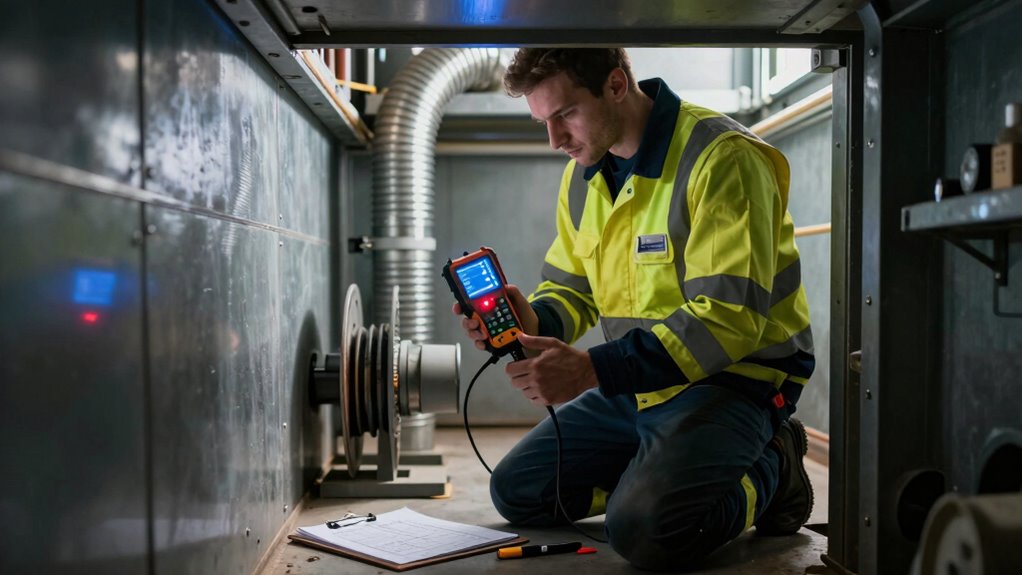
When you’re interpreting sensor data and setting alarm thresholds, base decisions on gas properties, occupational exposure limits, sensor response characteristics, and the specific hazards of the confined space rather than on arbitrary numbers. You’ll perform reading interpretation by comparing real-time concentrations to STEL, TWA, and IDLH values; you’ll also consider sensor cross-sensitivity and response time. Alarm calibration must align with those limits, documented procedures, and traceable calibration gases. Set multi-tier alarms (caution, action, evacuation) with hysteresis to avoid nuisance trips. Use sensor diagnostics and trend analysis to detect slowly rising levels before setpoints are reached. Record thresholds, rationales, and verification tests; audit them when processes or occupancy change. Communicate thresholds clearly to entrants and supervisors. Below is a simple table to evoke the stakes and clarity you’re enforcing:
| Threshold | Meaning |
|---|---|
| Caution | Monitor, investigate |
| Action | Stop operations |
| Evacuation | Immediate exit |
| Audit | Review and adjust |
Maintenance Checklist and Emergency Response Integration
Because routine maintenance and emergency planning are tightly linked, your maintenance checklist must integrate tasks that directly support detection reliability and rapid response capability. You’ll schedule sensor calibration intervals based on manufacturer MTTF and site-specific exposure data, log calibration results, and replace sensors at defined end-of-life to prevent drift.
Your checklist will include verification of power redundancy, battery health, and communication links to control panels and SCADA to guarantee alarm propagation. Perform functional tests of audible/visual alarms and automated ventilation or shutoff actuators under controlled conditions, documenting response times against performance criteria.
Verify power redundancy, battery health, and SCADA links; test alarms and shutdown actuators, documenting response times against criteria.
Include verification of documented emergency protocols alongside each physical task: confirm personnel know evacuation routes, alarm meanings, and shutdown sequences; validate notification cascades and contact lists quarterly.
Integrate corrective-action tracking for failed tests, root-cause analysis, and sign-off. By combining maintenance procedures with emergency protocols in one controlled record, you’ll maintain traceability, reduce response latency, and meet regulatory audit expectations.
Frequently Asked Questions
Can Personal Wearable Detectors Replace Fixed Sensors in Confined Spaces?
No — you shouldn’t rely solely on wearables; like a lone lighthouse, wearable technology complements but can’t replace fixed sensors due to sensor limitations, coverage gaps, calibration drift, regulatory requirements, and the need for redundant, spatially distributed monitoring.
How Do Gas Detectors Perform in Extreme Temperatures or Humidity?
They’ll still work but performance varies: temperature effects alter sensor sensitivity and response time, while humidity challenges cause condensation or interference, so you’ll need rated sensors, environmental compensation, and calibrated maintenance to guarantee reliable readings.
Are Wireless Detectors Susceptible to Interference or Hacking?
Studies show over 60% of industrial wireless systems face interference; yes, wireless detectors can suffer signal interference and wireless security vulnerabilities, so you should implement encryption, spectrum management, and intrusion detection to mitigate hacking and interference risks.
What Training Is Required to Use and Calibrate Detectors Safely?
You need formal training covering detector operation, calibration procedures, sensor theory, safety protocols, spill response, and documentation; hands-on competency checks, periodic recertification, and adherence to manufacturer and regulatory (OSHA/EN) standards are required.
How Long Do Sensor Components Typically Remain Accurate Before Replacement?
Sensor lifespan typically ranges 1–5 years depending on sensor type and environment; you’ll set replacement frequency based on manufacturer specs, drift rates, calibration records, and exposure to contaminants, ensuring documented performance verification intervals.