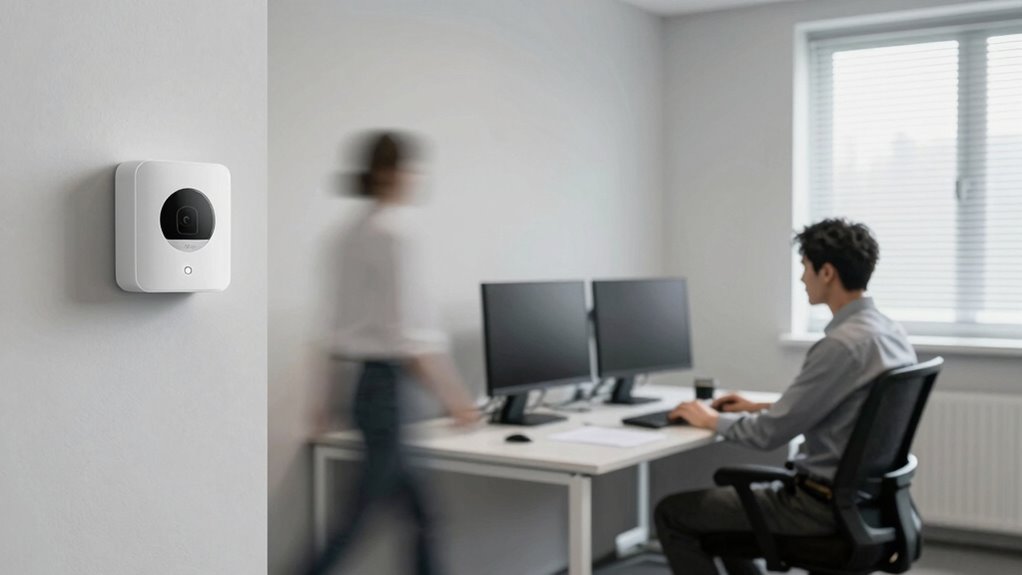
You’ve likely used motion sensors like PIR for quick alerts in hallways—they need big movements to trigger. Presence sensors, using mmWave tech, catch subtle shifts like breathing, even through walls, for true occupancy tracking. Which fits your space, or do you combine them?
PIR vs. mmWave: How They Detect Motion and Presence
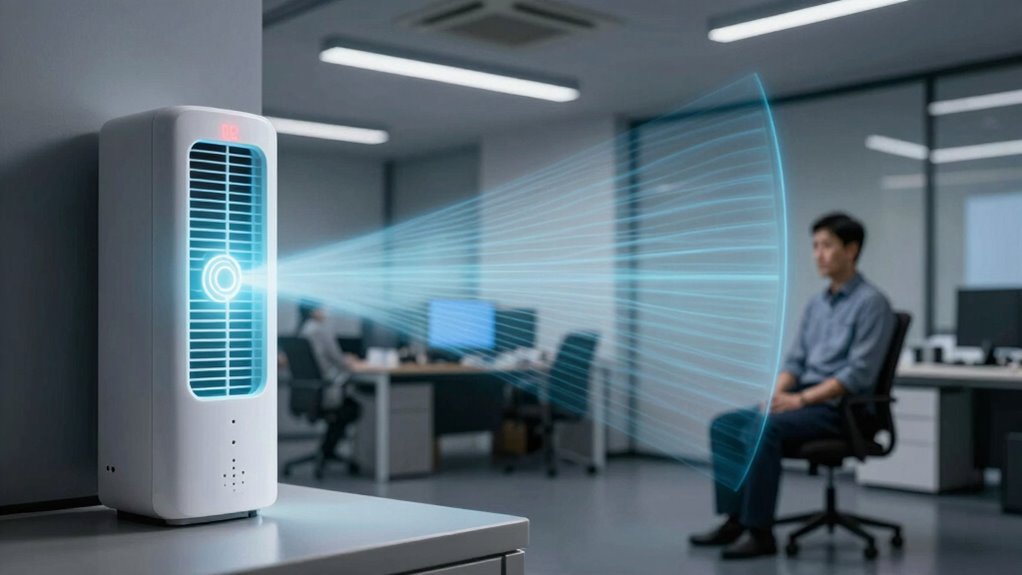
Here’s what makes them different: PIR offers low battery consumption and fast initial reaction times, making it ideal for simple motion-triggered lighting.
However, you’ll experience false alarms from sunlight or heat vents. mmWave provides broader, adjustable coverage and resists thermal interference, but it’s highly sensitive to environmental factors like moving curtains or ceiling fans.
> However, you’ll experience false alarms from sunlight or heat vents. mmWave provides broader, adjustable coverage and resists thermal interference, but it’s highly sensitive to environmental factors like moving curtains or ceiling fans.
The key advantage of mmWave technology is its ability to confirm continuous presence. You won’t lose lights while sitting on the couch watching a movie—a common PIR limitation.
For peak performance, many modern systems combine both sensors, with PIR triggering initial detection and mmWave verifying actual presence.
Core Differences in Sensitivity and Tech
Presence sensors excel in sensitivity, detecting subtle movements like breathing or slight shifts that PIR motion sensors overlook due to their reliance on larger thermal changes. This distinction stems from fundamental technology advancements: presence sensors use millimeter-wave radar or high-frequency technology, while motion sensors rely on passive infrared detection.
| Feature | Motion Sensor | Presence Sensor |
|---|---|---|
| Detection Method | PIR, microwave, ultrasonic | Millimeter-wave radar |
| Sensitivity Level | Requires considerable movement | Detects micro-movements |
| False Triggers | Prone to environmental factors | Minimal false positives |
| Response Time | Delayed reporting | Immediate detection |
| Ideal Environment | High-traffic areas | Offices, bedrooms |
You’ll notice presence sensors register movements you’d barely notice—a shoulder shrug, slight breathing. Motion sensors need obvious activity to trigger. This sensitivity advantage means you won’t experience annoying light shutoffs while working quietly at your desk. Technology advancements in radar-based systems have made presence detection considerably more reliable for stationary occupancy scenarios.
Motion Sensors for Security and Alerts
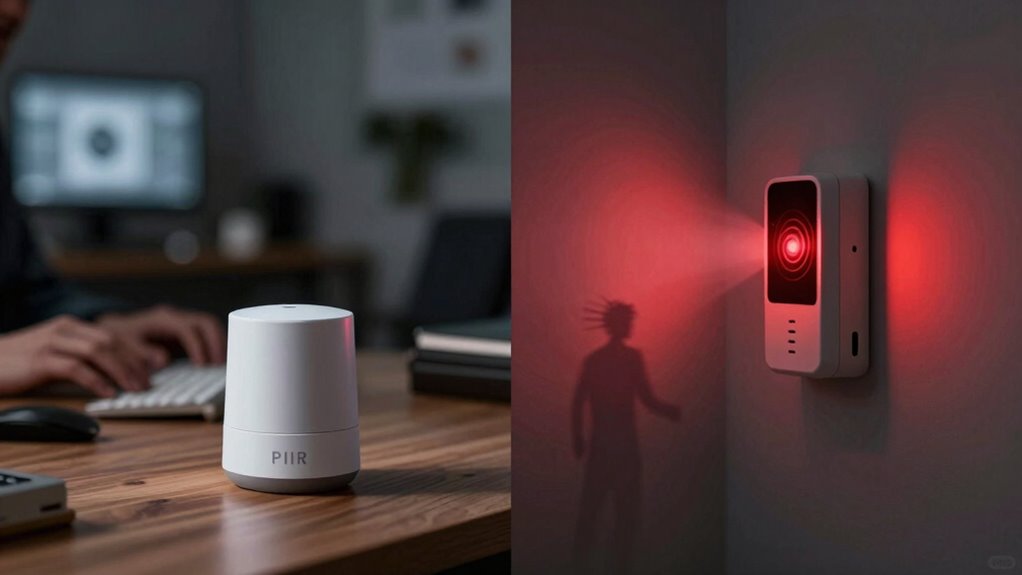
Motion sensors shine in security and alerts, where you’ll want reliable detection of intruders or unusual activity in high-traffic areas like hallways and driveways.
These devices trigger alarms, notify you instantly, and activate security cameras to capture evidence of potential break-ins. When integrated with smart home systems, motion sensors send real-time notifications to your mobile device, allowing you to monitor your property remotely from anywhere.
Sensor reliability is critical for effective security. Advanced motion detectors use passive infrared (PIR) technology to detect heat signatures from humans and animals, while some models distinguish between human movement and pet activity to reduce false alarms.
You can customize detection zones and sensitivity levels to focus on specific areas and ignore unwanted motion. By strategically placing sensors at entry points like windows and doors, you’ll establish a strong deterrent against intruders while receiving immediate alerts when movement occurs in protected spaces.
Presence Sensors for Steady Occupancy
For best results, focus on sensor placement: mount PIR or ultrasonic types on ceilings or under desks for 360-degree views.
Position entry/exit sensors at doors, and use WiFi-based ones facility-wide to avoid blind spots.
This setup guarantees reliable, real-time data without constant recalibration.
Coverage, Range, Wall Penetration Compared
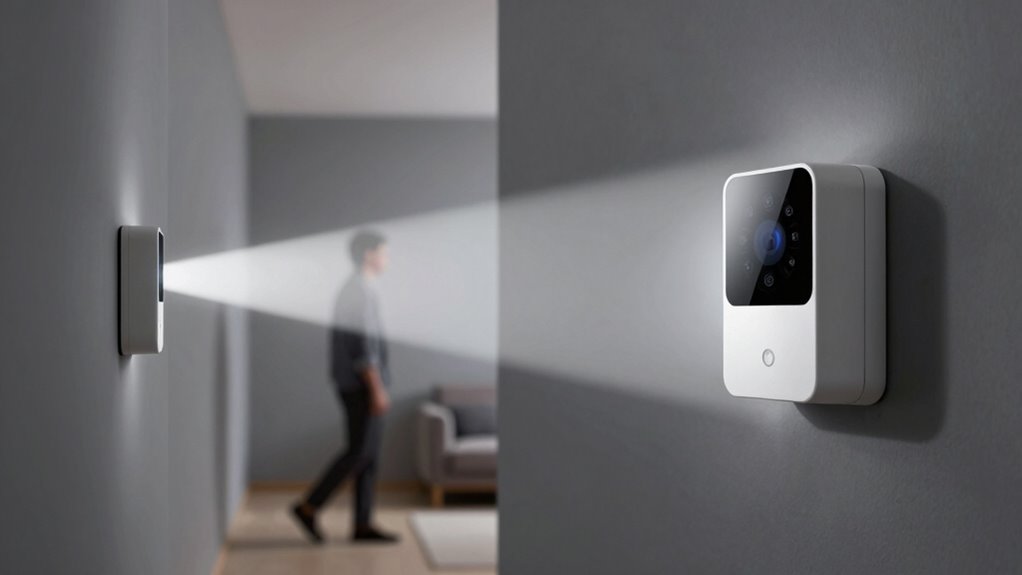
When you’re evaluating sensors for your space, understanding their reach and ability to penetrate obstacles becomes essential.
Motion sensors typically cover a room-sized area of 4 to 7 meters and struggle to detect through walls or windows, limiting their flexibility in complex layouts.
Presence sensors, by contrast, can detect movement up to 8 meters and transmit signals through walls and certain materials, giving you more versatile placement options.
Detection Ranges
| Feature | Motion Sensor | Presence Sensor |
|---|---|---|
| Range | 4-8m | 8-15m |
| Wall Penetration | Poor | Good |
| Ideal Placement | Open areas | Enclosed rooms |
Optimize sensor placement for your layout—you’ll get reliable coverage without blind spots. (124 words)
Wall Penetration
One of the most significant differences between motion and presence sensors lies in their ability to penetrate walls and obstacles. Motion sensors, typically PIR-based, require a direct line of sight and get blocked by walls, furniture, or glass, limiting detection to open areas.
Presence sensors, using mmWave radar, penetrate thin materials like drywall, curtains, or glass, enabling detection through partitions.
Wall penetration varies by:
- Sensor type: PIR stops at solids; mmWave passes through non-metallic barriers.
- Wall material effects: Drywall allows mmWave; concrete or thick walls block it more.
- Frequency: 24 GHz offers balanced penetration without excess bleed-through.
- Sensor placement: Ceiling mounts reduce obstacles; tune sensitivity to avoid adjacent rooms.
- Hybrid use: PIR wakes mmWave for efficient, zoned coverage.
Adjust sensor placement to optimize wall material effects and prevent false triggers from neighboring spaces.
Energy Savings and Fewer False Triggers
Presence detection outperforms motion detection in energy savings and fewer false triggers because it senses stationary occupants via micro-movements like breathing, preventing premature shutdowns of lights and HVAC.
While motion sensors require obvious movement to activate, presence detectors pick up subtle changes—like typing at a keyboard—ensuring systems stay operational when you’re actually present. This sensitivity eliminates false alarms that plague motion sensors in outdoor settings or areas with environmental disturbances.
Additionally, presence detectors continuously monitor ambient brightness and automatically switch off artificial lighting when daylight suffices, even if movement continues. Motion sensors measure brightness only once upon activation, often leaving lights on unnecessarily throughout the day.
One office building retrofit achieved a 30% reduction in lighting energy use by replacing motion sensors with dual-technology occupancy sensors.
For energy efficiency and reduced false alarms, presence detection delivers superior performance in spaces where occupants remain relatively stationary, making it ideal for offices, conference rooms, and bathrooms where you need reliable automation without wasteful operation.
Pick the Right Sensor by Use Case
Selecting the appropriate sensor depends on your space’s traffic and activity level. Your sensor selection should match your specific use case scenarios to maximize efficiency and minimize false alarms.
- Hallways and entryways: Motion sensors work well here since they detect significant movement from people passing through and don’t require constant sensitivity.
- Offices and bedrooms: Presence sensors excel in these spaces because they detect subtle movements like breathing, keeping lights on while you’re stationary at a desk.
- Outdoor areas and driveways: Motion sensors are ideal for security purposes, providing coverage across larger zones without triggering on minor activity.
- Bathrooms and changing rooms: Presence sensors offer enhanced privacy since they don’t resemble cameras, while still detecting occupancy reliably.
- Multi-room homes: Combine both technologies—use presence sensors for rooms where you spend extended time and motion sensors for transit areas.
Consider your layout, lighting needs, and whether you need to identify specific individuals. Presence sensors provide superior accuracy for stationary occupancy, while motion sensors offer practical security coverage in high-traffic zones.
Combine Motion and Presence for Best Results
| Use Case | Motion Sensor Role | Presence Sensor Role |
|---|---|---|
| Hallways/Entrances | Instant activation on entry | N/A (short-term use) |
| Living Rooms/Offices | Initial trigger | Sustained detection while seated |
| Energy Savings | Quick shutoff after exit | Precise occupancy for HVAC/lights |
You’ll achieve seamless routines: motion sparks lights in hallways, while presence maintains them in rooms during reading or work. Integrate via smart hubs for unified control—motion alerts security, presence personalizes thermostats. Devices like Everything Presence One fuse both for minimal false positives, enhancing reliability. Result? Peak efficiency without overlap.
Frequently Asked Questions
How Much Do Sensors Cost?
You’ll pay $12-$40 for affordable motion sensors like TP-Link Tapo, contrasting $15-$50+ for advanced presence types like Meross MS600 at $30. Sensor pricing varies by sensor types, installation pushing motion lights to $350-$500.
What Are Top Sensor Brands?
Top sensor brands include Bosch Sensortec, Murata Manufacturing, Analog Devices, NXP Semiconductors, and TDK among leading manufacturers in sensor technology. You’ll find these reliable for motion and presence detection.
How to Install Sensors?
Oh, installing sensors? Because nothing says “fun weekend” like playing electrician with your walls! Choose ideal sensor placement—6-8ft high for motion, near entries for doors. Follow installation tips: clean surfaces, align magnets <½in apart, use adhesive/screws, test thoroughly.
Are Sensors Pet-Friendly?
Yes, your sensors can be pet-friendly with pet safe options using advanced sensor technology like PIR and dual-tech. Choose models immune to pets up to 100 lbs by adjusting sensitivity and mounting height.
What Is Battery Life?
Imagine your pet-friendly sensor humming quietly for years, undisturbed. You’ll enjoy battery longevity of 4-7 years, boosted by superior energy efficiency in motion and presence detectors—Honeywell hits 7 years, SimpliSafe 4.