Imagine walking through a pitch-black parking lot where ordinary cameras fail to detect movement. You might not realize that motion detectors rely on sensing infrared radiation—heat emitted by objects—to identify activity in darkness. But how do these sensors differentiate between harmless environmental changes and genuine motion? Understanding the underlying technology reveals why some systems excel at night while others struggle.
How Motion Detectors Spot Movement in Total Darkness
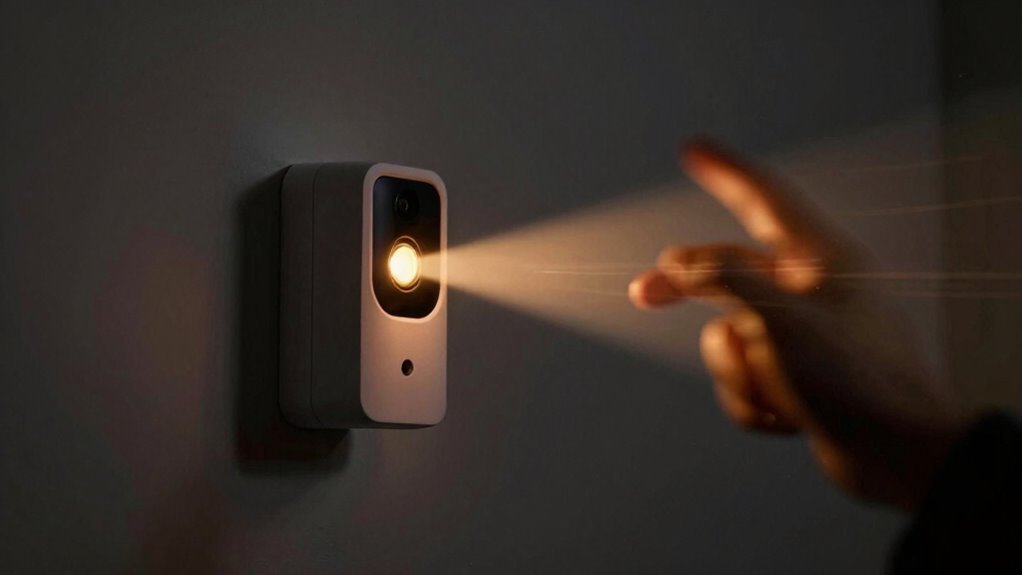
Although you can’t see anything in total darkness, motion detectors can still effectively identify movement by relying on sensors that detect changes in infrared radiation or ultrasonic waves.
Motion detectors detect movement in complete darkness using infrared and ultrasonic sensor technology.
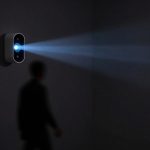
For nighttime surveillance, these sensors operate independently of visible light, making them indispensable for environments where illumination is either unavailable or undesirable. The detector’s infrared sensors capture the heat emitted by objects, while ultrasonic sensors emit high-frequency sound waves, measuring the time it takes for echoes to return, thereby identifying motion.
This dual-modality approach enhances accuracy and reduces false alarms. When integrated with stealth technology, motion detectors function without alerting subjects, maintaining operational secrecy. This is vital in security applications where overt detection might compromise the system’s effectiveness.
You’ll find these devices essential for monitoring dark areas, ensuring precise movement detection without visible cues. Their ability to function covertly and reliably in the absence of light underscores their value in advanced nighttime surveillance systems.
Infrared Sensors for Motion Detection
Infrared sensors detect motion by measuring changes in the heat energy emitted from objects within their field of view. When an object moves, it causes a variation in the infrared radiation detected, allowing the sensor to identify motion even in complete darkness.
This use of infrared technology leverages the thermal emissions naturally produced by living beings and objects, making it highly effective for low-light or no-light conditions. In sensor applications, these devices convert the detected infrared radiation into electrical signals, which are then processed to determine movement.
You’ll find infrared sensors integrated into security systems, automated lighting, and environmental monitoring due to their reliability and sensitivity. Their precision depends on factors like sensor resolution, field of view, and signal processing algorithms, which collectively minimize false positives.
Understanding these operational principles will help you appreciate how infrared sensors maintain accurate motion detection without relying on visible light, hence proving indispensable in darkness-based sensor applications.
Passive vs Active Infrared Detectors: What’s the Difference?
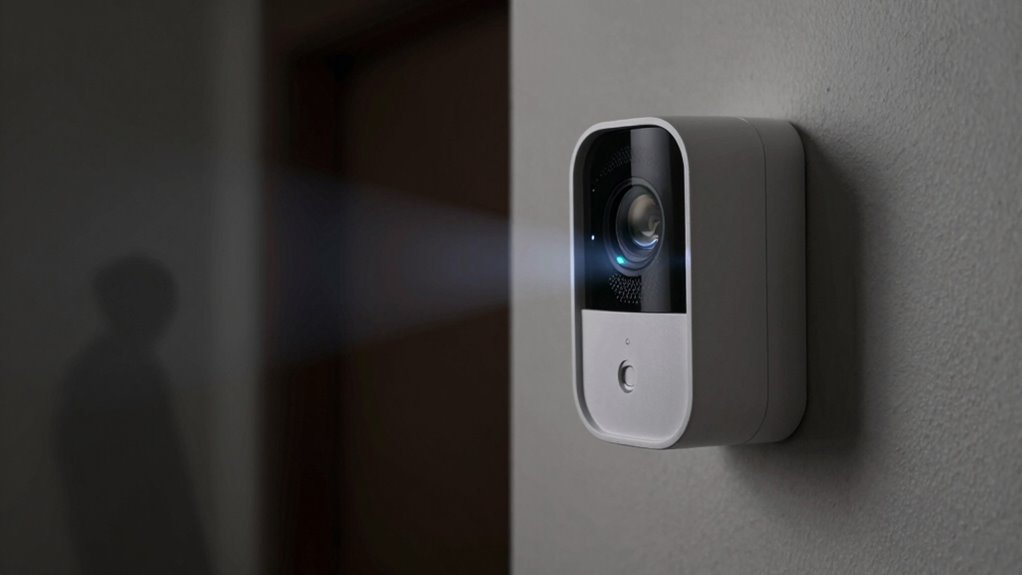
When you need to detect motion using thermal energy, understanding the distinction between passive and active infrared detectors is essential.
Passive technology relies solely on sensing the natural infrared radiation emitted by objects, such as human bodies, without emitting any energy itself. It detects changes in ambient infrared levels to identify motion, making it energy-efficient and less prone to interference from external signals.
In contrast, active technology emits its own infrared signals and measures the reflection or interruption caused by moving objects. This method provides more controlled detection and can operate effectively in various environmental conditions, including total darkness.
However, active infrared detectors may consume more power and are susceptible to signal interference.
Thermal Imaging Cameras for Motion Detection
Thermal imaging cameras detect motion by capturing the heat signatures emitted by objects, translating temperature differences into visible images. This process leverages advanced thermal camera technology to provide reliable motion detection, especially in complete darkness where traditional night vision applications may fall short.
When using these cameras, you benefit from:
- Passive sensing: They don’t rely on external light sources, detecting infrared radiation naturally emitted by all objects.
- High contrast imaging: Differentiates objects based on temperature variance, enhancing motion detection accuracy.
- Wide detection range: Enables monitoring over large areas without illumination constraints.
- Environmental adaptability: Performs well in smoke, fog, and varying weather, where visible light cameras struggle.
Microwave and Ultrasonic Sensors in Darkness
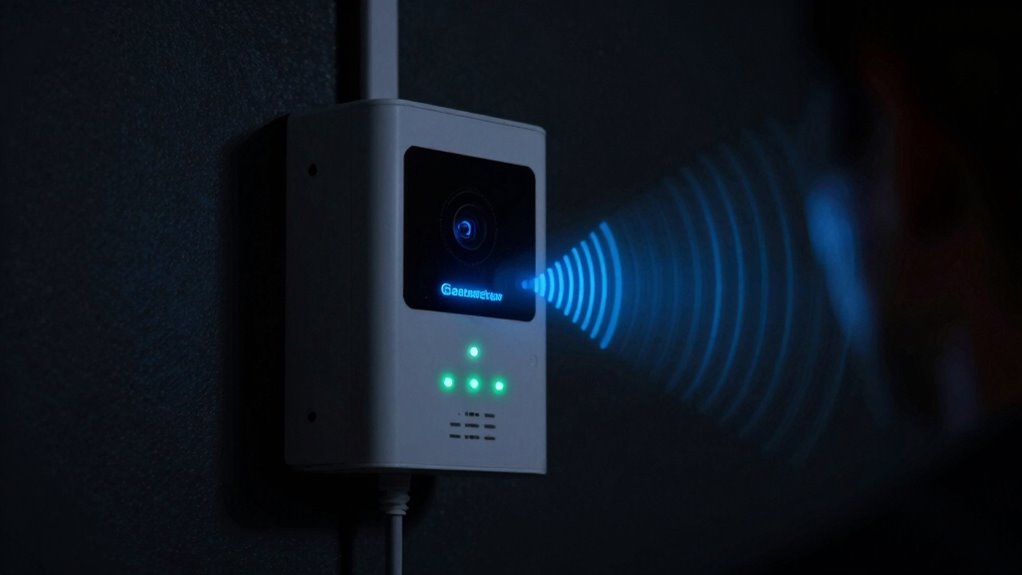
You’ll find that microwave sensors emit electromagnetic waves to detect motion by analyzing frequency shifts caused by moving objects.
Ultrasonic sensors operate by sending high-frequency sound pulses and measuring the time it takes for echoes to return, enabling precise distance calculations.
Both technologies excel in darkness since they don’t rely on visible light, offering reliable motion detection under low or no illumination.
Microwave Sensor Functionality
Although visible light is absent in darkness, microwave sensors remain effective by emitting high-frequency electromagnetic waves that detect motion through frequency shifts caused by moving objects.
Using microwave technology based on radar principles, these sensors analyze Doppler shifts to identify movement with high accuracy.
When you use a microwave sensor, consider these key aspects:
- Emission of continuous microwave signals that reflect off surfaces.
- Detection of frequency changes in returned signals caused by object velocity.
- Signal processing algorithms that differentiate motion from background noise.
- Ability to penetrate non-metallic materials, enabling detection through obstacles.
Ultrasonic Sensor Mechanism
When detecting motion in darkness, ultrasonic sensors operate by emitting high-frequency sound waves beyond human hearing range and measuring the time it takes for the echoes to return after bouncing off nearby objects. This time-of-flight calculation enables precise distance measurement within the sensor’s detection range. Ultrasonic waves provide reliable detection unaffected by lighting conditions, making them ideal for dark environments.
| Parameter | Description |
|---|---|
| Ultrasonic Waves | High-frequency, inaudible sound |
| Detection Range | Typically 2 cm to 4 meters |
| Echo Time | Time delay between emission and return |
Advantages in Darkness
Since darkness limits the effectiveness of optical sensors, microwave and ultrasonic sensors offer distinct advantages by relying on non-visual detection methods.
When you deploy these sensors for nighttime security, you benefit from their ability to function independently of ambient light, essential for low light technology applications.
Key advantages include:
- Consistent Detection: They maintain reliable performance regardless of lighting conditions.
- Penetration Ability: Microwaves can detect motion through certain materials, enhancing coverage.
- Reduced False Alarms: Ultrasonic sensors adapt to environmental changes, minimizing inaccuracies.
- Energy Efficiency: Both sensor types operate with low power consumption, ideal for continuous monitoring.
How Motion Detectors Reduce False Alarms at Night
You’ll find that motion detectors cut down false alarms at night primarily by adjusting sensitivity levels to ignore minor movements.
They also use advanced filtering algorithms to differentiate between relevant motion and environmental noise like wind or small animals.
Understanding these mechanisms helps optimize detector performance in low-light conditions.
Sensitivity Adjustments
Although motion detectors are highly effective during the day, their sensitivity must be carefully adjusted at night to minimize false alarms caused by environmental factors like shifting shadows, temperature fluctuations, and small animals.
Sensitivity calibration involves fine-tuning detection thresholds to distinguish genuine motion from noise. You can optimize this process by:
- Lowering sensitivity levels to reduce responsiveness to minor thermal variations.
- Adjusting detection thresholds based on ambient temperature shifts.
- Implementing dynamic sensitivity scaling to adapt to changing night conditions.
- Configuring zone-specific sensitivity to prioritize critical areas.
Environmental Interference Filtering
When environmental factors like wind-blown foliage or small animals trigger motion sensors, filtering algorithms become essential for minimizing false alarms at night.
You rely on advanced filtering techniques to discern genuine intrusions from environmental noise. These algorithms analyze movement patterns, velocity, and thermal signatures to suppress irrelevant signals.
By applying temporal and spatial filters, the system reduces sensitivity to transient disturbances caused by environmental noise. Additionally, adaptive thresholding adjusts detection parameters in real-time based on ambient conditions, enhancing accuracy.
This precision guarantees that only significant motion events activate alerts, preserving system reliability. Understanding and implementing these filtering techniques allows you to optimize motion detector performance in darkness, maintaining security without being overwhelmed by false positives due to environmental interference.
Common Uses for Motion Detection in Dark Spaces
Since motion detection technology excels in low-light conditions, it’s widely deployed across various dark environments where visibility is limited.
You’ll find it essential in security applications, where detecting unauthorized movement without relying on visible light enhances surveillance effectiveness. Similarly, wildlife monitoring benefits from motion sensors that track animal activity at night without disturbing natural behaviors.
Here are common uses for motion detection in dark spaces:
- Security applications: Detect intruders and trigger alarms or cameras in poorly lit areas.
- Wildlife monitoring: Monitor nocturnal animals for research without using intrusive lighting.
- Energy management: Automate lighting in dark corridors or storage spaces to conserve energy.
- Industrial safety: Alert personnel to movement in hazardous zones during non-operational hours.
Choosing the Right Motion Detector for Your Dark Environment
How do you determine which motion detector best suits your specific dark environment? Start by analyzing sensor types—infrared (PIR), ultrasonic, microwave, or dual-technology sensors each have strengths depending on conditions.
PIR sensors detect heat changes, ideal for environments without visual light but with temperature contrasts. Ultrasonic sensors emit sound waves, useful where heat signatures are weak or variable. Microwave sensors detect movement via radio waves, penetrating certain obstructions but susceptible to false alarms. Dual-technology sensors combine methods to reduce errors.
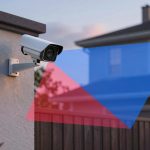
Next, consider installation tips: position sensors to minimize obstructions and avoid heat sources like vents or sunlight reflections, which can cause false triggers.
For dark environments, verify sensor sensitivity is calibrated to detect subtle motion without oversensitivity. Finally, evaluate power requirements and environmental durability.
Frequently Asked Questions
Can Motion Detectors Work Effectively in Complete Darkness Outdoors?
You’ll find that over 80% of outdoor motion detectors use infrared technology, enabling effective function in complete darkness. Thanks to advanced night vision sensors, they accurately detect heat signatures, ensuring reliable motion detection even without visible light.
How Do Weather Conditions Affect Motion Detection Accuracy at Night?
Weather impacts night visibility considerably, reducing motion detection accuracy. Rain, fog, or snow scatter infrared signals and obscure camera lenses, causing false alarms or missed detections. You’ll need sensors with advanced algorithms to compensate for these conditions.
Are Motion Detectors Safe for Pets in Dark Environments?
Sure, your pet’s not auditioning for a sci-fi thriller! Pet friendly technology and night vision guarantee motion detectors won’t startle or harm them. These devices analyze infrared signals precisely, distinguishing pets from threats even in total darkness.
What Maintenance Is Required for Motion Detectors Used in Darkness?
You’ll need regular sensor cleaning to prevent dust buildup that impairs infrared sensitivity, alongside timely battery replacement to guarantee consistent power. Periodic testing and firmware updates also maintain ideal detection accuracy in dark conditions.
Can Motion Detectors Be Integrated With Home Security Systems?
Yes, you can integrate motion detectors with home security systems. This integration benefits you by enhancing security features like real-time alerts and automated responses, improving overall system efficiency and providing thorough monitoring and threat detection.