Just as a watchful detective glimpses clues in the shadows, you encounter motion sensors that uncover movement through environmental shifts, not direct observation. You’re likely familiar with their role in security systems, but consider how they analyze heat patterns or wave disruptions. They compare baselines to real-time data via algorithms. Yet, which technology reigns supreme in accuracy?
The Core Concept: Motion Sensors Detect Change, Not Movement
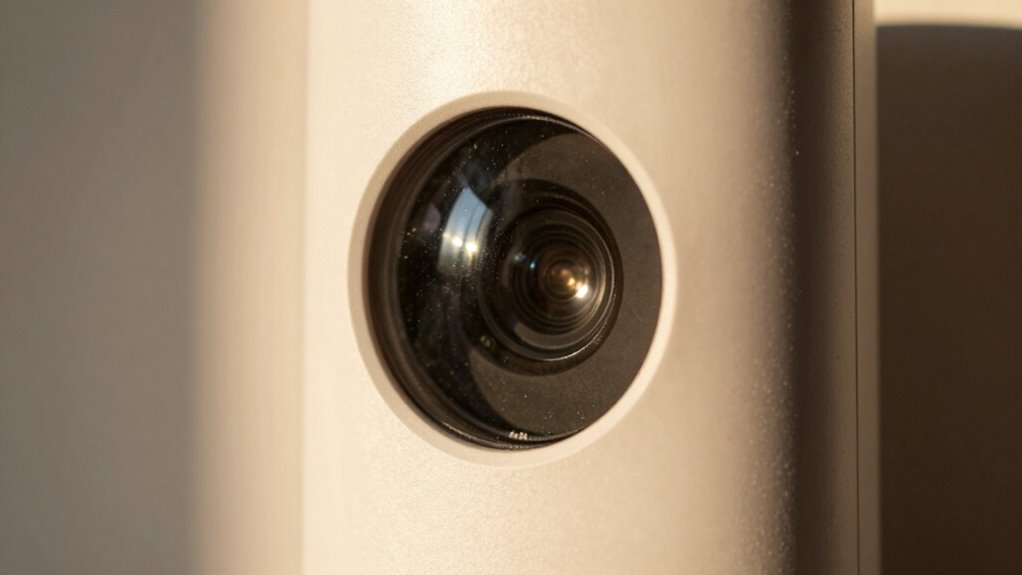
While many assume motion sensors directly detect movement, they actually sense changes in their environment, such as shifts in infrared radiation or ultrasonic waves. You’re dealing with devices that monitor variations to infer motion, not observing it directly. This core concept underpins all sensor types, ensuring reliable detection methods without constant scanning.
Consider the primary sensor types: passive ones, like those relying on ambient energy changes, and active ones that emit signals to measure disruptions. Detection methods vary accordingly. For instance, ultrasonic sensors emit high-frequency sound waves; when you move, you alter the echo patterns they receive, triggering an alert.
Microwave sensors use radio waves, detecting Doppler shifts from your motion-induced frequency changes. Systematically, these detection methods process data through algorithms that compare baseline environmental states against real-time inputs.
If you’re installing one, understand that sensitivity settings calibrate how minor a change—like your subtle footsteps—activates the system. This precision minimizes false positives from non-motion factors, such as temperature fluctuations or vibrations.
Passive Infrared (PIR): The Heat-Sensing Technology Behind Most Sensors
Passive infrared (PIR) sensors form the backbone of most motion detection systems, operating as passive devices that capture natural infrared energy emitted by warm objects in their field of view. You’ve likely encountered them in security lights or alarms, where they excel at heat detection by monitoring thermal radiation shifts. When you move, your body heat alters the infrared pattern, triggering the sensor’s response. They’re energy-efficient since they don’t emit signals, relying instead on ambient IR for detection.
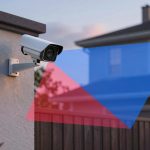
To optimize performance, sensor calibration is crucial; you’ll adjust sensitivity to minimize false alarms from pets or environmental factors. The system divides your space into zones using lenses, detecting motion as heat crosses segments.
| PIR Component | Role in Heat Detection |
|---|---|
| Pyroelectric Element | Converts IR fluctuations into electrical signals for precise motion tracking. |
| Fresnel Lens | Focuses incoming infrared rays onto the element, enhancing detection range. |
| Signal Processor | Analyzes changes post-calibration, filtering noise for accurate alerts. |
This systematic approach guarantees reliable operation in controlled environments, though you’ll need proper calibration to avoid issues.
Microwave Sensors: How They See Through Walls and Materials

You’ll begin with microwave emission basics, where sensors generate and transmit electromagnetic waves at frequencies typically between 1 and 100 GHz to cover a detection area.
Next, consider wall penetration mechanics, as these waves propagate through non-conductive materials like drywall or fabric due to their longer wavelengths and lower attenuation rates.
Finally, examine movement sensing techniques, which detect shifts in the reflected wave’s frequency via the Doppler effect to identify and track motion accurately.
Microwave Emission Basics
Microwave sensors rely on emitting high-frequency electromagnetic waves, typically in the 10-24 GHz range, to detect motion by analyzing reflected signals.
You’ve likely encountered microwave technology in everyday devices like radar guns or Wi-Fi routers, but in motion sensors, it leverages radar principles to measure changes in wave patterns. When you activate the sensor, it broadcasts continuous microwaves that bounce off objects in the environment.
These waves follow radar principles, where the sensor acts as both transmitter and receiver.
You’ll notice that any movement alters the frequency of the returned signal via the Doppler effect—if an object approaches, the frequency increases; if it recedes, it decreases.
This precise detection relies on systematic signal processing to filter noise and identify true motion.
Wall Penetration Mechanics
While traditional barriers like walls often block visible light or infrared signals, microwave sensors penetrate them effectively due to their longer wavelengths.
You’re dealing with electromagnetic waves in the microwave spectrum, typically 1 GHz to 30 GHz, which interact differently with materials than shorter waves do. This wall material interaction allows detection beyond obstacles, but it’s not unlimited—you’ll encounter attenuation based on material density and composition.
Here’s how it works systematically:
- Emission and Propagation: You emit microwaves that travel through air and non-metallic walls, losing minimal energy in porous materials like drywall.
- Wall Material Interaction: Dense substances like concrete absorb or reflect waves, reducing penetration depth depending on frequency and thickness.
- Reflection and Detection: Waves bounce off moving objects behind walls, returning altered signals for processing.
- Sensor Range Limitations: Factors like moisture content or metal reinforcements cap effective range, often to 10-20 meters through typical barriers.
Understanding these mechanics guarantees you optimize sensor placement for reliable through-wall detection.
Movement Sensing Techniques
Several techniques enable microwave sensors to detect movement through walls and materials, building on the penetration mechanics you’ve already explored.
First, consider the Doppler effect: when you emit microwave signals, they reflect off moving objects, causing frequency shifts that indicate active motion. This enhances detection accuracy by distinguishing between static and dynamic targets, even behind obstacles like drywall or wood.
Next, pulse radar techniques send short bursts of microwaves, measuring echo times to locate movement precisely. You’ve seen how low-frequency waves penetrate materials; here, they guarantee minimal signal loss, boosting reliability.
Finally, continuous wave methods maintain constant emissions, analyzing phase changes for subtle active motion. These systematic approaches optimize detection accuracy, filtering noise and false positives in cluttered environments.
Integration with signal processing algorithms further refines outputs, adapting to varying wall compositions for consistent performance.
Dual-Technology Sensors: Combining PIR and Microwave for Fewer False Alarms
Dual-technology sensors combine passive infrared (PIR) and microwave detection methods to reduce false alarms in motion-sensing applications.
You’re enhancing sensor reliability by requiring both technologies to trigger simultaneously before an alarm activates. This dual verification minimizes environmental interferences that plague single-method sensors, such as heat sources affecting PIR or moving objects impacting microwave alone.
Enhance sensor reliability with simultaneous PIR and microwave triggers, slashing false alarms from environmental factors like heat or movement.
In your security setup, you’ll notice improved false alarm prevention, as the system cross-checks data for accurate movement detection.
To understand the systematic integration, consider these key aspects:
- PIR Component: Detects infrared radiation changes from body heat, providing initial thermal confirmation.
- Microwave Element: Emits radio waves to measure Doppler shifts from motion, adding velocity-based validation.
- Logic Processing: Employs AND logic gates to require concurrent signals, boosting overall sensor reliability.
- Application Tuning: Allows adjustable sensitivity levels for environments, further aiding false alarm prevention.
You’re achieving precise detection in varied settings, from homes to commercial spaces, without unnecessary alerts.
This combination guarantees systematic reliability, making your motion-sensing strategy more effective and efficient.
Ultrasonic Sensors: Using Sound Waves for Detection in Confined Spaces
You activate ultrasonic sensors by emitting high-frequency sound waves that propagate through the air and reflect back from nearby surfaces.
These waves enable detection when you observe shifts in return times or frequencies caused by moving objects.
In confined spaces, you’ll appreciate their advantages, as they offer reliable coverage without interference from walls or obstacles, ensuring systematic motion monitoring.
Sound Wave Emission
Ultrasonic sensors operate by emitting high-frequency sound waves, typically above 20 kHz, that bounce off objects and return as echoes to detect motion. You’re dealing with ultrasonic technology that relies on sound wave applications for precise detection.
The process starts when you activate the sensor; it generates pulses of sound waves that travel through the air at about 343 meters per second. If there’s movement, the echoes shift in frequency due to the Doppler effect, signaling a change.
To understand the emission systematically, consider these steps:
- Transducer Activation: The piezoelectric transducer vibrates to produce ultrasonic waves.
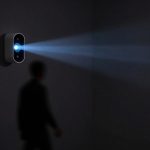
- Wave Propagation: Waves spread outward in a cone-shaped pattern, covering the detection area.
- Frequency Selection: You choose frequencies like 40 kHz for ideal range and sensitivity.
- Pulse Timing: Emissions occur in short bursts, allowing time for echo reception before the next pulse.
This methodical approach guarantees reliable motion tracking without interference from visible light.
Confined Space Advantages
In confined spaces, sound waves offer distinct advantages for motion detection, building on their emission principles to navigate tight environments where other sensors falter.
You’re dealing with ultrasonic sensors that emit high-frequency pulses, which bounce off objects and return as echoes, allowing precise calculation of distance and movement via time-of-flight measurements.
This method excels in space optimization, as the sensors require minimal footprint—you can mount them discreetly without needing wide fields of view, unlike infrared alternatives that struggle with obstructions.
For sensor placement, you’ll position them strategically in corners or ceilings, ensuring thorough coverage in cramped areas like closets or elevators.
Moreover, they’re immune to visual interferences; dust or low light doesn’t impair detection.
You benefit from adjustable sensitivity, tuning for small movements while ignoring echoes from static fixtures.
This systematic approach enhances reliability, reducing false positives in confined setups where precision is critical.
Camera-Based Sensors (Video Motion Detection): Pixels Tell the Story
Camera-based sensors employ video motion detection to identify movement through pixel analysis in captured footage.
You’re integrating cameras with sophisticated software that scrutinizes frame-by-frame changes, ensuring precise detection in various environments. This method relies on image processing to break down visuals, while detection algorithms flag anomalies like shifting pixel values or patterns indicating motion.
Here’s how it systematically unfolds:
- Capture Phase: You position the camera to record continuous video streams, converting scenes into digital pixel grids for analysis.
- Processing Stage: Image processing techniques filter noise and enhance contrast, preparing data for efficient scrutiny by detection algorithms.
- Comparison Step: Algorithms compare consecutive frames, calculating differences in pixel intensity or color to pinpoint movement vectors.
- Alert Mechanism: Once motion thresholds are met, the system triggers responses, such as notifications or recordings, optimizing security without constant human oversight.
You’ve got a reliable tool here—it’s adaptable for homes or businesses, though it demands computational power for real-time accuracy.
Tomographic Sensors: Creating a Wireless “Net” of Motion Across an Area
Tomographic sensors utilize radio frequency signals to form a wireless detection network, shifting from visual pixel analysis to electromagnetic field monitoring across entire areas.
You’re dealing with a system that propagates RF waves between multiple nodes, creating a mesh that detects perturbations caused by movement. This isn’t like point-based sensors; it’s a volumetric approach where you integrate data from distributed transceivers to reconstruct motion paths in 3D space.
In sensor integration, you link tomographic units into existing wireless networks, enhancing scalability. You’ve got transmitters emitting low-power RF signals, and receivers capturing signal variations—attenuation, phase shifts, or multipath distortions indicate intrusions.
Systematically, you process this via algorithms like inverse Radon transforms, mapping disturbances without line-of-sight requirements. Precision comes from calibrating node positions; technical setup involves frequency selection to minimize interference.
You’re building a “net” that covers large zones efficiently, ideal for pervasive monitoring where optical methods fail. Contractions guarantee you’re adapting to dynamic environments seamlessly.
Common Real-World Uses for Each Type of Motion Sensor
You’ll encounter motion sensors in diverse real-world applications depending on their type: passive infrared (PIR) for home security alarms, automatic lighting, and occupancy-based HVAC control; microwave for perimeter intrusion detection, traffic speed monitoring, and automatic door activation; ultrasonic for parking assistance, robotic obstacle avoidance, and industrial distance measurement; tomographic for large-area wireless surveillance, warehouse inventory tracking, and smart building occupancy analysis; camera-based for video analytics in retail theft prevention, crowd counting, and behavioral recognition in public spaces.
In these sensor applications, motion detection enables precise functionality across environments. You’ll integrate them systematically to address specific needs, from energy efficiency to surveillance.
Explore these four sensor applications for motion detection:
Explore these four sensor applications for motion detection, from home security to warehouse inventory tracking.
- PIR in homes: You’ll deploy them for heat-based intrusion alerts, activating systems when movement occurs.
- Microwave in traffic: You’ll use radar waves to gauge speeds, supporting enforcement and flow control.
- Ultrasonic in robotics: You’ll apply sound pulses for real-time obstacle mapping, guiding autonomous navigation.
- Tomographic in warehouses: You’ll establish wireless grids for inventory motion tracking, optimizing stock management.
Camera-based options extend motion detection to visual analysis, identifying patterns efficiently.
How to Choose the Right Motion Sensor for Your Needs
Selecting the appropriate motion sensor requires evaluating key factors like environment, range, accuracy, and power needs.
You’ll first assess the deployment area—indoor or outdoor—to determine if it’s exposed to weather, dust, or temperature extremes, which influences durability and enclosure ratings.
For range, measure the detection zone: PIR sensors suit short to medium distances, while ultrasonic or microwave types cover larger areas but may trigger false alarms in open spaces.
Next, prioritize accuracy based on application. If you’re securing a home, opt for sensors with adjustable sensitivity to minimize pet-induced triggers; for industrial use, choose models with high precision to detect subtle movements.
Review sensor specifications, including field of view, response time, and integration with systems like smart homes or alarms.
Consider power needs: battery-operated for flexibility or wired for reliability.
Installation requirements vary—wired sensors demand electrical access, while wireless ones need strong signal strength.
Budget for costs, compatibility, and maintenance to guarantee long-term performance.
Always test in situ before finalizing your choice.
Frequently Asked Questions
What Is the History of Motion Sensors?
You explore motion sensors’ history starting with early innovations in the 1950s, like Samuel Bagno’s ultrasonic detectors for security. Technological advancements followed, evolving to passive infrared in the 1970s and microwave systems in the 1980s, enhancing precision and integration in modern smart devices.
How Do I Install a Motion Sensor?
You choose from motion sensor types like PIR, ultrasonic, or microwave, you follow installation tips by shutting off power, mounting at 7-8 feet high, avoiding heat sources, wiring per instructions, restoring power, adjusting sensitivity, testing range systematically for accuracy.
What Causes Motion Sensor False Positives?
You encounter motion sensor false positives from environmental factors like temperature fluctuations, air currents, sunlight reflections; pet interference via small animals triggering detection zones; improper installation angles; electromagnetic interference; vibrations from nearby machinery; or rapid light changes in the monitored area.
How Much Do Motion Sensors Cost?
Like whispers of vigilance echoing through your space, you encounter motion sensor costs flowing rhythmically: basic PIR sensor types at $10-30, microwave variants $20-50, dual-tech models $40-100, smart versions $50-200, installation costs adding $50-300 for professional wiring, precise calibration.
Are Motion Sensors Weatherproof?
You’ll find many motion sensors are weatherproof, crafted from durable, weatherproof materials like sealed plastics and corrosion-resistant metals. For outdoor placement, select IP-rated models that withstand rain, snow, and temperature extremes, ensuring reliable detection without environmental degradation or failure in harsh conditions.