A curtain billowing in a draft, a large dog pacing the living room, a balloon drifting across a party venue — a basic motion sensor treats all of these as intruders. False alarms are the slow poison of security systems: every false alert trains the owner to respond a little slower, until the alarm becomes background noise. Dual-technology motion sensors were invented to break that cycle by refusing to cry wolf unless two completely different sensing principles agree that something is really there.
The idea is simple and powerful. A passive infrared sensor watches for body heat; a microwave sensor watches for physical movement via Doppler-shifted radio waves. Each has its own characteristic false alarms, but those false alarms almost never happen at the same time. Requiring both to fire simultaneously — AND logic — filters out the vast majority of nuisance triggers while still catching real intruders, who obligingly produce both heat and motion.
What “Dual-Tech” Means
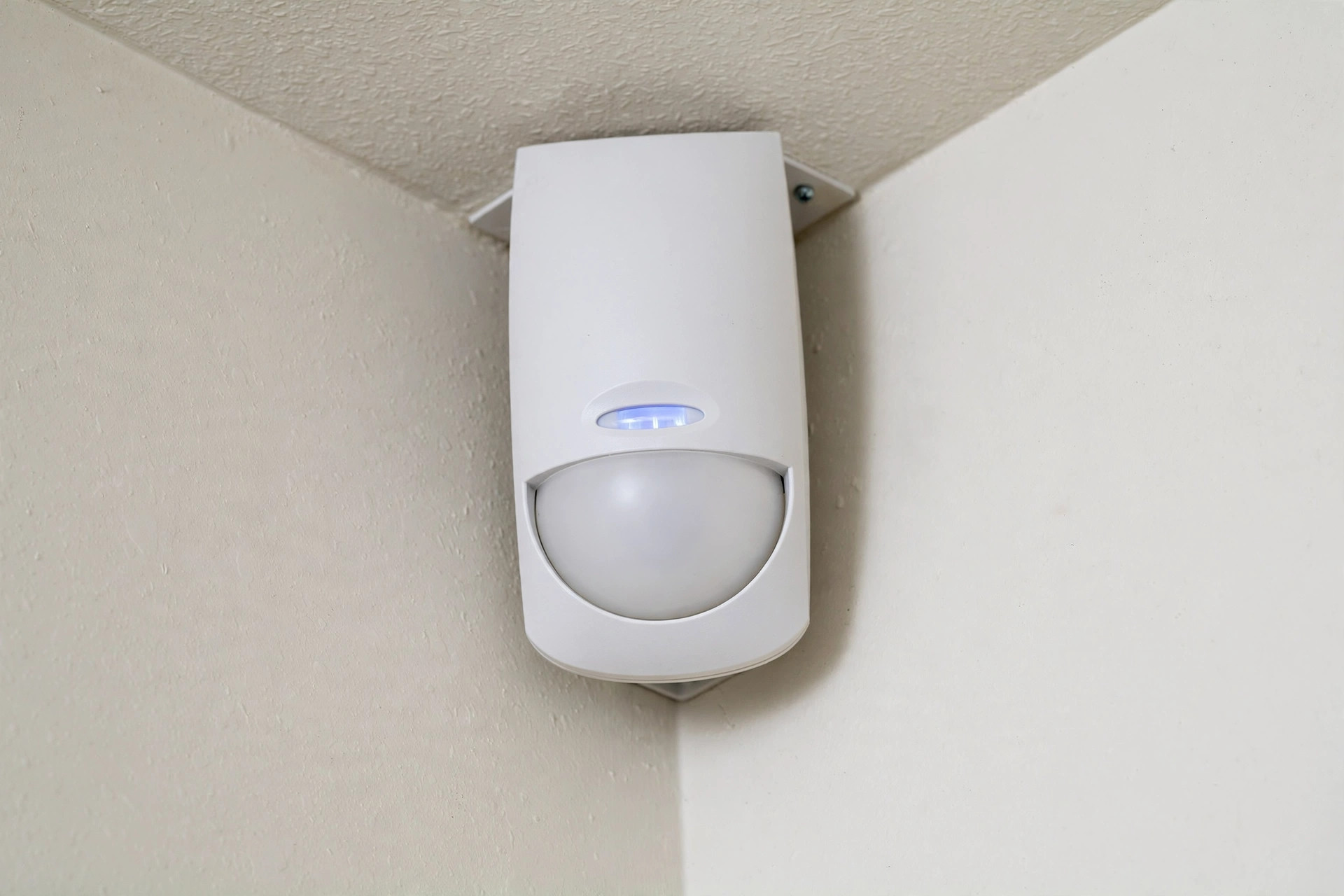
A dual-tech (or dual-technology) sensor houses two independent detectors in one enclosure, looking at the same space through the same lens arrangement. The PIR half monitors infrared energy in the 8–14 micrometer band for the moving heat signature of a warm body. The microwave half emits low-power radio waves — usually around 5.8 or 10.5 GHz — and listens for frequency shifts in the reflections that indicate something is moving toward or away from the sensor.
The two halves share power and a housing but nothing else: separate sensing elements, separate signal processing, separate causes of false motion detection. The alarm relay only trips when both channels report an event within the same short time window, typically a second or two. Either channel firing alone is treated as environmental noise and ignored.
How Each Half Works (Briefly)
The PIR half uses a pyroelectric element behind a faceted Fresnel lens that divides the field of view into alternating sensitive and insensitive zones. A warm body crossing from one zone to the next creates the alternating hot-cold-hot signal the electronics recognize. Standing perfectly still, a person fades into the thermal background — PIR sees change, not presence.
The microwave half is an active sensor: it transmits continuously and mixes a sample of the transmitted wave with the received reflection. Anything moving with a radial velocity component shifts the reflected frequency by the Doppler effect, producing a beat frequency the circuit detects. Unlike PIR, microwave does not care about temperature at all — a rolling office chair triggers it as readily as a person — but it is exquisitely sensitive to even tiny movements, and its radio waves pass through drywall, glass, and most interior partitions.
Why Requiring Both Cuts False Alarms
Consider the classic false-alarm scenarios. A sunbeam sweeping across the room as clouds pass: the PIR half may fire on the moving heat pattern, but nothing is physically moving, so the microwave half stays quiet — no alarm. A ceiling fan or fluttering curtain: the microwave half fires on the motion, but there is no warm-body heat signature, so the PIR half stays quiet — no alarm. An insect crawling across the PIR lens: the PIR half screams, but the insect’s movement is too small and slow to register meaningfully on the microwave channel — no alarm.
A real intruder defeats none of these filters: a walking human is both warm and moving, triggering both channels within the coincidence window. The statistics are what make the design compelling. If each technology false-alarms once a month independently, and their false alarms are uncorrelated, the AND combination false-alarms roughly once in centuries. Real-world improvement is less dramatic — some disturbances do affect both channels — but reductions of 80–95% in nuisance alarms are commonly reported, which is the difference between a system owners trust and one they disable.
The correlated-failure exception
The AND logic has one blind spot: disturbances that genuinely produce both heat and motion. A powerful gust of warm air from a malfunctioning heater vent, or a large pet, can trip both channels together. This is why dual-tech sensors still need sensible placement — away from HVAC vents, fireplaces, and sun-struck windows — and why pet-immune models add extra logic on top of the dual-tech foundation.
Pet Immunity: How It Really Works
“Pet immune up to 40 kg” does not mean the sensor recognizes your dog. It means the optics and thresholds are designed so that heat-and-motion signatures below a certain size, height, and intensity are ignored. The Fresnel lens is shaped so its lower zones — where a small animal moves — contribute less signal, and the processing requires a minimum signal strength consistent with an adult human. A large dog rearing up at the window, or a cat walking along the top of a bookshelf at sensor height, can still defeat pet immunity, because at that point the animal genuinely looks human-sized to the sensor. Mounting height is part of the specification for exactly this reason: install the sensor higher or lower than rated and the size thresholds shift, quietly voiding the pet-immunity claim.
Dual-tech helps here too: a small animal produces a weaker PIR signature and a different Doppler profile than a walking adult, so the coincidence requirements can be tuned more aggressively without missing real intruders. But no sensor is immune to physics — the honest version of “pet immune” is “pet resistant within the stated weight and mounting-height limits.”
Placement Rules and Remaining Weaknesses
Dual-tech sensors inherit constraints from both halves. From the PIR side, they need a clear view and suffer in hot environments: when the room approaches body temperature, the thermal contrast the PIR half depends on collapses, which is exactly how motion detectors fail in hot conditions — a garage in a heatwave, a sun-baked conservatory. From the microwave side, they see through interior walls, so a sensor aimed at a partition wall may detect people in the next room; installers must aim them into open space and use the range adjustment to keep the microwave field inside the protected area.
The other trade-off is response time. Because both channels must fire within the coincidence window, dual-tech sensors can be marginally slower to alarm than a hair-trigger PIR — typically fractions of a second, irrelevant for security but worth knowing. And like all multi-sensor systems that detect more reliably by cross-checking, they cost more than single-technology units. For a bedroom hallway where a false alarm at 3 a.m. costs you sleep and trust, it is money well spent; for a garden shed, a basic PIR is probably fine.
Tuning Sensitivity and the Coincidence Window
Dual-tech sensors expose two adjustments most single-tech units lack: independent sensitivity for each channel and, on better models, the length of the coincidence window. Lowering microwave sensitivity shrinks the radio field so it stays inside the room; lowering PIR sensitivity reduces the range at which small heat signatures register. The coincidence window — how close together the two detections must occur — is the subtlest control: too wide and unrelated events start pairing up (the microwave catches a curtain gust seconds after the PIR catches a sunbeam), too narrow and a slow-moving intruder’s two signatures drift apart and the alarm never fires.
Professional installers tune in a specific order: mount at the recommended height (usually around 2–2.4 meters), aim across the expected path of travel rather than at it (both technologies respond best to lateral movement), set both channels to medium, walk-test, then adjust only what the test reveals. The most common amateur mistake is maxing out both sensitivities “to be safe” — which is precisely how you convert a false-alarm-immune sensor back into a false-alarm machine. Restraint is a feature.

Frequently Asked Questions
Are dual-tech motion sensors worth the extra cost?
In living spaces where false alarms are disruptive, yes. The AND logic between PIR and microwave eliminates the large majority of nuisance triggers — pets, drafts, insects, curtains — which is what keeps owners from disabling the system.
Can dual-tech sensors still be fooled?
Yes, by anything that produces both heat and motion together: large pets, powerful warm air blasts from vents, or a person-sized warm object moving. Correct placement away from vents and heat sources handles most of these.
Should I use dual-tech indoors or outdoors?
Both, but for different reasons. Indoors, they tame pet and draft false alarms. Outdoors, they tame weather, vegetation, and small-animal triggers — though outdoor models need weatherproofing and careful aiming regardless of technology.
Why does my dual-tech sensor seem slower to trigger?
Both channels must fire within a short coincidence window before the alarm trips, which adds a fraction of a second compared to a single PIR. The delay is imperceptible in practice and is the price of the false-alarm immunity.
Do dual-tech sensors work in hot rooms?
Less well. When ambient temperature approaches body temperature, the PIR half loses the thermal contrast it needs, leaving effectively only the microwave half — and the AND logic means reduced sensitivity. Avoid mounting them in routinely hot spaces.