Inside every carbon monoxide detector, every breathalyzer, and countless industrial gas monitors sits the same humble component: an electrochemical gas sensor. It is a chemical-to-electrical transducer with no moving parts — gas diffuses in, a reaction releases electrons, and the resulting current reveals the concentration. This single principle underlies an enormous share of the gas detection in the modern world.
This article explains how electrochemical gas sensors work at the electrode level, the two operating modes that cover different gases, what limits their accuracy and lifespan, and where the technology is headed.
The Core Idea: Gas In, Current Out
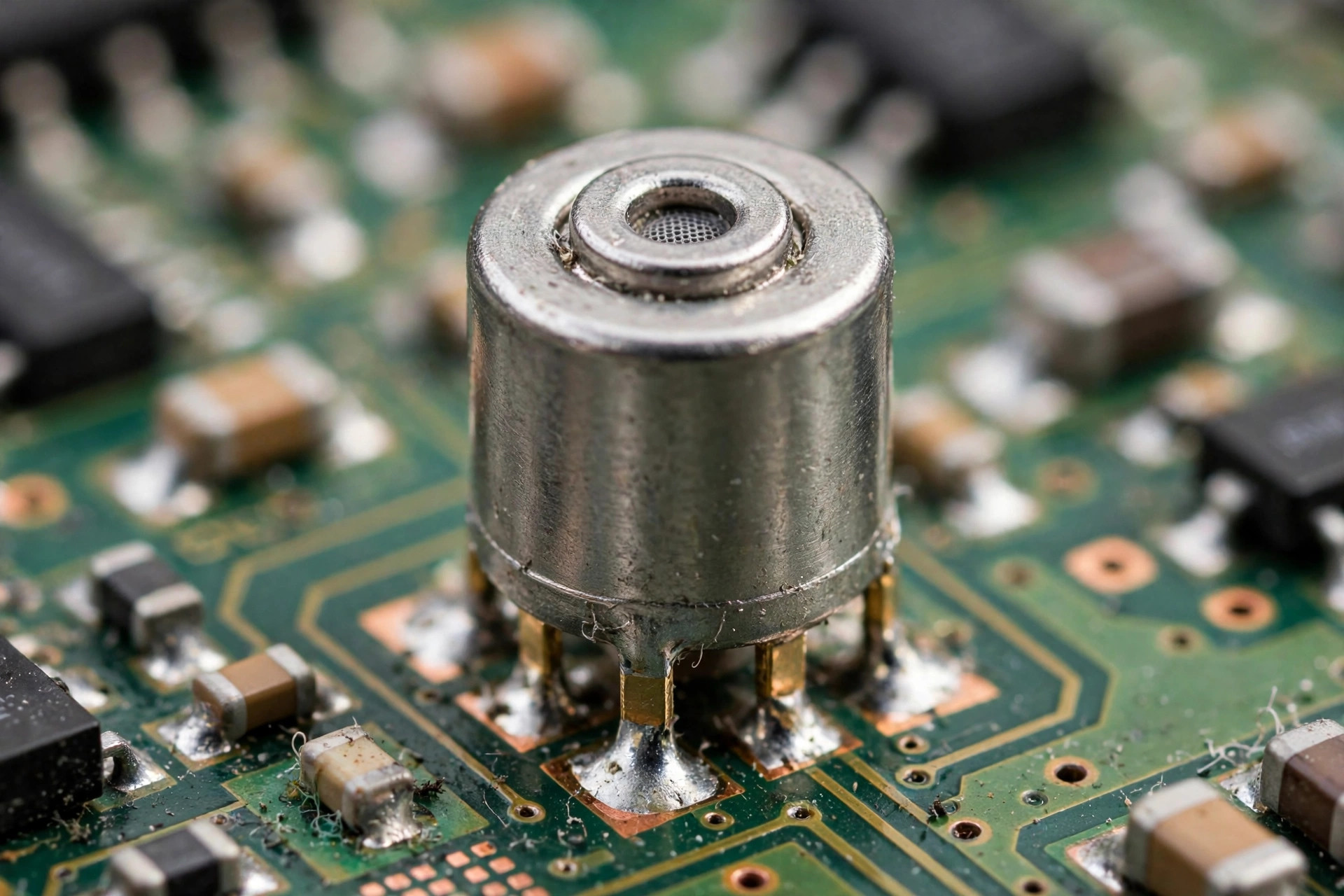
An electrochemical sensor is a small sealed cell containing two or three electrodes immersed in an electrolyte — typically a mineral acid or an organic electrolyte, chosen for the target gas. The top of the cell is capped by a gas-permeable membrane that lets the target gas diffuse in while keeping the liquid electrolyte from leaking out and blocking dust and bulk airflow.
When target gas molecules reach the working electrode (also called the sensing electrode), they undergo an electrochemical reaction — oxidation or reduction, depending on the gas. Carbon monoxide oxidizes, releasing electrons; nitrogen dioxide reduces, consuming them. Either way, electrons flow, and that flow is the signal: the current generated is directly proportional to the gas concentration. Zero gas, zero current; double the gas, double the current. It is one of the most linear transduction mechanisms in all of sensing, which is why calibration is comparatively simple.
A third electrode — the reference electrode — holds the working electrode at a stable electrochemical potential, like a voltage anchor. Without it, the reaction potential would drift with temperature and contamination, and the current would wander. The counter electrode completes the circuit, balancing the reaction. Three electrodes, one membrane, and a thimbleful of acid: that is the whole sensor.
Two Modes: Amperometric and Potentiometric
Amperometric: measuring the current
Most toxic-gas sensors (CO, H2S, NO2, SO2, chlorine) run amperometric: the working electrode is held at a fixed potential and the sensor measures the resulting current. Because the current comes only from the target reaction, selectivity is good — the electrode potential is chosen so that the target gas reacts readily while common interferents do not. This is why a quality CO sensor ignores the background soup of household VOCs that would confuse a semiconductor sensor.
Potentiometric: measuring the voltage
Some sensors instead measure the voltage developed between electrodes at near-zero current — the potentiometric mode, familiar from pH electrodes. It suits gases where a stable equilibrium potential forms, and it draws essentially no power, which matters for ultra-long-life applications. The trade-off is a logarithmic rather than linear response, demanding more careful signal processing.
Oxygen Sensors: A Special Case
Oxygen sensors deserve their own mention because they work in reverse. A galvanic oxygen sensor is essentially a fuel cell that consumes itself: oxygen diffuses in and is reduced at the cathode while a lead anode oxidizes, generating a current proportional to oxygen concentration. No external power needed — the sensor is its own battery.
The catch is built into the chemistry: the lead anode is consumed by the reaction, so the sensor has a finite life determined by total oxygen exposure — typically 1 to 2 years in normal air, less in oxygen-enriched environments. When a confined-space monitor’s oxygen channel dies, it is usually this depletion, not electronics failure — one reason OSHA’s confined-space rules demand calibrated, in-date instruments before anyone enters. It is the clearest illustration of the technology’s central bargain: the sensor works by slowly consuming itself.
What Limits Accuracy: Cross-Sensitivity, Drift, and Environment
Electrochemical sensors are selective, not specific. Each sensor has a published cross-sensitivity table, and reading it is essential: a CO sensor responds to hydrogen (the classic false-positive near battery chargers), an H2S sensor sees traces of certain mercaptans, and NO2 sensors notice chlorine. In mixed-gas environments, the reading is always the sum of target plus interferents — which is why chemical sensors that identify substances must be chosen against a known background, not in the abstract.
Drift comes from the slow degradation of every component: electrolyte evaporation through the membrane (accelerated by heat and low humidity), electrode poisoning by contaminants, and reference-electrode wander. Quality sensors lose only a few percent of signal per month, but “a few percent per month” compounds — which is why industrial instruments demand bump testing before each use and scheduled calibration with span gas.
Environment matters more than datasheets suggest. Temperature swings shift reaction kinetics; the sensor compensates with a built-in thermistor, but rapid thermal shock still causes transient errors. High humidity is generally fine — the electrolyte is aqueous anyway — but condensing water on the membrane blocks gas diffusion and blinds the sensor temporarily. Pressure changes alter diffusion rates, a real effect in aviation and process applications that environmental conditions can quietly degrade.
Lifespan: The Chemistry Is Consumable
Every electrochemical sensor is dying from the day it is manufactured. Electrolyte slowly evaporates, electrodes gradually poison, and seals age — even on the shelf, in the sealed bag. Typical service life is 2 to 3 years for toxic-gas cells, shorter for oxygen cells, and the warranty clock usually starts at manufacture, not installation.
This is why professional gas detectors stamp an expiry date and why “the sensor still beeps on test gas” is not a license to exceed it: an aged cell can pass a bump test at one concentration and still read dangerously low at another, because poisoning rarely degrades the response uniformly. The economics follow directly — the sensor is a consumable, like a printer cartridge, and budgeting for replacement cells is part of owning the instrument.
There is also a quiet distinction between warranty and service life that trips up buyers. A sensor may carry a two-year warranty but a three-year rated life — the manufacturer guarantees it for two, expects three, and the instrument keeps working until the chemistry says otherwise. Conversely, a sensor stored badly can die within its warranty period. Date codes and storage conditions matter more than brand promises; when in doubt, a fresh cell of a mid-range brand outperforms an aged cell of a premium one.
Storage matters at the margins: cool, moderate humidity, sealed packaging. But no storage trick stops the chemistry; it only slows it. When selecting instruments, check the sensor’s date code the way you would check milk — sensor sensitivity versus accuracy is meaningless once the cell is past its prime.
Where the Technology Is Going
The fundamental cell has barely changed in decades — it works — but everything around it is evolving. MEMS-scale electrochemical sensors now put the three-electrode system on a silicon chip, slashing size and cost for wearables and IoT air-quality nodes. Solid-polymer electrolytes replace liquid acid, eliminating leak and orientation constraints and extending shelf life. And multi-gas arrays pair several tuned cells with pattern-recognition firmware, edging toward the selectivity of a laboratory instrument in a handheld package.
Printed and flexible electrochemical sensors are pushing into wearables — thin patches that monitor personal exposure to CO or ozone through the workday, logging dose the way a fitness tracker logs steps. The readings are noisier than a benchtop instrument, but the paradigm is new: instead of one accurate sensor guarding a room, dozens of approximate sensors guard the person, and the cloud does the averaging. For occupational health, that shift from area monitoring to personal monitoring may prove as significant as the sensor itself.
What is not changing is the core bargain: exquisite low-power sensitivity to specific gases, purchased with finite life and mandatory calibration discipline. Understand that trade, and electrochemical sensors become what they are at their best — the most trustworthy nose in the building, as long as you remember that noses need checkups.
Frequently Asked Questions
How does an electrochemical gas sensor work?
Target gas diffuses through a membrane to a working electrode, where it oxidizes or reduces, releasing or consuming electrons. The resulting current is directly proportional to gas concentration. A reference electrode stabilizes the reaction potential and a counter electrode completes the circuit.
What gases can electrochemical sensors detect?
Common targets include carbon monoxide, hydrogen sulfide, nitrogen dioxide, sulfur dioxide, chlorine, ammonia, and oxygen (with a special galvanic cell). Each gas needs its own tuned cell — one sensor does not detect them all.
Why do electrochemical sensors need calibration?
The chemistry drifts: electrolyte evaporates, electrodes poison, and the reference wanders — typically a few percent of signal per month. Bump testing with known gas before use and scheduled span calibration keep readings trustworthy.
How long do electrochemical sensors last?
Typically 2–3 years for toxic-gas cells and 1–2 years for oxygen cells, counted from manufacture — even unused, sealed sensors age. An expired cell can pass a simple test yet read dangerously wrong, so respect the date code.
What causes false readings in electrochemical sensors?
Cross-sensitivity to chemically similar gases (hydrogen on CO sensors is the classic), temperature shock, condensing water blocking the membrane, and pressure changes. Check the sensor’s published cross-sensitivity table against your environment.