Anomaly detection in machinery involves monitoring sensor data streams such as temperature, vibration, and pressure to identify deviations from established operational baselines. Algorithms analyze these continuous inputs to recognize patterns indicative of potential failures by correlating subtle changes with fault precursors. This article examines how data-driven models differentiate between normal fluctuations and critical anomalies, addressing challenges in early fault diagnosis and predictive maintenance. Key topics include sensor data integration, baseline modeling techniques, anomaly scoring methods, and the interpretation of warning signals prior to machine failure.
What Is Anomaly Detection In Machines And Why It Matters
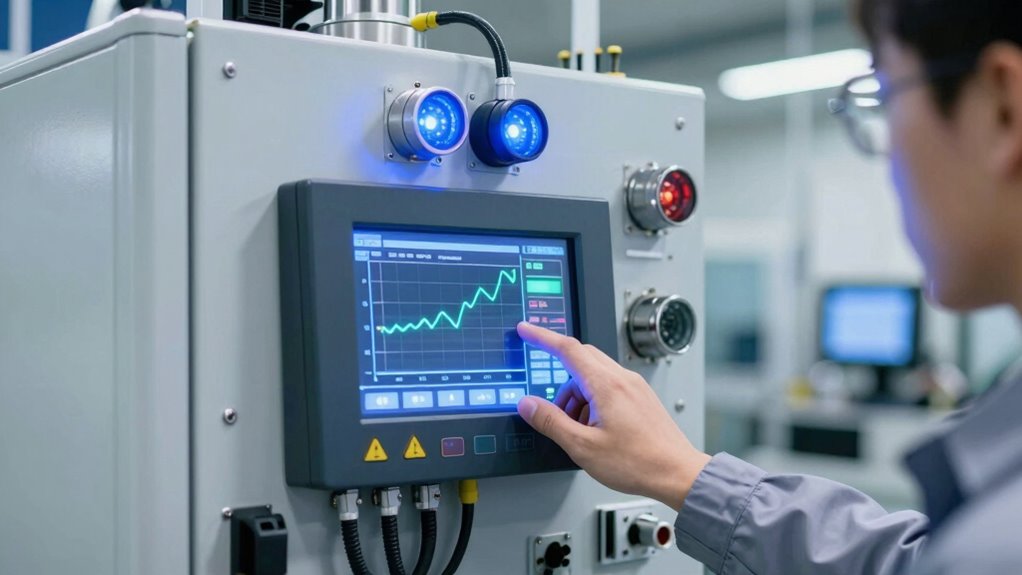
Although you mightn’t always notice, machines constantly generate data reflecting their operational status; anomaly detection is the process of analyzing this data to identify deviations from normal patterns.
By employing sophisticated detection algorithms, you can systematically perform anomaly identification, pinpointing irregularities that signal emerging issues. These algorithms compare real-time data streams against established baselines, flagging outliers that diverge from expected behavior.
This approach frees you from relying on manual inspections or reactive responses, enabling precise, data-driven insights into machine health. Anomaly detection is essential because it translates raw data into actionable intelligence, allowing you to understand operational dynamics without constraints.
Why Early Anomaly Spotting Improves Maintenance
When you spot anomalies early, you reduce unexpected machine failures that cause costly downtime, saving significant operational expenses.
Data shows that addressing issues promptly can extend equipment lifespan by up to 30%, maximizing your asset value.
Prioritizing early detection lets you schedule maintenance efficiently, improving overall system reliability.
Preventing Costly Downtime
Three key benefits emerge when you spot anomalies early in machine operations: reduced downtime, lower repair costs, and extended equipment lifespan.
By conducting a thorough cost analysis, you can quantify the downtime impact on your operations, revealing how unplanned halts drastically inflate expenses. Early anomaly detection minimizes unexpected failures, enabling you to schedule maintenance proactively rather than reactively.
This strategic approach reduces downtime duration and frequency, directly cutting labor and replacement part costs. Additionally, by identifying subtle deviations before they escalate, you preserve machine integrity, avoiding costly breakdowns.
Fundamentally, early spotting empowers you to maintain operational freedom, optimizing resource allocation while safeguarding productivity. The data clearly show that investing in anomaly detection technology pays off by preventing the substantial financial and operational setbacks associated with downtime.
Enhancing Equipment Longevity
Because early anomaly spotting allows you to address minor issues before they escalate, it directly contributes to extending your equipment’s lifespan.
Detecting deviations from normal machine behavior enables targeted maintenance strategies that enhance equipment efficiency and reduce wear. Data shows that predictive maintenance, guided by early anomaly detection, can increase equipment longevity by up to 30%, minimizing unplanned replacements.
When you integrate real-time monitoring systems, you gain precise insights into component health, allowing you to schedule interventions only when necessary. This approach not only conserves resources but also grants you freedom from rigid maintenance schedules and unexpected failures.
How Sensors Gather Data To Monitor Machine Health
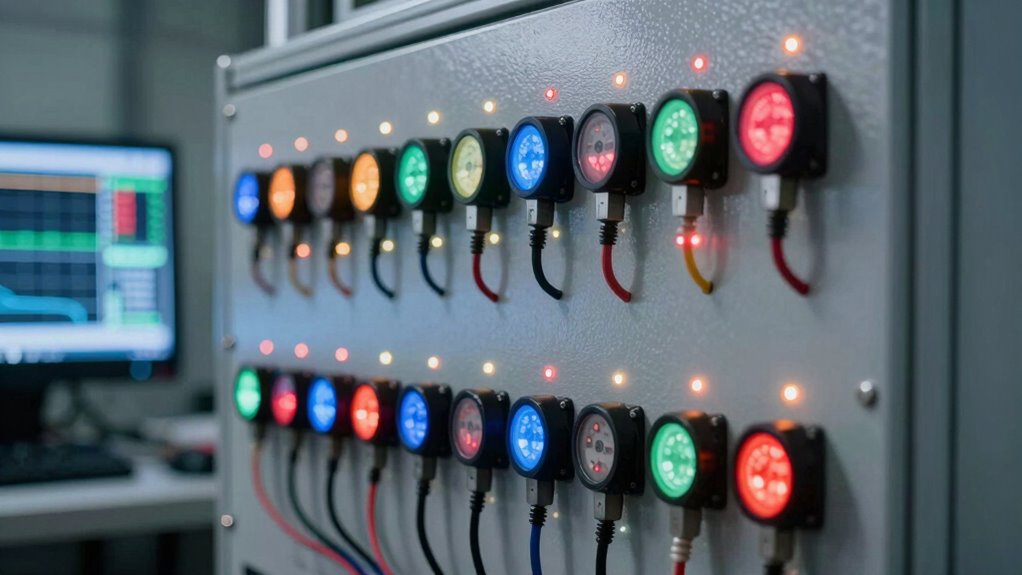
Sensors act as the frontline in collecting critical data that reveals a machine’s operational status and potential issues. You rely on various sensor types—temperature, pressure, and current sensors—to capture precise measurements. The accuracy of this data is paramount; even minor deviations can signal early anomalies. By continuously gathering high-fidelity data, sensors empower you to monitor machine health proactively and maintain operational freedom without unexpected downtime.
| Sensor Type | Function | Data Accuracy Importance |
|---|---|---|
| Temperature | Measures heat levels | Detects overheating, preventing damage |
| Pressure | Monitors fluid/gas pressure | Guarantees system stability |
| Current | Tracks electrical current flow | Identifies power anomalies |
| Vibration | Detects mechanical oscillations | (Discussed in next subtopic) |
Understanding these sensor roles and data accuracy enables you to spot subtle shifts, preserving machine integrity and your ability to operate freely and efficiently.
Vibration Analysis For Early Anomaly Detection
Vibration data offers a powerful lens to detect mechanical issues before they escalate. By continuously monitoring vibration signatures, you can identify subtle deviations that signal early-stage faults.
Frequency analysis breaks down these complex vibration patterns into distinct components, revealing irregularities invisible to the naked eye. When abnormal frequencies or amplitudes emerge, they often indicate imbalances, misalignments, or bearing wear.
Leveraging algorithms to analyze these shifts enables you to predict failures with high accuracy, granting you the freedom to schedule maintenance proactively rather than reactively. This approach minimizes downtime and extends equipment lifespan.
By focusing on precise vibration signatures and their frequency domains, you gain actionable insights into machine health. Fundamentally, vibration analysis transforms raw data into an early warning system, empowering you to intervene before minor anomalies develop into costly breakdowns.
This data-driven methodology not only enhances reliability but also optimizes operational efficiency, giving you control over your machinery’s performance and maintenance planning.
Temperature Monitoring For Anomaly Detection
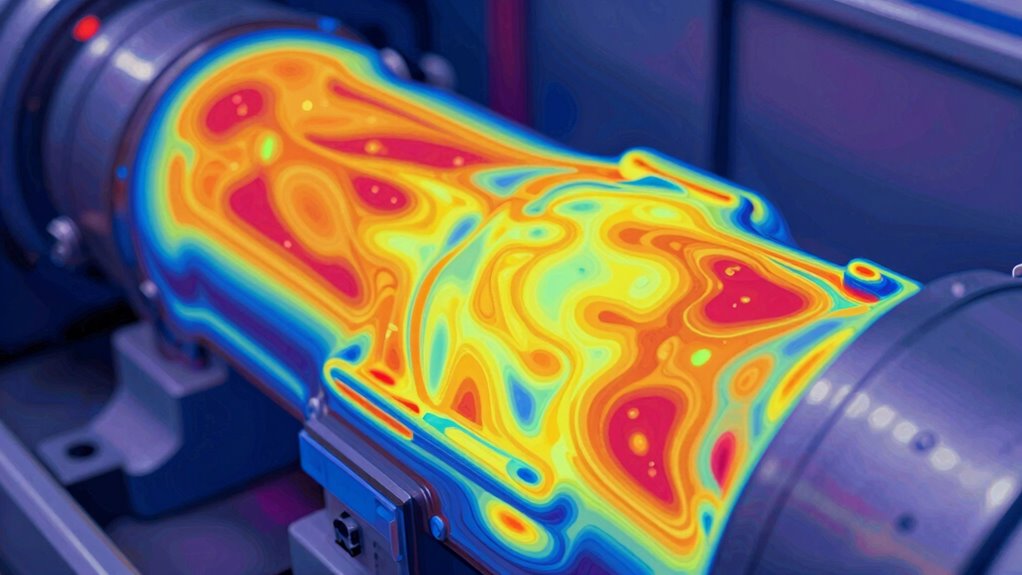
While vibration analysis reveals mechanical imbalances, temperature monitoring offers a complementary perspective by tracking thermal patterns that signal abnormal machine conditions.
By continuously measuring temperature against predefined temperature thresholds, monitoring systems can detect subtle anomalies indicative of impending failures, such as overheating bearings or electrical faults.
You’ll find that integrating real-time temperature data with automated alerts enables prompt interventions, reducing downtime and maintenance costs.
These systems rely on precise sensors strategically placed on critical components, feeding data into analytics platforms that identify deviations from normal thermal behavior.
This data-driven approach empowers you to predict failures before they escalate, enhancing operational freedom and equipment reliability.
Ultimately, temperature monitoring is an essential layer in a multi-sensor strategy, providing actionable insights that vibration analysis alone might miss.
Acoustic Sensors For Detecting Hidden Anomalies
Because many machine faults produce distinct acoustic signatures before becoming visually or mechanically apparent, acoustic sensors provide a critical layer of anomaly detection. By leveraging advanced sensor technology, you can capture high-fidelity sound data that reveals subtle changes in machine operation.
Acoustic analysis enables you to identify patterns like increased vibration frequencies or irregular noise bursts, which often precede failures. This data-driven approach allows you to detect hidden anomalies with greater accuracy and earlier than traditional methods.
Integrating acoustic sensors into your monitoring system offers a non-invasive, real-time insight into machine health. The precision of sensor technology guarantees minimal false positives, allowing you to focus on genuine threats to operational freedom.
Why Historical Data Helps Spot Anomalies
You’ll find that analyzing patterns in past data lets you establish a baseline of normal machine behavior.
By learning from these historical trends, you can more accurately identify when deviations occur.
This data-driven approach reduces false alarms and improves anomaly detection precision.
Patterns In Past Data
Although machines generate vast amounts of data continuously, it’s the patterns within historical data that allow you to distinguish normal behavior from anomalies. By analyzing historical patterns, you gain critical data insights that reveal what “normal” looks like over time. This baseline is essential for detecting deviations signaling potential failures.
When you examine past data, you can identify:
- Consistent operational ranges defining standard performance
- Recurring cycles and seasonal fluctuations in machine behavior
- Sudden spikes or drops that historically preceded faults
- Correlations between multiple sensor readings indicating systemic issues
These patterns empower you to create precise anomaly detection models. Understanding historical data liberates you from reactive maintenance, enabling proactive interventions that extend machine life and guarantee operational freedom.
Learning From Historical Trends
Building on the patterns identified in past data, learning from historical trends sharpens your ability to spot anomalies by highlighting long-term shifts and subtle deviations. Historical insights feed predictive algorithms, enabling them to distinguish normal variations from genuine faults. By analyzing extensive time-series data, you gain a baseline understanding of expected behavior, which empowers early anomaly detection before failure occurs.
| Aspect | Historical Insights | Predictive Algorithms |
|---|---|---|
| Data Scope | Long-term, thorough | Real-time, adaptive |
| Detection Focus | Trends and gradual changes | Sudden deviations, outliers |
| Outcome | Accurate baseline modeling | Timely anomaly alerts |
Leveraging historical data gives you freedom to act proactively, reducing downtime and enhancing machine reliability.
How Machine Learning Automatically Detects Anomalies
Machine learning leverages vast datasets and advanced algorithms to identify patterns that deviate from normal behavior in machines. You rely on anomaly algorithms and detection models that automatically scan data to flag irregularities, minimizing downtime and maximizing operational freedom.
These models continuously learn from incoming data, refining their accuracy without manual intervention.
When using these systems, you’ll notice they:
- Analyze sensor readings for sudden spikes or drops
- Compare current signals against established baselines
- Detect subtle shifts in vibration or temperature patterns
- Adapt to evolving machine behavior over time
Why Real-Time Data Processing Speeds Up Detection
The continuous learning and adaptation of anomaly detection models are only as effective as the speed at which data is processed. When you rely on real-time monitoring, data latency is minimized, allowing immediate recognition of deviations from normal machine behavior.
This rapid processing translates into faster alerts, enabling swift interventions before minor anomalies escalate into costly failures. By reducing data latency, you maintain a constant, up-to-the-second flow of information, which sharpens the model’s ability to adjust dynamically.
This immediacy empowers you to act decisively, preserving operational freedom without being tethered to delayed reports. Additionally, real-time data processing supports continuous feedback loops, improving the model’s accuracy and responsiveness.
Ultimately, cutting down latency not only accelerates detection but also enhances predictive precision, providing you with a proactive edge. Essentially, embracing real-time monitoring transforms anomaly detection from a reactive to a predictive discipline, granting you greater control over machine health and operational uptime.
Combining Multiple Data Sources For Accurate Detection
You’ll improve detection accuracy by integrating data from multiple sensors, capturing different aspects of machine behavior.
This fusion of diverse data streams reduces false positives and uncovers subtle anomalies that single sources might miss.
Integrating Diverse Sensor Data
Although individual sensors provide valuable insights, integrating data from multiple sources greatly enhances the accuracy of anomaly detection.
You’ll want to leverage sensor fusion and data integration techniques to synthesize diverse inputs into a coherent picture. This approach allows you to detect subtle deviations that single sensors might miss.
For example, you could combine:
- Vibration patterns revealing mechanical stress
- Temperature fluctuations indicating overheating
- Acoustic signals capturing unusual noise
- Electrical current variations showing load anomalies
Enhancing Accuracy With Fusion
Bringing together varied sensor inputs sharpens your ability to identify anomalies with higher confidence. Sensor fusion leverages data integration techniques to combine multiple data streams, reducing noise and improving signal reliability.
By correlating temperature, vibration, and acoustic data, you create a thorough view of machine health that single sources can’t provide alone. This fusion enhances detection accuracy by highlighting subtle deviations that may indicate early failure.
Advanced algorithms analyze integrated datasets in real time, enabling you to spot patterns invisible to isolated sensors. With precise fusion methods, false positives decrease, and predictive maintenance becomes more effective.
Embracing sensor fusion empowers you to make data-driven decisions, ensuring operational freedom through timely, accurate anomaly detection before failures disrupt your workflow.
How Edge Computing Enhances On-Site Machine Monitoring
Edge computing revolutionizes on-site machine monitoring by processing data locally, reducing latency and bandwidth usage.
With edge analytics and decentralized processing, you gain immediate insights without waiting for cloud analysis, empowering you to act swiftly. This setup enhances reliability since data transmission failures won’t halt anomaly detection.
Edge analytics deliver instant insights locally, ensuring continuous anomaly detection even if data transmission fails.
Imagine your system handling:
- Real-time vibration analysis directly on the machine
- Immediate temperature anomaly alerts without network delays
- Local pattern recognition reducing false positives
- Continuous monitoring despite intermittent internet connectivity
How Cloud Platforms Support Machine Anomaly Detection
You can leverage cloud platforms to handle vast volumes of machine data through scalable processing, ensuring no anomaly goes unnoticed.
These platforms enable seamless integration of real-time analytics, allowing you to detect and respond to irregularities promptly.
Scalable Data Processing
Scalable data processing is essential when handling the vast and continuous streams of sensor data generated by industrial machines. To detect anomalies effectively, you need scalable algorithms that can sift through big data without bottlenecks.
Cloud platforms empower you to manage this volume by distributing workloads and enabling parallel processing. Imagine your system effortlessly handling:
- Terabytes of sensor readings every hour
- Dynamic scaling based on data influx
- Integration of diverse data types from multiple machines
- Real-time batch processing pipelines
This approach guarantees you maintain freedom from hardware constraints while extracting actionable insights.
Real-Time Analytics Integration
Handling immense volumes of sensor data is only part of the challenge; integrating real-time analytics is what transforms raw information into immediate, actionable insights.
When you leverage cloud platforms, you gain access to powerful tools that provide real time insights, enabling you to detect anomalies the moment they occur. These platforms facilitate seamless data visualization, allowing you to monitor machine performance through intuitive dashboards.
This instant clarity helps you intervene before minor deviations escalate into failures. By integrating streaming analytics and automated alerting systems, you maintain continuous oversight without sacrificing operational freedom.
The result is a dynamic environment where data flows freely, and you can make precise decisions swiftly, minimizing downtime and optimizing machine health effectively. Real-time analytics integration isn’t just a feature—it’s the backbone of proactive anomaly detection.
Challenges In Implementing Anomaly Detection
Although anomaly detection holds significant promise for predictive maintenance, implementing it effectively presents several challenges that can impede its accuracy and reliability. You’ll face issues like data privacy, where sensitive operational data must be protected without limiting analytical power.
Anomaly detection offers great potential but demands careful handling of privacy and accuracy challenges.
Integration complexity arises as you try to merge anomaly detection systems with existing infrastructure, often leading to compatibility and scalability hurdles. Additionally, you must manage:
- High dimensionality of sensor data, requiring sophisticated feature selection
- Imbalanced datasets where failure events are rare but critical
- Variability in machine behavior that complicates baseline establishment
- Real-time processing demands that strain computational resources
To navigate these challenges, you’ll need precise algorithms that adapt dynamically and maintain data security.
Balancing thorough analysis with operational freedom means building systems that aren’t only accurate but also flexible and secure, empowering you to detect anomalies early without compromising control or privacy.
Predictive Maintenance: Using Anomaly Detection To Save Costs
When you leverage anomaly detection in predictive maintenance, you can markedly reduce downtime and maintenance costs by identifying machine issues before they escalate.
By applying predictive analytics to sensor data, you gain real-time insights into equipment behavior, enabling you to detect subtle deviations from normal patterns. This early warning system allows you to schedule maintenance precisely when needed, avoiding unnecessary interventions and costly breakdowns.
Anomaly detection algorithms analyze historical and current data, accurately forecasting potential failures and optimizing resource allocation. This approach not only enhances operational efficiency but also extends asset lifespan.
Embracing predictive maintenance frees you from reactive firefighting, empowering you with data-driven decision-making that maximizes uptime.
Ultimately, integrating anomaly detection with predictive analytics transforms maintenance from a costly burden into a strategic advantage, giving you the freedom to focus on innovation rather than disruption.
Case Studies: Machines Caught In The Act Before Failing
The power of anomaly detection in predictive maintenance becomes clear when you examine real-world examples where machines were identified as failing before any visible signs appeared.
These anomaly case studies highlight how timely data insights lead to effective failure prevention, sparing costly downtime and enhancing operational freedom. For instance, vibration sensors detected early imbalance in a turbine, enabling preemptive repair.
In another case, temperature anomalies in a compressor hinted at impending bearing failure weeks before breakdown. A manufacturing robot’s irregular current draw predicted motor issues, allowing scheduled maintenance without disrupting workflow.
Ultimately, subtle acoustic pattern changes in a pump revealed seal wear long before leaking occurred.
These examples show how precise anomaly detection empowers you to act decisively, transforming raw data into actionable intelligence. By leveraging these insights, you maintain control, avoid unexpected halts, and optimize machine lifespan—freeing you from reactive firefighting and costly interruptions.
Future Trends In Machine Anomaly Detection Technology
As machine learning algorithms evolve and sensor technology advances, you’ll see anomaly detection becoming faster, more accurate, and increasingly autonomous.
Future technologies will leverage enhanced sensor advancements and edge analytics to process data locally, reducing latency and enabling real-time anomaly prediction. Predictive algorithms will integrate machine intelligence with cloud integration, facilitating seamless automated monitoring across distributed systems.
Enhanced sensors and edge analytics enable real-time anomaly detection with seamless cloud-integrated monitoring across systems.
This synergy improves maintenance optimization by identifying subtle deviations before failures occur. You’ll also benefit from sophisticated data visualization tools that translate complex patterns into actionable insights, empowering swift decision-making.
The combined effect of edge analytics and cloud computing guarantees scalability and robustness, granting you freedom from constant manual oversight.
As these innovations mature, anomaly detection will shift from reactive troubleshooting to proactive system health management, fundamentally transforming operational reliability and efficiency.
Embracing these trends means you can expect smarter, more adaptive monitoring solutions that free you to focus on strategic priorities rather than firefighting unexpected machine failures.
Frequently Asked Questions
What Are the Initial Costs of Setting up an Anomaly Detection System?
You’ll face an initial investment covering hardware, software, and data integration. Prioritize system scalability to avoid costly upgrades. Analytical planning guarantees efficient resource use, empowering you with freedom to adapt as your anomaly detection needs evolve.
How Do Anomaly Detection Systems Handle False Alarms?
You reduce false alarms by carefully tuning detection thresholds, balancing sensitivity and specificity. This data-driven approach guarantees you maintain freedom from unnecessary alerts while accurately identifying true anomalies, optimizing system reliability and operational efficiency.
Can Anomaly Detection Be Applied to All Types of Machines?
You might think anomaly detection suits all machine types, but it doesn’t. Detection techniques must be tailored, considering specific machine data and failure modes, ensuring precise monitoring while granting you freedom from unnecessary alerts or downtime.
What Training Is Required for Staff to Use These Systems Effectively?
You’ll need targeted staff training focusing on system usability, ensuring team members understand data inputs, anomaly indicators, and response protocols. This approach maximizes efficiency and empowers your staff to act autonomously, minimizing downtime and enhancing predictive accuracy.
How Is Data Privacy Maintained in Machine Anomaly Detection?
You want robust data privacy, so systems use data encryption and require user consent; this balance guarantees your freedom isn’t compromised while keeping anomaly detection precise, secure, and compliant with data protection standards you trust.