You rely on smoke detectors to warn you, but they can miss fires for technical and practical reasons. Different sensor types respond to different particle sizes, placement and airflow can dilute signals, and dust or humidity can blind sensors over time. Understanding these limits and common mistakes will show you what to check first—and why a silent detector doesn’t always mean you’re safe.
Quick Checklist: What to Do If a Smoke Detector Fails
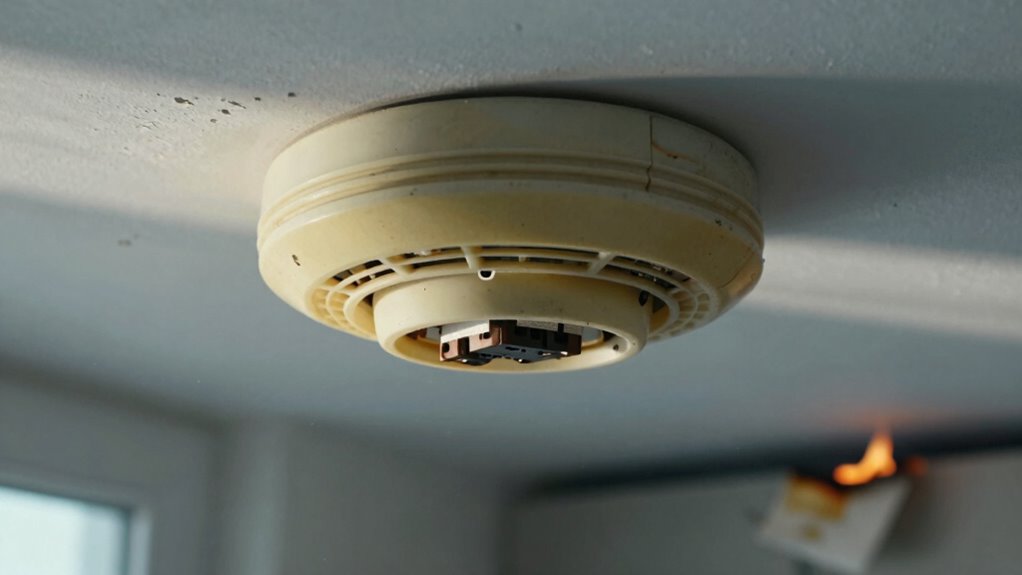
What should you do first when a smoke detector fails? You’ll want to confirm the failure quickly and safely: check the unit for flashing lights or error codes, listen for chirps, and verify power connections.
If battery-powered, replace the battery and test; if hardwired, confirm circuit power and inspect the backup battery. Document the failure time and conditions for your records.
Next, isolate the area—use portable alarms or continuous visual monitoring while you implement emergency plans and notify occupants. Schedule a replacement or professional repair immediately; don’t rely on intermittent function.
Add the incident to your maintenance log and adjust timelines for regular inspections to prevent recurrence. If multiple detectors fail or you detect smoke, execute evacuation protocols and call emergency services.
Finally, review causes after resolution: environmental factors, age, or wiring faults, and update training and procedures so your household or facility maintains reliable early warning without delay.
Detector Type and Sensing Limits
1 key factor in detector reliability is matching detector type to the fire risks and sensing limits of the space: ionization detectors respond best to fast-flaming fires with small combustion particles, photoelectric units detect the larger particles typical of smoldering fires, and specialized models—like heat, multi-criteria, or aspiration systems—cover scenarios where smoke sensing alone won’t suffice.
You should evaluate fire dynamics in the environment and select sensors accordingly; ionization sensors offer rapid response to rapid-fire growth, while photoelectric sensors reduce nuisance alarms from cooking and detect slow, smoldering ignitions.
Consider environmental influences—dust, humidity, airflow—that degrade sensor sensitivity or create false positives. Use technology advancements, like adjustable alarm thresholds and multi-criteria fusion, to tune detection to realistic risk profiles.
Finally, factor detector placement into system design to guarantee sampled air reflects likely smoke paths, and set alarm thresholds based on risk tolerance, not factory defaults, so alerts occur early enough without constant nuisance trips.
Smoke Detector Placement Mistakes to Avoid
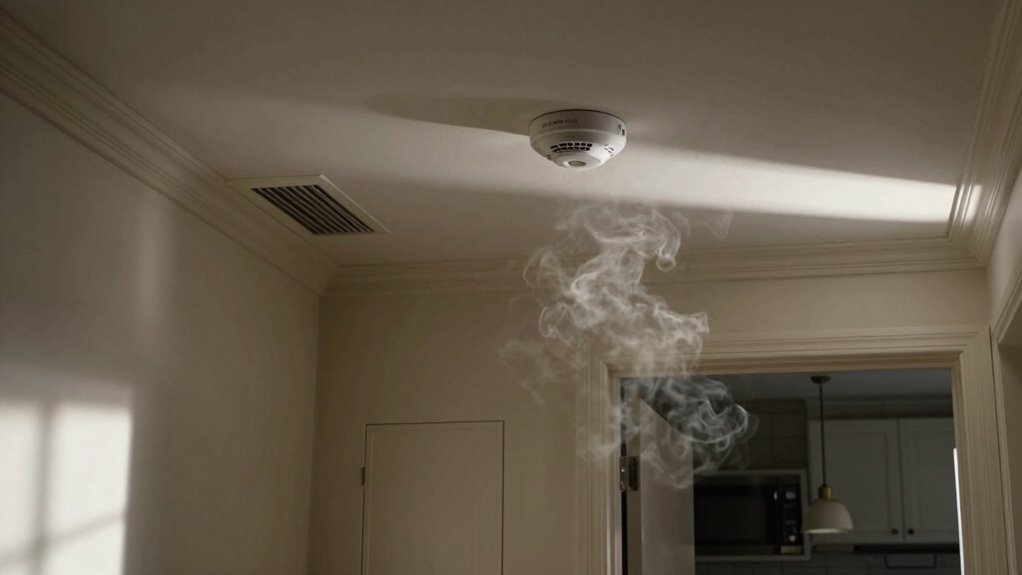
You’ll want to avoid common placement mistakes that compromise detection: mounting detectors only on ceilings can miss smoke in upper-level stairwells, while placing them too close to air vents can prevent smoke from reaching the sensor.
Also make sure detectors aren’t located far from sleeping areas—response time matters most at night. I’ll outline practical placement corrections and spacing guidelines next.
Ceiling Mounting Only
Ceiling-only mounting is a common shortcut that can compromise detection because it assumes smoke will always rise evenly and reach a single overhead sensor.
You should evaluate ceiling heights and installation angles when planning coverage: high or vaulted ceilings delay smoke reaching a single detector, while steep angles can create dead zones.
Don’t rely on one ceiling unit in large rooms, multi-level spaces, or where obstructions (beams, tall furniture) alter airflow.
Position additional detectors on walls or lower ceilings where permitted by code to intercept stratified smoke layers and smoldering fires that pool below the ceiling.
Use manufacturer guidance to set mounting distances and test placement with smoke cans or detectors’ built-in sensitivity checks.
Regular reassessment after layout changes keeps detection effective.
Near Air Vents
If you’ve corrected ceiling-only blind spots, don’t swap them for another common error: mounting smoke detectors too close to air vents, returns, or HVAC outlets.
You’ll want to assess how air flow from vents can dilute or divert smoke before it reaches the sensor. Position detectors where disrupted flow won’t push smoke away — typically several feet from supply registers and returns, not directly adjacent.
Consider vent placement relative to likely fire sources and typical circulation patterns; ceiling-mounted detectors near a strong supply can remain oblivious to rising smoke. Use simple tests: simulate smoke movement with incense and observe paths.
When planning placement, prioritize unobstructed detection paths over convenience. Proper spacing from vents improves response time and reduces false negatives without compromising system accessibility.
Too Far From Bedrooms
Because most fatal home fires happen at night while people are asleep, putting detectors too far from bedrooms creates a dangerous delay in alerting those who need it most.
You should assess bedroom distance quantitatively: measure hall lengths and note intervening doors or walls that can slow smoke travel. Detector effectiveness drops considerably when units are sited only in living areas or basements; you need at least one on every level and one within hearing range of each sleeping area.
Mount detectors on ceilings or high on walls outside bedroom doors, following manufacturer spacing limits. Test alarm audibility in each bedroom and simulate closed-door conditions.
Replace units older than ten years and maintain batteries. Prioritize placement that minimizes detection lag to maximize escape time.
How Smoldering vs. Flaming Fires Trigger Alarms Differently
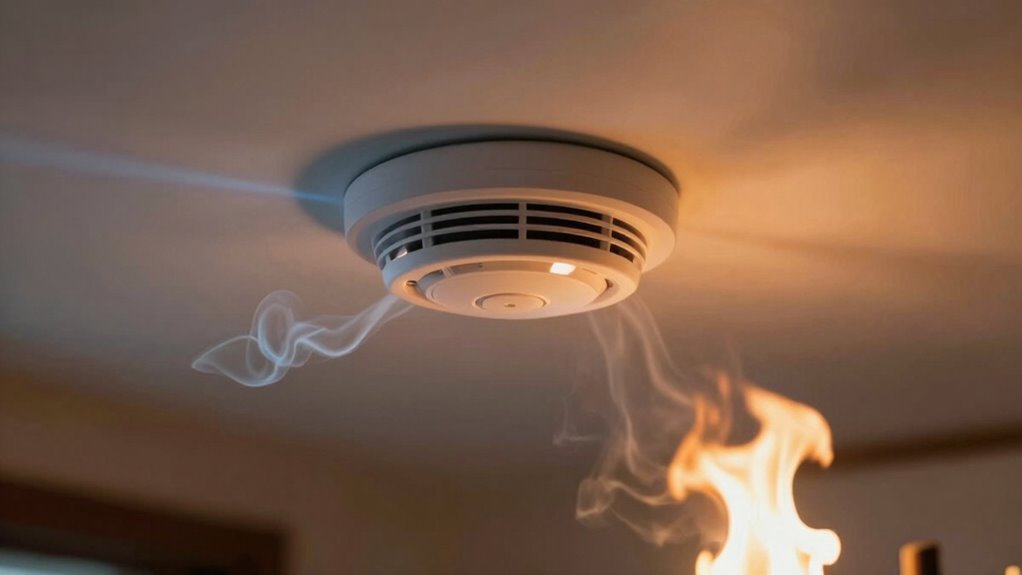
When smoke develops slowly from a smoldering fire, it produces a high concentration of small, oily particles and chemical vapors that are detected differently than the large, incandescent particles and heat produced by flaming fires.
You need to understand that ionization and photoelectric sensors respond to different signatures: photoelectric units react faster to the dense, opaque particulate typical of smoldering fires, while ionization alarms can be quicker with the smaller, more electrically charged aerosols of some flaming fires.
You should place detectors where each sensor type performs best—photoelectric near sleeping areas and upholstered furniture, ionization where fast-flaming kitchen hazards might occur, or use dual-sensor models.
Don’t assume one alarm covers every scenario; test and maintain them so sensing elements and chambers remain unobstructed.
How Dust, Humidity and Household Habits Hide Smoke
Although you rarely notice it day to day, dust, high humidity and common household habits can all mask or mimic smoke and considerably reduce a detector’s effectiveness.
You need to understand how dust accumulation inside sensing chambers physically blocks optical paths in photoelectric units and coats ionization plates, lowering sensitivity.
High humidity alters particle behavior: water droplets bind with combustion aerosols, changing scattering characteristics and reducing alarm thresholds, while persistent elevated humidity levels can trigger nuisance alerts or sensor desensitization over time.
High humidity changes how smoke particles scatter light, lowering detector sensitivity and causing false alarms or long-term desensitization.
Everyday activities—cooking steam, shower steam, candle smoke and aerosol sprays—create transient aerosols that either swamp detectors with non-hazardous particulates or condition sensors to ignore similar signatures.
Placement choices, like installing detectors near kitchens or bathrooms, amplify these effects by increasing exposure frequency.
To assess risk practically, observe local humidity levels and visible dust accumulation trends and note how routine activities correlate with false alarms or silence.
That data helps you judge whether a detector’s signal reflects real danger or environmental interference.
Smoke Detector Maintenance, Testing and Upgrade Checklist
If you want your smoke detectors to actually protect you, follow a concise, repeatable maintenance and testing routine that targets common failure modes and prioritizes upgrades where needed.
Begin by documenting all units’ locations and models; note manufacture dates to track smoke detector lifespan. Test each device monthly using the built-in button and a handheld smoke test canister quarterly to verify sensor response, not just the alarm tone.
Replace batteries annually unless units use 10-year sealed cells; log every battery replacement with date and type. Clean detectors every six months: vacuum vents gently and wipe housings to reduce dust and insect ingress.
Inspect mounting, wiring, and interconnects for corrosion or loose connections; tighten or replace components as needed. Upgrade ionization-only units near kitchens to dual-sensor or photoelectric models for better detection of smoldering fires and follow manufacturer end-of-life guidance, replacing detectors typically every 10 years to maintain reliable protection.
Frequently Asked Questions
Can Smoke Detectors Be Hacked or Disabled Remotely?
A hacker remotely disabled a smart alarm during a staged break-in; yes, you can be targeted via remote access that allows alarm tampering. You’ll need strong passwords, firmware updates, network segmentation, and monitoring to reduce risk.
Do Pets or Insects Commonly Trigger False Alarms?
Yes — pets or insects can trigger false alarms. You’ll find pet reactions (barking, scratching) stir detectors, and insect interference (nesting, crawling) fools sensors; inspect, clean, and reposition units to reduce such nuisance activations.
Are There Smart Detectors That Differentiate Cooking From Real Fires?
Yes — you can get smart technology fire detection that’s tuned to reduce cooking false alarms; it combines multi-sensor inputs, algorithms and learning, so you’ll get practical, analytical decision-making distinguishing benign smoke from real, hazardous fires.
How Do Building Materials Affect Early Smoke Detection?
Building materials affect early smoke detection because you’ll see different fire chemistry and particle output; low-density materials smolder and produce fine smoke quickly, while high-density materials char, delaying detectable smoke and altering alarm response.
Can Paint or Renovations Interfere With Alarm Sensitivity?
Like a sieve clogged with flour, you’ll find paint interference and renovation dust can reduce sensitivity; you’ll need careful cleaning, sealed detector during painting, and possibly relocating or replacing sensors to preserve reliable early detection and meet code.