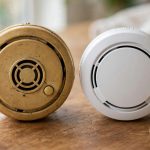
You’ll notice that the choice between heat and smoke detectors can mean the difference between an early alert and a missed hazard. You need detectors matched to the fire type and environment, since smoke sensors pick up smoldering particles while heat units respond to temperature changes or rapid rises. Knowing how each detects, where each performs best, and how they’re combined will let you design a far more reliable system—keep going to see the specifics.
Quick Decision Guide: Smoke vs Heat Detectors

Wondering whether to install smoke or heat detectors? You’ll weigh application, environment, and compliance.
For living spaces and escape-route protection, smoke detection technologies (ionization and photoelectric) provide early warning of combustion products; they’re preferred where occupants need rapid notification.
In harsh, dusty, or high-velocity-ventilation areas—garages, kitchens, attics—heat detectors resist nuisance alarms and meet safety regulations requiring thermal sensing in those locations. Choose fixed-temperature or rate-of-rise heat detectors based on expected thermal profiles and response time needs.
Integrate detectors with building systems so control panels, power supplies, and placement follow codes and manufacturer specifications.
Ensure detectors tie into building systems—control panels, power, and placement must comply with codes and manufacturer specs.
Mixed installations — smoke for habitable areas, heat for adverse environments — optimize coverage while maintaining compliance.
Testability, maintenance access, and documented conformity to local safety regulations are decisive. You should map detector type to fire hazard, environmental factors, and regulatory requirements to guarantee effective, code-compliant detection.
Which Warns First: Smoke or Heat in Flaming vs Smoldering Fires?
Which detector alerts you first depends on the fire mode: smoke detectors typically respond earlier to smoldering fires that produce large volumes of particulate and combustion products, while heat detectors usually trigger sooner during fast-developing flaming fires that rapidly raise ambient temperature.
You should expect smoke detection to provide earlier warning when a fire progresses slowly within upholstery, insulation, or concealed spaces; these smoldering fires emit sustained aerosol and gaseous byproducts that activate smoke sensors before temperature rise is significant.
Conversely, when ignition produces open flame—flaming fires—radiant and convective heat elevates local air temperature quickly, causing fixed- or rate-of-rise heat detectors to operate prior to substantial smoke accumulation.
Your selection and placement should reflect likely fire modes and detection objectives: life-safety favors early smoke detection for smoldering scenarios, while property-protection and false-alarm resistance may justify heat detection in areas prone to dust, steam, or combustion sources where flaming fires present the dominant hazard.
How Smoke Detectors Work: Ionization vs Photoelectric

Knowing whether smoke or heat will alert you first depends on detector type as well as fire behavior, so it’s useful to understand how the two primary smoke-sensing technologies operate.
You’ll encounter ionization detectors and photoelectric detectors; each senses different particle characteristics. Ionization detectors contain a small radioactive source that ionizes air between electrodes; combustion-generated ions change the current, triggering an alarm rapidly in fast-flaming fires that produce many small particles.
Photoelectric detectors use a light source and a photodiode arranged so that smoke scattering into the chamber redirects light onto the sensor; they respond well to larger particles from smoldering fires and layered combustions.
You should choose based on expected fire modes and installation location: ionization for rapid-flash risks, photoelectric for smolder-prone environments. Many modern systems combine both technologies or use dual-sensor units to reduce detection gaps.
Maintain and test detectors per manufacturer guidance to preserve sensitivity and reliability.
How Heat Detectors Work: Rate-of-Rise vs Fixed-Temperature
While smoke detectors sense combustion byproducts, heat detectors monitor temperature changes and trigger when heat reaches a preset threshold or rises rapidly; they’re designed for environments where smoke alarms would nuisance-trigger or be ineffective.
You’ll choose between two basic heat response mechanisms: fixed-temperature and rate-of-rise.
- Fixed-temperature detectors activate when ambient temperature crosses a specified set point; they’re simple, predictable, and suited to stable environments where heat builds steadily.
- Rate-of-rise detectors sense rapid temperature change over time—typically a rise of 12–15°F (6–8°C) per minute—and trigger before absolute thresholds are met, useful for fast-developing fires.
- Many systems combine both modes to cover slow smoldering and fast-flash scenarios, reducing single-mode blind spots.
- You must account for environmental influences—ventilation, thermal inertia, radiant heat, and ambient temperature extremes—which can alter response time and may require detector selection, placement, or calibration to maintain reliable performance.
Where Smoke Detectors Work Best : And Common False-Alarm Causes
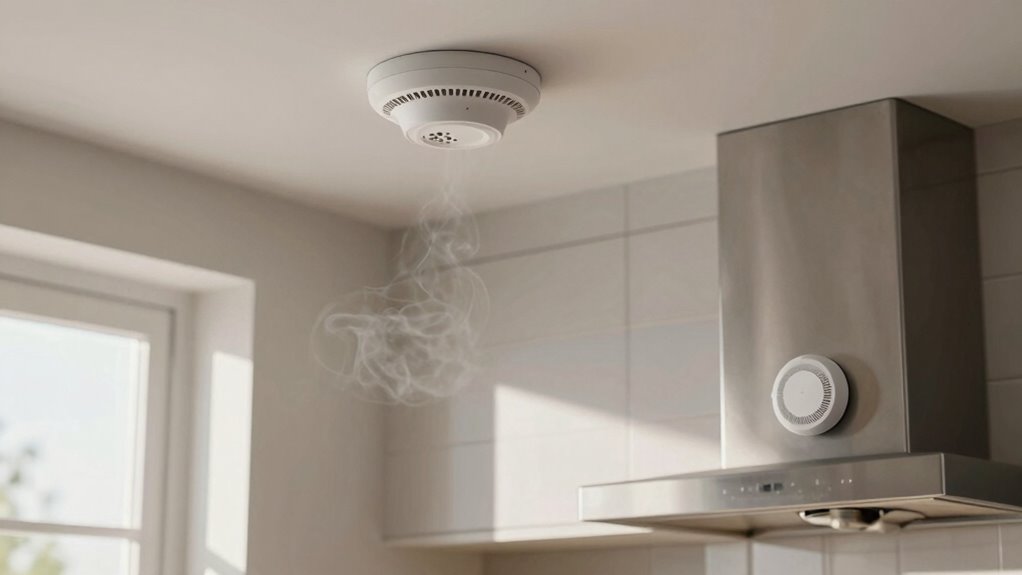
You’ll find photoelectric and ionization smoke detectors are ideal for homes, offering fast, reliable detection of smoldering and flaming fires with minimal installation complexity.
In commercial and industrial settings you’ll need engineered smoke-detection systems—zoned addressable units, aspirating detectors, and integrated alarms—that match enclosure size, airflow, and regulatory requirements.
Expect most false alarms to come from steam, cooking aerosols, dust, and improper placement or maintenance, so specify detector type and siting to minimize nuisance trips.
Home Use Advantages
Because smoke detectors respond to combustion products rather than temperature, they’re the preferred choice for most living spaces — bedrooms, hallways, living rooms and kitchens (with proper placement away from cooking sources).
You’ll benefit from their sensitivity to early fire signatures, enhancing home safety and minimizing escape time. They offer superior device reliability for typical residential scenarios compared with heat detectors that trigger later.
- Early detection: senses smoke particles before thermal rise, giving you more reaction time.
- Distributed coverage: affordable, easy installation in multiple rooms increases overall protection.
- False-alarm management: photoelectric models reduce nuisance alarms from cooking or steam.
- Maintenance: simple battery and sensor checks keep performance predictable and auditable.
Use smoke detectors as primary residential protection; reserve heat detectors for specialized zones.
Commercial And Industrial Fit
If a commercial or industrial space has open ceilings, high ceilings, significant airflow, or processes that produce heat but not early smoke, smoke detectors are best suited for most occupant-occupied areas because they detect combustion products well before a thermal rise; they’ll provide early warning in offices, corridors, showrooms and retail floors where smoldering fires or slow-developing smokes are the primary risk.
In commercial applications you’ll rely on photoelectric or aspirating systems for sensitive coverage, especially where occupants require prompt evacuation.
In industrial environments, integrate smoke detection with ventilation control and zoned notification to avoid response delays.
You should locate detectors to avoid drafts and process emissions, follow regulatory spacing, and combine detection types where particulate or high-heat risks coexist.
Common False Alarm Causes
1 key challenge with smoke detection in commercial and industrial spaces is minimizing false alarms while preserving sensitivity; understanding common causes helps you balance detection performance against nuisance triggers.
You’ll assess these typical sources so you can tune systems, choose sensor types, and implement mitigations.
- Environmental particulates: dust, fibers, and steam increase scattering and trigger false alarms; regular cleaning and selecting appropriate sensor technology reduce incidents.
- Aerosols and chemicals: spray operations, fumes, and paint particulates mimic smoke signatures; zone-specific sensor selection and ventilation controls are essential.
- Installation issues: incorrect mounting height, conduit routing, or corroded components produce spurious signals; follow manufacturer specs and commissioning protocols.
- Electrical interference and maintenance lapses: transient faults and expired sensors raise nuisance alarms; enforce testing, firmware updates, and EMI controls.
Where Heat Detectors Are the Better Choice : And Their Limits
You’ll prefer heat detectors in high-temperature or dusty environments where smoke sensors would false-alarm or fail.
You should also factor in maintenance: heat sensors tolerate grime and require less frequent cleaning but need calibration and periodic testing to guarantee threshold accuracy.
Remember their limits — they react to temperature rise, so they won’t provide early warning for smoldering fires.
High-Temperature Environments
When ambient temperatures routinely run high or smoke-producing processes are common, heat detectors outperform smoke detectors by responding to temperature changes rather than airborne particulates. You need to assess high temperature risks and choose devices with appropriate detector sensitivities.
Consider these operational points:
- Fixed-temperature detectors trigger at a set threshold; use where steady high ambient temps exist.
- Rate-of-rise detectors respond to rapid temperature increases; use where transient spikes indicate fire.
- Thermal environments with dust, steam, or combustion byproducts favor heat detection to avoid nuisance alarms.
- Pairing detector type to ceiling height, airflow, and heat sources optimizes detection time and reduces false positives.
You’ll balance sensitivity and environment to maintain reliable, technically sound early warning without overtriggering.
Maintenance And Limitations
Although heat detectors require less frequent cleaning than smoke detectors, they still need regular inspection, calibration, and functional testing to secure reliable operation in harsh or variable environments.
You’ll follow defined maintenance schedules aligned with manufacturer guidance and local codes; these include visual inspection, temperature drift checks, and timed functional tests. Documented records of calibration and replacement dates reduce performance uncertainty.
Know detector limitations: slower response to smoldering or smolder-prone fires, sensitivity to ambient temperature shifts, and potential mechanical degradation in corrosive atmospheres.
Where you choose heat detection for high-temperature or dusty areas, supplement it with complementary systems or address blind spots via zoning strategies.
Implement preventive maintenance and contingency plans to mitigate detector limitations and secure compliant, dependable protection.
Placement, Spacing, and Mounting Rules for Smoke and Heat Detectors
Because detector performance depends on airflow, heat rise, and room geometry, correct placement, spacing, and mounting are critical to reliable smoke and heat detection. You need to control detector positioning and mounting height to guarantee timely detection: smoke detectors belong near ceilings or high on walls where smoke stratifies; heat detectors must be placed where rapid temperature rise reaches them without obstruction.
Consider airflow patterns, obstructions, and ceiling height when selecting locations.
- Mount detectors on ceiling centers for uniform coverage; wall mounting is secondary and requires specified mounting height to capture rising smoke or heat.
- Space detectors per ceiling height and type; high ceilings need closer spacing or beam-type systems.
- Avoid dead-air spaces, corners, and air registers; ducts and fans alter detector sensitivity.
- Use listed mounting hardware and follow manufacturer spacing data; improper mounting voids performance.
Key Codes and Standards That Affect Detector Choice (NFPA, UL)
You’ll need to follow specific NFPA standards—primarily NFPA 72 for detection and notification and NFPA 101 for life safety—to determine whether heat or smoke detectors are required in a given occupancy.
You’ll also need detectors and control equipment that are UL-listed for the intended application to guarantee performance and code acceptance.
Understanding these listings and sections of NFPA will direct your selection and installation practices.
Applicable NFPA Standards
Codes and standards determine which detectors you can specify and where they must be installed, so understanding the relevant NFPA and UL requirements is essential.
You’ll rely on NFPA guidelines to choose heat versus smoke detection, and detector installation must follow chapter-specific rules for coverage, spacing, and environmental suitability.
- NFPA 72: addresses system design, placement, sensitivity, notification appliances, and performance criteria you must meet.
- NFPA 101: life safety code dictates means of egress and detector requirements in occupancies, influencing detector type choices.
- NFPA 13: sprinkler design impacts detector coordination and clearance requirements in protected spaces.
- NFPA 75/90A: data center and HVAC standards prescribe detector locations and false-alarm mitigation for critical environments.
Follow the codes; document compliance during design and inspection.
UL Listings Required
One key element you’ll need to verify when selecting detectors is their UL listing—these listings define tested performance, environmental limits, and application-specific approvals that codes and AHJs rely on.
You must confirm UL certification requirements for the detector type (fixed-temperature, rate-of-rise, or combined) and for the intended environment (hazardous, garage, cooking).
UL testing procedures determine sensitivity, temperature tolerance, false-alarm resistance, and survivability under power-failure and EMI conditions.
Relying on listed products guarantees code compliance with NFPA chapters and simplifies approval by the authority having jurisdiction.
When you compare models, review the specific UL standard referenced, the test reports, and any limitation statements to guarantee the device meets both performance and installation constraints.
How to Combine Smoke and Heat Detectors Safely (Wiring, Zones, Logic)
When combining smoke and heat detectors, plan wiring, zoning, and alarm logic so each device type retains its purpose without creating nuisance signals or masking real hazards; use separate detection zones or prioritized inputs on the control panel, wire detectors to compatible circuits (conventional or addressable) per manufacturer instructions, and implement logic that tolerates transient heat rises while insisting on confirmed smoke conditions for high-sensitivity areas.
- Map wiring configurations: separate detector power loops and supervised signaling conductors; clearly label polarity and end-of-line resistors for conventional circuits or correct node addressing for addressable loops.
- Define zone integration: assign heat and smoke detectors to distinct zones where possible; use cross-zone verification only when required to reduce false alarms and improve event discrimination.
- Specify alarm logic: prioritize smoke for life-safety alerts, allow heat-trigger escalation for equipment-protection scenarios, and implement time/temperature thresholds and debounce algorithms.
- Document commissioning and maintenance procedures, including periodic testing, firmware compatibility checks, and adherence to manufacturer and code requirements.
Recommended Detectors by Scenario: Kitchens, Garages, Attics, Steamy/Dusty Areas
Because environmental conditions change detector performance, you should pick detector types by scenario to avoid nuisance alarms and guarantee early detection where it matters most.
For kitchen safety, use heat detectors (fixed temperature or rate-of-rise) or photoelectric smoke with cooking-delay logic; they’re tolerant of brief particulate and steam but still signal real fire.
For garage installation, choose heat or combination detectors rated for dirty, cold, and drafty spaces; hardwired units with sealed sensing chambers resist exhaust and particulates.
For attic considerations, select high-temperature-rated heat detectors and address ventilation—place detectors away from drafts and follow manufacturer temperature limits to prevent false trips or missed events.
In steamy environments, avoid ionization and sensitive smoke sensors; use thermal detection or photoelectric devices with humidity compensation.
For dusty areas, use sealed or screened detectors, higher alarm thresholds, or heat detection; schedule frequent maintenance and follow environmental ratings (IP/Ingress protection) to maintain reliability and minimize nuisance alarms.
Smoke alarms worth buying
Understanding how smoke detectors work is only half the job — the other half is having reliable units installed. These are proven models that cover the failure modes this article talks about.
- 2-in-1 photoelectric smoke + electrochemical CO sensing
- 10-year sealed battery — no replacements
- Voice alert tells you the danger type and location
- Plug-in design with AA battery backup for outages
- Electrochemical CO sensor with test/hush button
- Loud 85 dB alarm with low-battery warning
Disclosure: as an Amazon Associate, awasc.com earns from qualifying purchases.
Frequently Asked Questions
Can Pets or Dust Buildup Disable Smoke or Heat Detectors Over Time?
Yes — pet interference and dust accumulation can degrade sensors, trigger false alarms, or block sensitivity; you’ll need routine cleaning, proper detector placement away from pets, and periodic testing/replacement to guarantee reliable smoke or heat detection.
Can Detector Type Affect Insurance Premiums or Claims?
By and by, yes — you’ll see insurance assessments vary with detector compliance and type; insurers may lower premiums or deny claims if your system (smoke, heat, or monitored) fails standards, installation, or maintenance.
How Do Environmental Sensors (Co, Gas) Integrate With Detectors?
You’ll integrate CO/gas sensors via compatible modules or panels, ensuring sensor compatibility; expect integration challenges like signal protocols, mounting, calibration and false-alarm logic, but properly configured systems provide unified monitoring, alerts and centralized diagnostics.
Are Wireless Detector Networks Vulnerable to Interference or Hacking?
Sure — here’s your sarcastic wake-up: yes, wireless detector networks can be hacked or suffer interference; you’ll need robust wireless security, firmware updates, encryption, and redundancy to mitigate network vulnerabilities and maintain reliable detection performance.
What Maintenance Schedule and Record-Keeping Do Inspectors Expect?
You’ll follow prescribed maintenance frequency: monthly tests, quarterly inspections, annual full servicing; inspectors want complete inspection records detailing dates, findings, corrective actions, component replacements, technician IDs and signatures, plus retained logs for specified regulatory periods.