Chemical sensors identify airborne substances by utilizing selective interactions between sensor materials and target gas molecules, which induce measurable changes in physical properties such as electrical resistance or optical signals. Key components influencing sensor performance include the sensing element’s material composition, surface morphology, temperature control, and signal transduction mechanisms. These interactions trigger specific responses that correlate with the presence and concentration of gases, but factors like humidity, cross-sensitivity to other compounds, and environmental conditions can affect detection accuracy. This article examines the underlying detection principles, sensor design considerations, and environmental influences that determine the reliability and specificity of chemical gas sensors.
What Are Chemical Sensors and How Do They Work?

Although chemical sensors come in various types, they all function by detecting specific chemical compounds in the air and converting their presence into measurable signals.
When you engage with sensor design, you must consider factors like sensitivity, selectivity, and response time to guarantee accurate detection within the intended environment. Understanding detection limits is vital because it defines the minimum concentration of a chemical that the sensor can reliably identify, granting you precise control over monitoring air quality.
By optimizing materials and transduction methods, sensors translate chemical interactions into electrical, optical, or other signals you can quantify. This process allows you to identify pollutants, toxins, or gases instantly, supporting your autonomy in maintaining a safe environment.
Optimizing materials and transduction transforms chemical interactions into measurable signals, enabling instant pollutant detection and environmental safety.
Your freedom to act depends on how well the sensor distinguishes target compounds amidst complex air mixtures, making rigorous calibration and validation essential.
Ultimately, mastering these technical aspects empowers you to deploy chemical sensors effectively, enhancing your environmental awareness and control.
Chemical Interactions Between Sensor Materials and Gases
The effectiveness of chemical sensors hinges on the specific interactions between sensor materials and target gas molecules. When you use these sensors, you rely on adsorption mechanisms where gas molecules adhere to the sensor surface, initiating measurable changes. These interactions are finely tuned to preserve your freedom of choice in sensing accuracy and responsiveness.
Key processes include:
- Physical adsorption – Gas molecules weakly attach through van der Waals forces, allowing reversible detection ideal for dynamic environments.
- Chemical adsorption – Stronger bonds form via surface reactions, altering electrical or optical properties for selective sensing.
- Catalytic surface reactions – Some sensors exploit catalytic activity to convert gases into detectable products, enhancing specificity and sensitivity.
Understanding these mechanisms helps you appreciate how sensors discriminate gases under varying conditions, ensuring reliable air quality monitoring without compromising your autonomy in environmental control decisions.
Main Types of Chemical Sensors for Air Detection
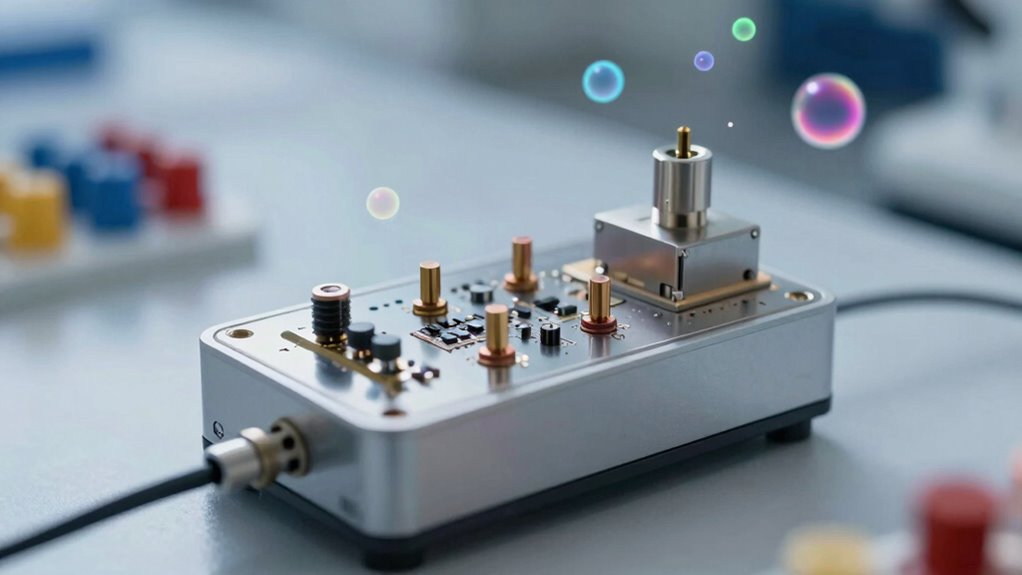
Chemical sensors for air detection come in several main types, each tailored to specific detection principles and target gases.
You’ll encounter electrochemical sensors, which rely on redox reactions between the target gas and electrodes to generate measurable currents.
Metal oxide semiconductor (MOS) sensors detect gases by changes in electrical resistance caused by surface interactions.
Then, there are photoionization detectors (PIDs) that use ultraviolet light to ionize volatile organic compounds, measuring the resulting current.
Infrared (IR) sensors identify gases through absorption of specific IR wavelengths, enabling selective detection.
Each sensor type employs distinct detection methods based on the chemical and physical properties of target substances.
Converting Chemical Reactions Into Electrical Signals
To understand how chemical sensors detect air pollutants, you need to examine the reaction mechanisms that occur at the sensing interface.
These chemical reactions initiate signal transduction processes that convert molecular interactions into measurable electrical outputs.
Interpreting these electrical signals accurately is vital for quantifying pollutant concentrations and ensuring reliable sensor performance.
Reaction Mechanism Basics
Although you mightn’t see it directly, chemical sensors translate specific reactions into measurable electrical signals by exploiting changes in material properties such as conductivity, capacitance, or potential.
Understanding the reaction mechanism basics is key to grasping how these changes occur.
You’ll recognize three fundamental steps:
- Surface Interactions: Target molecules adsorb onto the sensor’s active surface, initiating the reaction.
- Reaction Kinetics: The rates of chemical transformations dictate how quickly sensor properties respond.
- Material Property Alteration: Resulting chemical changes alter electron density or ion mobility, shifting conductivity or potential.
Signal Transduction Processes
Once the chemical reactions alter the sensor’s material properties, these changes must be accurately converted into electrical signals you can measure and analyze. This conversion relies on transduction mechanisms—commonly resistive, capacitive, or electrochemical—that translate physical variations into electrical outputs.
To guarantee reliable detection, signal amplification is essential; it boosts weak signals without distorting the information content, enabling you to discern subtle changes in analyte concentration. Following amplification, data processing algorithms filter noise and linearize sensor responses, preserving signal integrity.
This systematic approach allows you to maintain measurement fidelity while adapting to environmental fluctuations and sensor drift. By mastering signal transduction, you gain precise control over the sensor’s output, empowering you to extract meaningful quantitative data vital for accurate air quality assessment.
Electrical Output Interpretation
While chemical reactions initiate changes in sensor materials, interpreting these electrical outputs demands a systematic approach that translates raw signals into meaningful data.
You’ll need to manage output variability caused by environmental factors and sensor aging to guarantee accuracy. Sensor calibration is essential for converting electrical signals into reliable concentration readings.
Here’s how you can tackle this:
- Signal Conditioning: Amplify and filter the raw electrical output to reduce noise and stabilize the signal.
- Calibration Curves: Use pre-established calibration data to map electrical responses to specific chemical concentrations.
- Data Normalization: Adjust readings to compensate for output variability, ensuring consistent performance across varying conditions.
Common Technologies in Chemical Sensors for Air Detection
When you’re selecting a chemical sensor for air quality monitoring, understanding the common technologies behind these devices is essential.
Chemical sensors typically rely on specific sensing materials—such as metal oxides, polymers, or electrochemical elements—that interact selectively with target gases. These materials form the core of the sensor, enabling precise identification through varied detection methods.
Common detection methods include resistive sensing, where changes in electrical resistance indicate gas presence, and amperometric sensing, which measures current generated by chemical reactions. Optical sensors utilize light absorption or fluorescence changes to detect specific compounds.
Each method offers distinct advantages in sensitivity, response time, and selectivity, affecting your ability to monitor diverse air pollutants effectively. By grasping these technologies’ operational principles, you can better match sensors to your application’s needs, ensuring reliable detection while maintaining flexibility in deployment and freedom from complex calibration requirements.
This technical insight empowers you to make informed choices in air quality assessment.
Key Factors Influencing Chemical Sensor Accuracy

Although chemical sensors have advanced considerably, their accuracy hinges on several vital factors you need to contemplate carefully. To guarantee reliable detection, you must understand how these elements interplay and affect sensor performance.
- Sensor Calibration: Proper calibration is fundamental. Without frequent and precise calibration, sensor readings can drift, leading to inaccurate identification of chemical substances. Calibration aligns sensor output with known standards, maintaining measurement integrity.
- Environmental Factors: Temperature, humidity, and pressure variations influence sensor response. These factors can alter sensor sensitivity and selectivity, causing false positives or negatives. Compensating for environmental conditions is essential for consistent accuracy.
- Sensor Aging and Contamination: Over time, sensors may degrade or accumulate contaminants, impairing their responsiveness. Regular maintenance and timely replacement are vital to preserve sensor functionality and measurement precision.
Chemical Sensor Applications in Environment and Safety
Understanding the factors that influence chemical sensor accuracy lays the groundwork for recognizing their practical applications in environmental monitoring and safety systems.
Grasping accuracy factors is key to unlocking chemical sensors’ role in environmental and safety monitoring.
When you deploy these sensors, you gain precise, real-time data critical for evaluating air quality, detecting hazardous gases, and ensuring compliance with environmental regulations. Their sensitivity enables early detection of pollutants like volatile organic compounds and particulate matter, helping you mitigate health risks promptly.
In industrial settings, chemical sensors provide essential safety by alerting you to toxic leaks or explosive atmospheres, reducing accident potential.
Furthermore, in urban environments, these sensors support continuous air quality evaluations, empowering you to make informed decisions on pollution control strategies.
By integrating chemical sensors into monitoring networks, you establish robust, responsive systems that protect both public health and ecosystems.
Understanding their application helps you leverage sensor technology effectively, enhancing environmental stewardship and workplace safety without compromising your operational freedom.
Future Trends in Chemical Sensors for Air Quality
As air quality concerns grow increasingly complex, you’ll find that future chemical sensors are being designed with enhanced selectivity, sensitivity, and integration capabilities.
These advancements empower you to monitor pollutants with unprecedented accuracy and real-time responsiveness. Key trends shaping this evolution include:
- Advancements in Nanotechnology: Nanomaterials enable sensors to detect trace gas concentrations at molecular levels, dramatically improving sensitivity and enabling miniaturization without sacrificing performance.
- Wireless Sensor Networks: Integration of chemical sensors into wireless networks facilitates distributed, scalable monitoring systems that provide continuous, spatially resolved air quality data, giving you freedom to deploy sensors in diverse environments.
- Multi-Analyte Detection: Future sensors will simultaneously identify multiple pollutants, leveraging advanced algorithms and sensor arrays, allowing thorough air quality assessment without bulky instruments.
Frequently Asked Questions
How Long Do Chemical Sensors Typically Last Before Needing Replacement?
Think of chemical sensors like a marathon runner; their lifetime expectancy typically ranges from 1 to 5 years, depending on usage and environment. Sensor degradation gradually impairs accuracy, so you’ll need timely replacements to maintain freedom in monitoring air quality.
Can Chemical Sensors Detect Multiple Gases Simultaneously?
Yes, you can rely on advanced sensor technology for gas discrimination, enabling detection of multiple gases simultaneously. This precision allows you greater freedom to monitor complex environments efficiently without sacrificing accuracy or responsiveness.
What Maintenance Is Required for Chemical Sensors to Function Properly?
You’ll need regular sensor cleaning to remove contaminants and maintain accuracy. Calibration frequency depends on the sensor type and environment but typically occurs monthly or quarterly to guarantee precise measurements and peak sensor performance.
How Are Chemical Sensors Calibrated for Accurate Readings?
Oh, because sensors just magically perform perfectly, right? You use calibration techniques involving known gas concentrations to adjust sensor performance precisely. This guarantees accuracy, letting you measure freely without second-guessing your data’s reliability.
Are Chemical Sensors Affected by Extreme Weather Conditions?
Yes, extreme weather impacts sensor reliability by altering temperature, humidity, and pressure. You’ll need to account for these variables to maintain accurate readings and guarantee your sensors perform consistently under varying environmental conditions.