When you use a metal detector, it’s not just about finding metal—it’s about identifying what kind of metal lies beneath the surface. This differentiation hinges on subtle variations in how metals respond to electromagnetic fields, influenced by their conductivity and magnetic properties. Understanding these responses can help you interpret signals more effectively, but the process involves complex factors like signal phase shifts and ground interference. Let’s explore how these elements come together to distinguish one metal from another.
How Metal Detectors Use Electromagnetic Fields to Find Metals
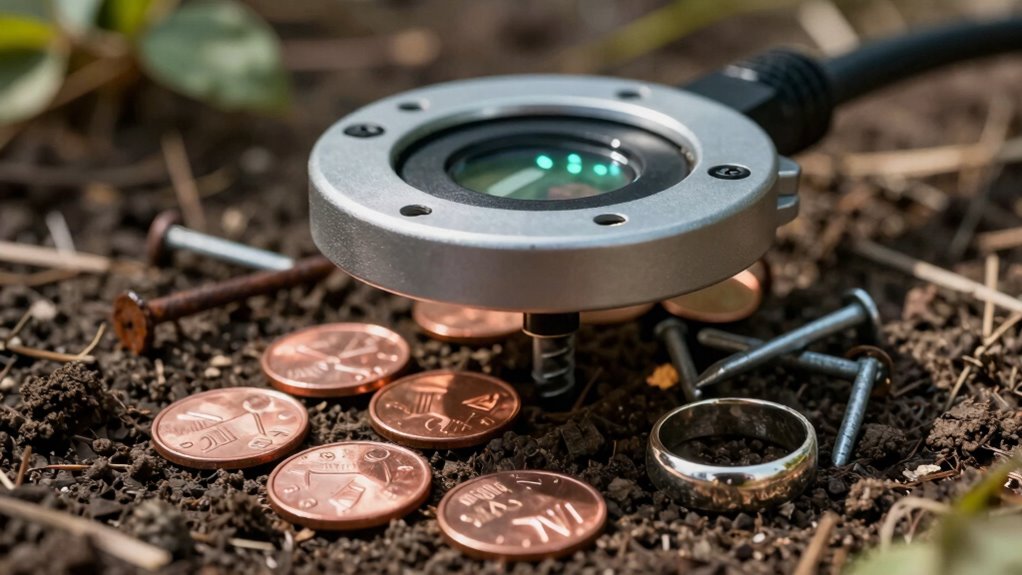
Although you mightn’t see it, metal detectors rely on carefully controlled electromagnetic fields to identify metallic objects beneath the surface. When you activate a metal detector, it generates an alternating electromagnetic field via a transmitting coil. This field induces eddy currents in nearby metal objects, which in turn produce their own secondary electromagnetic fields. The detector’s receiving coil senses these secondary fields, allowing the device to detect the presence of metal.
Understanding electromagnetic principles is essential here: the strength and phase shift of the returned signal vary based on the metal’s conductivity and permeability.
The returned signal’s strength and phase shift reveal a metal’s unique conductivity and permeability.
Frequency modulation plays a pivotal role, as metal detectors often sweep or switch frequencies to analyze these variations. By modulating frequency, the detector can differentiate signals more effectively, improving the detection range and accuracy.
This precise control of electromagnetic fields and frequency modulation forms the foundation for metal detection technology, enabling it to reliably locate hidden metals underground.
How Different Metals Respond Uniquely to Metal Detectors
When metal detectors send electromagnetic fields into the ground, each type of metal responds based on its unique electrical conductivity and magnetic permeability. You’ll notice that metal characteristics directly influence the signal strength and phase shift detected. Detector sensitivity plays an essential role here; it must be finely tuned to differentiate these subtle variations. For example, ferrous metals exhibit strong magnetic responses, while non-ferrous metals rely more on conductivity differences. Understanding these responses enables you to identify metal types more accurately.
| Metal Type | Magnetic Permeability | Typical Detector Response |
|---|---|---|
| Iron | High | Strong magnetic signal |
| Copper | Low | Moderate conductive signal |
| Aluminum | Low | Weak magnetic, moderate conductivity |
| Gold | Low | Weak magnetic, high conductivity |
| Stainless Steel | Variable | Mixed responses, depends on alloy |
This table highlights how metal characteristics impact detector sensitivity and signal interpretation.
How Conductivity Helps Metal Detectors Tell Metals Apart
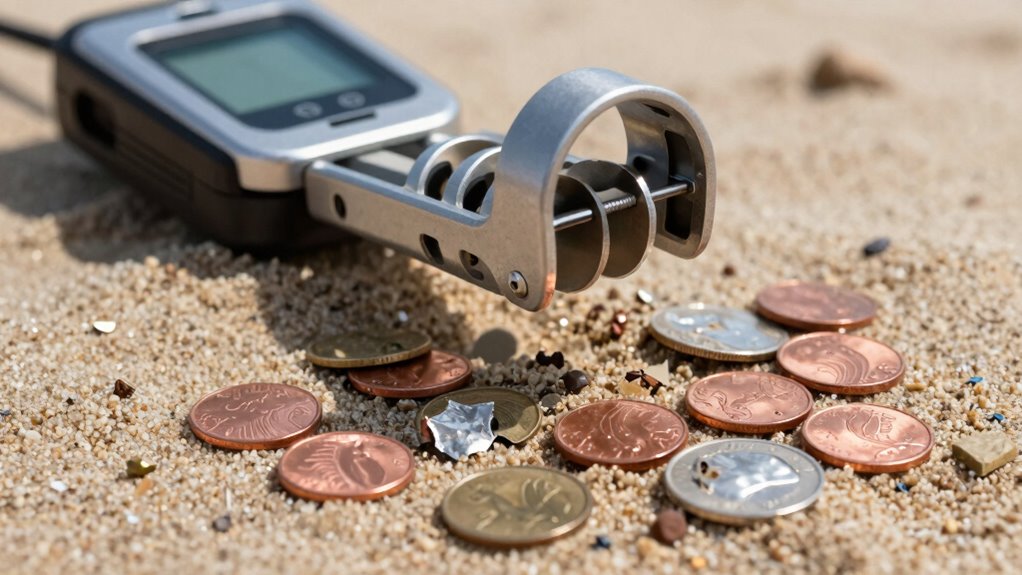
Since electrical conductivity varies considerably among metals, it provides a reliable metric for metal detectors to distinguish one metal from another. When your metal detector emits an electromagnetic field, conductive metals generate secondary eddy currents whose intensity and decay rates depend directly on conductivity variations.
High-conductivity metals like silver and copper induce strong, rapidly decaying signals, whereas lower-conductivity metals such as iron produce weaker, longer-lasting responses. By analyzing these signal characteristics, your detector’s circuitry can categorize the target metal types with notable accuracy.
Metals like silver produce strong, quick signals; iron yields weaker, lasting ones for accurate identification.
Understanding these conductivity variations enables your device to differentiate valuable metals from common trash metals, optimizing detection efficiency. The detector’s discrimination algorithms quantify the response signature, mapping it against known conductivity profiles for various metal types.
Consequently, conductivity serves as a critical parameter, allowing your metal detector not only to identify the presence of metal but also to infer its specific composition, enhancing both target identification and user decision-making in the field.
Why Magnetic Permeability Affects Metal Detectors
Conductivity isn’t the only property metal detectors rely on to distinguish metals; magnetic permeability also plays a significant role. When you operate a metal detector, it emits an electromagnetic field that interacts with the target metal’s magnetic properties. Metals with high permeability, like iron, enhance the detector’s magnetic response due to their ability to concentrate magnetic flux.
This permeability effect alters the induced eddy currents and the secondary magnetic field detected, providing critical data beyond conductivity alone.
You’ll notice that permeability effects influence the phase and amplitude of the received signal, allowing the detector’s circuitry to differentiate metals with similar conductivity but differing magnetic characteristics. Accurately interpreting these variations requires precise calibration of the detector’s discrimination algorithms.
How Metal Detectors Separate Ferrous and Non-Ferrous Metals
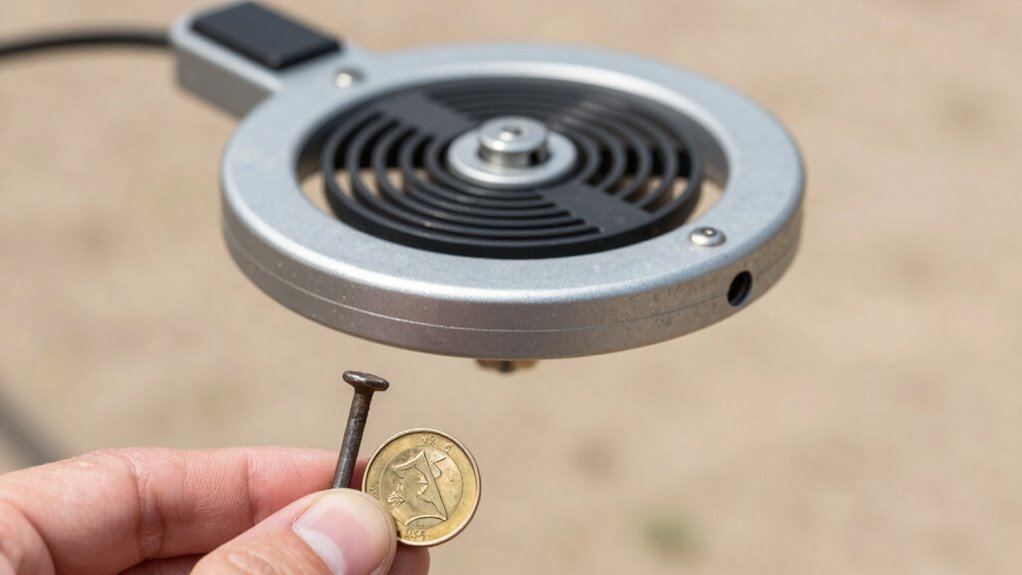
Although ferrous and non-ferrous metals can sometimes exhibit overlapping conductivity values, metal detectors separate them primarily by analyzing magnetic permeability differences.
Ferrous metals, containing iron, have high magnetic permeability, which greatly alters the detector’s electromagnetic field. When you use a metal detector, it senses this distinct magnetic response, allowing it to flag ferrous metals reliably.
Non-ferrous metals, such as copper, aluminum, and gold, exhibit low magnetic permeability but higher electrical conductivity. The detector measures the phase shift and amplitude of induced eddy currents to distinguish these metals from ferrous ones.
By processing signals related to both magnetic permeability and conductivity, the detector categorizes targets accurately. This dual-parameter approach lets you identify whether a buried object is ferrous or non-ferrous, improving target discrimination.
Understanding this separation mechanism helps you interpret detector signals more effectively and enhances your ability to locate specific metal types in diverse environments.
How Pulse Induction Helps Identify Metals
You’ll find that pulse induction works by sending short bursts of current through a coil, generating magnetic fields that induce eddy currents in nearby metals.
By measuring how quickly these induced currents decay, you can assess the metal’s conductivity, which varies between types.
This method provides a reliable way to differentiate metals based on their electromagnetic response.
Pulse Induction Basics
When you use pulse induction (PI) technology, the metal detector sends rapid electromagnetic pulses into the ground and measures the time it takes for the reflected signals to return. This pulse induction operation allows the detector to distinguish metals based on their unique response decay rates. One of the key pulse induction advantages is its ability to function effectively in mineralized soils and saltwater environments, where other methods struggle.
| Feature | Description |
|---|---|
| Pulse Duration | Short, high-energy bursts |
| Signal Reception | Measures decay time of returned pulse |
| Soil Interference | Minimal due to pulse timing |
| Metal Differentiation | Based on decay rate patterns |
Understanding these basics helps you analyze metal types more accurately with PI detectors.
Metal Conductivity Detection
Building on pulse induction’s ability to measure signal decay rates, metal conductivity detection leverages these measurements to identify specific metal types.
When you perform conductivity testing, the metal detector sends a pulse into the target and measures the rate at which the induced eddy currents dissipate.
Different metals exhibit characteristic decay patterns due to their unique electrical conductivities.
By analyzing these decay curves, the detector categorizes metals with greater precision, distinguishing between ferrous and non-ferrous materials as well as alloys.
This metal categorization enhances target identification, reducing false positives and improving retrieval accuracy.
Understanding conductivity testing’s role in pulse induction systems helps you appreciate how metal detectors move beyond simple detection to sophisticated metal classification based on intrinsic electromagnetic properties.
How VLF Technology Distinguishes Metals
With VLF technology, you transmit a continuous low-frequency signal that induces eddy currents in nearby metals.
The detector then measures the metal’s conductivity response to differentiate its type.
To maintain accuracy, you’ll need to adjust ground balance to compensate for mineralization interference.
VLF Signal Transmission
Three key components define how VLF (Very Low Frequency) metal detectors differentiate between metal types: transmitted signal, received response, and phase shift analysis.
When you operate a VLF detector, it emits a continuous vlf frequency modulation signal that penetrates the ground. This transmitted signal’s frequency and vlf signal strength are tightly controlled to optimize detection sensitivity and discrimination.
As the electromagnetic field interacts with subsurface metals, it induces eddy currents, altering the returned signal’s amplitude and phase. Your detector’s receiver captures this response, measuring changes relative to the original transmission.
Importantly, the vlf frequency modulation allows the device to distinguish subtle differences in phase shift caused by varying metal compositions. Consequently, by precisely analyzing transmitted and received signals, VLF systems effectively differentiate metals before conductivity response is assessed.
Metal Conductivity Response
Although phase shift analysis provides initial metal differentiation, the core of VLF technology’s metal discrimination lies in evaluating metal conductivity response.
When you operate a VLF metal detector, it measures the conductivity of a target by analyzing the induced eddy currents generated in the metal. This conductivity measurement is essential because each metal type exhibits a distinct response due to its unique electrical properties.
By precisely quantifying the conductivity, the detector can differentiate between ferrous and non-ferrous metals, as well as identify specific alloys. This metal identification process hinges on how efficiently the metal conducts electricity, influencing the amplitude and decay rate of the secondary signal detected.
Understanding these conductivity-based distinctions enhances your ability to accurately classify buried metals with VLF technology.
Ground Balance Adjustment
Since ground mineralization can interfere with the detection process, adjusting the ground balance is critical when using VLF metal detectors to distinguish metal types accurately.
Ground balance compensates for the natural electromagnetic response of soil minerals, which otherwise can mask or mimic signals from metal targets. You’ll need to apply precise adjustment techniques to calibrate the detector’s circuitry, optimizing sensitivity to target metals while minimizing false signals caused by mineralized ground.
Manual or automatic ground balance methods help isolate the genuine conductivity response by canceling out ground noise. Proper ground balance adjustment guarantees that the detector interprets the induced eddy currents in metal objects correctly, enhancing discrimination capabilities.
Without this adjustment, mineral interference distorts signal phase and amplitude, leading to ambiguous target identification and reduced reliability in metal differentiation.
What Target ID Numbers Really Tell You
Target ID numbers serve as a numerical representation of the conductivity and other electromagnetic properties of detected metals, providing you with a quantifiable way to distinguish between different metal types.
When your metal detector emits a target id, it’s processing the electromagnetic response generated by the buried object. This numeric value reflects the metal’s conductivity, magnetic permeability, and shape, allowing the detector’s circuitry to assign a specific identifier.
Understanding target id is essential for effective metal identification. Higher target id values generally indicate highly conductive metals like copper or aluminum, while lower values correspond to less conductive or ferrous metals.
Higher target ID values usually signify highly conductive metals, while lower values indicate less conductive or ferrous metals.
However, the target id isn’t an absolute measure; it’s influenced by factors such as target size, depth, and orientation, which can shift the reading. By interpreting target id numbers analytically, you can better discriminate between valuable finds and unwanted trash, optimizing your search strategy and minimizing false signals.
Why Gold and Silver Give Different Detector Signals
When you detect gold and silver with a metal detector, the signals they generate differ due to their distinct electromagnetic properties. Understanding these differences is essential for accurate gold detection and silver detection.
Gold, with its lower conductivity and unique magnetic permeability, produces a weaker, higher-frequency signal. Silver, being highly conductive, results in a stronger, lower-frequency response.
Here’s why their signals vary:
- Electrical Conductivity: Silver’s high conductivity induces stronger eddy currents, yielding more robust signals than gold.
- Magnetic Permeability: Gold’s near-nonmagnetic nature contrasts with silver’s slight diamagnetism, affecting signal phase.
- Signal Frequency Response: Gold detection typically involves higher frequency settings to capture subtle signals; silver detection favors lower frequencies.
- Target Size and Shape: Gold nuggets often have irregular shapes influencing signal distortion, whereas silver objects usually produce more uniform signals.
How Soil Mineralization Affects Metal Identification
Although metal detectors rely on electromagnetic signals to identify metals, soil mineralization can considerably complicate this process by introducing background noise and signal distortion.
The soil composition directly impacts the detector’s ability to accurately classify targets because various mineral types—such as iron oxides, magnetite, and other conductive or magnetic compounds—generate electromagnetic interference.
When you operate your detector in highly mineralized soil, these minerals produce their own signals that overlap with those from metal objects, reducing signal-to-noise ratio and causing false readings or masking weaker targets.
Understanding the specific mineral types and their concentrations in your soil helps explain why signal behavior varies across locations.
Knowing your soil’s mineral makeup clarifies why detector signals differ from place to place.
Highly mineralized soils often require advanced ground balancing techniques to neutralize the mineral-induced signals, allowing your detector to better isolate the electromagnetic response from the actual metal target.
Without compensating for soil mineralization, metal identification becomes less reliable, as your detector struggles to distinguish genuine metals from mineral-induced artifacts.
How Discrimination Settings Help Filter Unwanted Metals
You can fine-tune your metal detector’s discrimination settings to selectively identify target metals using built-in Metal ID technology.
By adjusting these levels, you’ll filter out unwanted metals like iron or aluminum, reducing false signals.
This precise control enhances detection efficiency by focusing on specific metal signatures.
Metal ID Technology
Since metal detectors encounter a variety of metals during scans, metal ID technology employs discrimination settings to distinguish and filter unwanted metals effectively.
It relies on advanced metal identification methods and detector signal interpretation to analyze conductivity and phase shift characteristics. This enables the device to categorize metals with precision.
Key components include:
- Signal processing algorithms that interpret electromagnetic responses.
- Conductivity profiling to differentiate ferrous and non-ferrous metals.
- Phase shift analysis to identify unique metal signatures.
- Real-time feedback systems that adjust discrimination thresholds dynamically.
Adjusting Discrimination Levels
Building on metal ID technology, adjusting discrimination levels fine-tunes the detector’s ability to filter out unwanted metals during scans.
You’ll use discrimination techniques to set threshold values, allowing the detector to ignore signals from metals you consider nuisance targets, like iron or aluminum. This process involves analyzing the frequency and amplitude of returned signals, applying signal filtering algorithms to isolate desirable metal signatures.
By calibrating discrimination settings precisely, you minimize false positives and enhance detection efficiency. It’s vital to understand that over-filtering might cause you to miss valuable targets, so balance is key.
Mastering these discrimination techniques guarantees your metal detector focuses only on relevant metals, optimizing performance in diverse environments while reducing signal clutter from undesired metallic objects.
How Multi-Frequency Detectors Improve Metal Differentiation
Although traditional single-frequency metal detectors provide basic metal identification, multi-frequency detectors greatly enhance metal differentiation by simultaneously transmitting multiple frequencies. This approach leverages the multi frequency advantages by analyzing how different metals respond across a spectrum rather than a single point, improving accuracy in metal differentiation techniques.
Multi-frequency detectors improve metal differentiation by analyzing responses across multiple frequencies simultaneously for greater accuracy.
When you use a multi-frequency detector, you benefit from:
- Enhanced target identification through frequency-dependent conductivity analysis.
- Improved discrimination between ferrous and non-ferrous metals based on differential frequency responses.
- Greater sensitivity to small or deeply buried objects due to broader frequency coverage.
- Reduced false positives by cross-referencing signals from multiple frequencies, refining target signals.
Why Ground Balancing Is Key for Accurate Metal Reading
When metal detectors operate in mineralized soil, you need ground balancing to filter out interference caused by naturally occurring minerals.
The ground balance importance lies in its ability to neutralize the soil’s magnetic and conductive properties, which can otherwise produce false signals or mask target responses.
Without proper ground balancing, your detector’s readings become unreliable, as mineral content distorts the electromagnetic field interaction critical for accurate metal identification.
Common Challenges Detecting Gold, Silver, and Iron
Since gold, silver, and iron each have distinct electrical conductivity and magnetic properties, detecting them accurately presents unique challenges for metal detectors.
You’ll face gold detection challenges due to its low conductivity, making signals weak and easily masked by environmental interference effects. Silver detection difficulties arise because of its high conductivity, which can cause signal saturation, complicating precise identification. Iron detection issues are linked to its strong magnetic properties, often triggering false positives or signal distortion.
Additionally, metal detector limitations, such as sensitivity thresholds and discrimination algorithms, further complicate accurate differentiation.
Key challenges include:
- Variability in target depth variances affecting signal strength and clarity.
- Environmental interference effects from mineralized soils and electromagnetic noise.
- Overlapping signal responses from mixed-metal targets.
- Device-specific sensitivity and discrimination constraints limiting detection accuracy.
Understanding these factors helps you anticipate and mitigate detection inaccuracies when searching for gold, silver, and iron.
Tips for Interpreting Metal Detector Signals Accurately
Accurately interpreting metal detector signals requires a clear understanding of how signal characteristics correspond to different metal types and environmental factors. When you analyze signals, focus on the tone, strength, and consistency; these elements provide critical clues about the target’s composition.
Adjusting detector sensitivity is essential—too high, and you risk false positives from mineralized soil; too low, and you may miss subtle signals from valuable metals. Calibrate sensitivity based on terrain and target depth for best results.
Utilize discrimination settings to filter out common iron signals, but be cautious as excessive discrimination can exclude desirable metals. Pay close attention to signal variability during sweep motion; stable signals often indicate solid metal objects, while erratic signals suggest mixed or fragmented metals.
Combining precise signal interpretation with appropriate sensitivity adjustments enables you to distinguish between gold, silver, and iron more reliably, enhancing detection accuracy and reducing unnecessary digs.
Metal detectors worth buying
Curious to test the detection principles in this article yourself? These are the two classic entry points into the hobby — one step up from toy detectors, without the pro price tag.
- Digital target ID (0–99) with iron discrimination
- 5 search modes and 8 sensitivity levels
- Includes headphones, coil cover and environmental cover-up
- 3 modes: All-Metal, Discrimination and Tone
- 8-inch waterproof searchcoil
- Preset ground balance — easy for beginners
Disclosure: as an Amazon Associate, awasc.com earns from qualifying purchases.
Frequently Asked Questions
Can Metal Detectors Identify Alloys or Just Pure Metals?
You can’t expect metal detectors to precisely identify pure metals versus alloys; however, advanced models offer alloy detection by analyzing conductivity and phase shifts, helping you differentiate mixed compositions rather than isolating pure metals exclusively.
How Do Environmental Factors Beyond Soil Affect Metal Detection?
Like a radio tuning into static, temperature variations and electromagnetic interference can disrupt your metal detector’s signal, causing false readings or reduced sensitivity, so you’ll need to adjust settings carefully to maintain accurate detection results.
Are There Metal Detectors Designed Specifically for Underwater Use?
Yes, you’ll find metal detectors specifically engineered with waterproof design and advanced underwater technology, ensuring peak performance and durability underwater, allowing precise detection in submerged environments without compromising sensitivity or functionality.
What Maintenance Is Required to Keep Metal Detectors Accurate?
You’ll need regular battery checks to guarantee consistent power, and precise coil cleaning to avoid signal interference. Additionally, calibrate settings periodically and inspect cables for damage to maintain your metal detector’s accuracy and performance.
Can Metal Detectors Differentiate Between Man-Made and Natural Metals?
You can’t reliably differentiate man-made from natural metal types solely through standard detection techniques, since metal detectors analyze conductivity and magnetic properties, which overlap across sources, requiring additional methods for precise material origin identification.