Metal detectors operate by generating and analyzing electromagnetic fields to identify metallic objects beneath the surface. Key factors influencing their accuracy include soil mineralization, electromagnetic interference, coil design, and device calibration, all of which affect signal interpretation. These environmental and technical variables can produce false signals that resemble genuine metal targets, leading to frustration during searches. This article examines the underlying causes of such false positives, detailing the impact of soil composition, electrical noise, and detector settings on signal reliability.
What Causes False Signals on Metal Detectors?
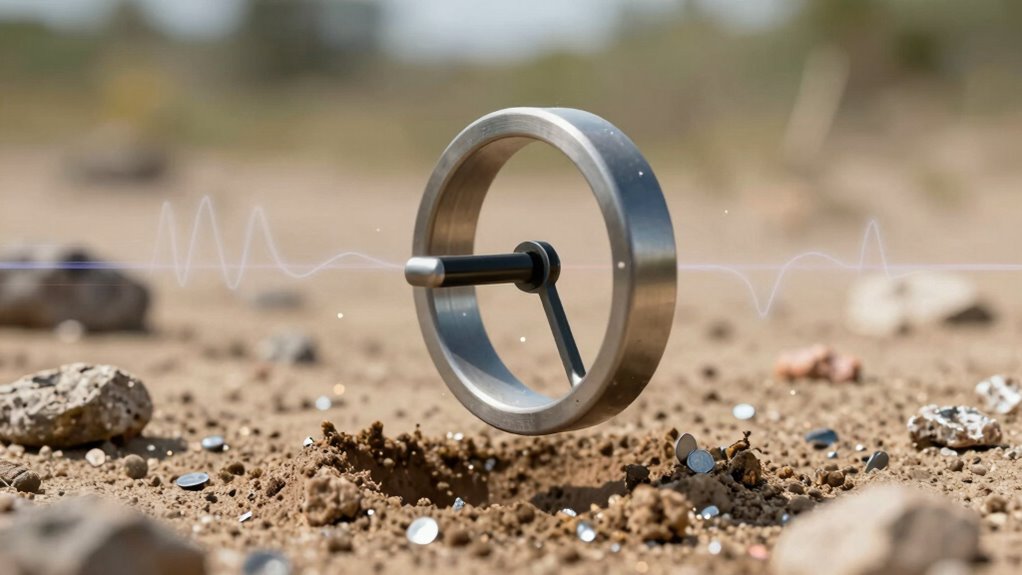
Although metal detectors are designed to identify metallic objects accurately, several factors can cause them to produce false signals. You should recognize that causes of interference, such as electromagnetic fields from nearby power lines or electronic devices, can disrupt the detector’s ability to differentiate between real metal and background noise.
Additionally, certain soil minerals containing iron oxides or salt deposits can mimic metallic signatures, leading to erroneous alerts. Signal processing errors within the detector’s circuitry also play a significant role; when the device misinterprets weak or overlapping signals, it may generate false positives.
Understanding these causes of interference and internal errors helps you maintain realistic expectations about your metal detector’s performance. By recognizing that false signals stem from environmental and technical limitations, you can better troubleshoot and adjust your detector settings to minimize inaccurate readings, preserving your freedom to explore with confidence and precision.
How Metal Detectors Work to Find Metal Objects
When you use a metal detector, it generates an electromagnetic field that interacts with nearby metal objects.
This interaction induces signals that the device detects and processes to determine the presence of metal.
Understanding how the detector interprets these signals helps explain why false positives can occur.
Electromagnetic Field Generation
Because metal detectors rely on detecting changes in electromagnetic fields, understanding how these fields are generated is key to grasping their function. When you activate a metal detector, it produces an electromagnetic field via a coil carrying an alternating current. This field interacts with metallic objects, inducing eddy currents that alter the original field.
Your device senses these changes, but electromagnetic interference from the environment can cause signal distortion, leading to false positives.
Key factors in electromagnetic field generation include:
- The frequency and strength of the transmitted electromagnetic field
- The geometry and orientation of the transmitting coil
- Environmental electromagnetic interference affecting signal clarity
Metal Object Detection Process
Understanding how electromagnetic fields interact with metal objects sets the stage for grasping the detection process itself.
When you sweep a metal detector, its transmitter coil generates an electromagnetic field that penetrates the ground. If metal is present, it disturbs this field, inducing eddy currents that create a secondary magnetic field.
The detector’s receiver coil senses this disturbance, translating it into an electrical signal. The quality of this signal directly impacts detection accuracy and signal clarity, allowing you to distinguish true metal targets from background noise.
Precise calibration and sensitivity settings enhance the detector’s ability to identify metal while minimizing false readings.
Signal Interpretation And Response
Interpreting the signals generated by a metal detector requires careful analysis of the electrical responses produced by the receiver coil.
When you sweep the detector, it picks up variations in electromagnetic fields caused by metal objects. Effective signal analysis is essential for discerning true targets from false positives.
Detection algorithms process these signals, filtering noise and identifying patterns that indicate the presence of metal. Your metal detector’s response depends on:
- The strength and phase shift of the induced signal
- Background electromagnetic interference
- The sophistication of embedded detection algorithms
Environmental Causes of False Signals on Metal Detectors
Although metal detectors are designed to identify metallic objects accurately, various environmental factors can trigger false signals that may confuse users. Environmental interference, such as natural mineral deposits or electromagnetic noise, often distorts the detector’s readings. Soil conductivity plays a significant role; highly conductive soils, like those rich in salts or moisture, can produce erratic signals. Additionally, temperature fluctuations and surface debris impact detection reliability. Understanding these factors helps you interpret signals more effectively and avoid misidentifications.
| Environmental Factor | Effect on Metal Detector |
|---|---|
| Mineralized Soil | Causes erratic signal spikes |
| High Soil Conductivity | Increases false signal frequency |
| Electromagnetic Interference | Distorts signal clarity |
| Temperature Changes | Alters detector sensitivity |
| Surface Debris | Creates inconsistent readings |
How Detector Settings and Sensitivity Affect False Alarms
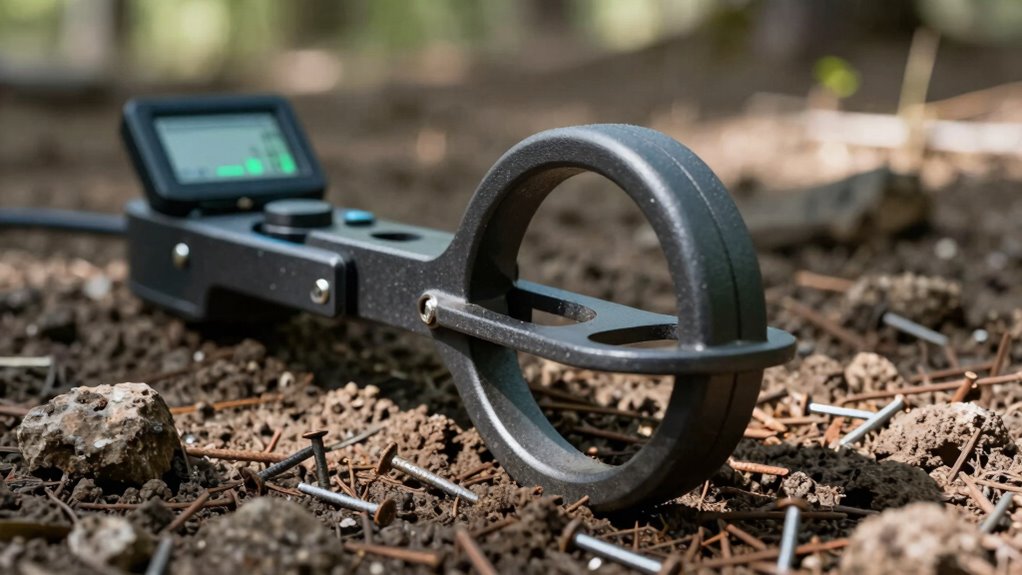
A metal detector’s settings and sensitivity levels play an essential role in determining how often you encounter false alarms. When you adjust the settings too high, the detector becomes overly responsive to minor metal traces or electromagnetic interference, resulting in frequent false positives.
Conversely, setting sensitivity levels too low might cause you to miss valuable targets. Achieving the right balance through careful settings adjustment is vital for reliable detection.
Consider these key factors:
- Sensitivity Levels: Higher sensitivity increases detection range but may amplify noise and false signals.
- Discrimination Settings: Fine-tuning discrimination helps ignore unwanted metals but might exclude some targets.
- Threshold Adjustment: Setting an appropriate audio threshold reduces background noise without missing faint signals.
How Ground Balancing Reduces False Detections
To reduce false detections, you need to understand how ground balancing works and its role in compensating for mineralized soil.
When you adjust the ground balance settings correctly, the detector ignores signals caused by natural minerals.
This calibration improves accuracy by filtering out unwanted noise, helping you focus on genuine targets.
Understanding Ground Balance Basics
When you adjust your metal detector’s ground balance, you calibrate it to ignore the natural minerals in the soil, which often cause false positives.
Ground balance compensates for variations in soil composition, allowing the detector to focus on actual metal targets. Without proper ground balance, mineralized soil can trigger signals that mimic metal objects, leading to wasted time and frustration.
Key points to understand ground balance basics include:
- Differentiating between mineralized soil and metal signals
- Adjusting ground balance to match local soil conditions
- Using manual or automatic ground balance settings effectively
Mastering ground balance gives you the freedom to explore confidently, reducing false detections and improving your metal detecting accuracy in diverse environments.
Effects of Mineralized Soil
Although mineralized soil often triggers false signals, properly adjusting your metal detector’s ground balance can greatly reduce these errors.
The mineral content in soil—iron oxides and other metallic particles—interacts with your detector’s electromagnetic field, producing misleading responses. Soil composition varies widely, affecting how signals are received.
When your detector is calibrated to the specific mineral content of the terrain, it filters out these unwanted disturbances. This calibration prevents the detector from interpreting natural soil elements as metallic objects, considerably lowering false detections.
By understanding and compensating for soil composition, you gain greater control and freedom in your search, ensuring that your device responds accurately to genuine targets rather than environmental noise.
Mastering ground balance is essential to traversing mineralized areas confidently and efficiently.
Adjusting Settings for Accuracy
A metal detector’s accuracy hinges considerably on how well you adjust its settings, particularly ground balance. Ground balancing compensates for mineralization in soil, reducing false signals that mimic metal objects.
Without proper adjustment, mineralized soil triggers constant false positives, wasting your time and energy. Fine-tuning sensitivity adjustments and discrimination settings complements ground balance, sharpening your device’s ability to distinguish valuable metals from clutter.
To optimize accuracy, focus on:
- Calibrating ground balance to match local soil mineral content
- Adjusting sensitivity to avoid detecting deep mineralized pockets as targets
- Setting discrimination to filter out common junk metals without missing valuable finds
Mastering these controls empowers you to explore freely, minimizing distractions and maximizing your detector’s true potential.
How to Tell Real Finds From False Signals
Since metal detectors often pick up signals from various sources, distinguishing real finds from false positives requires careful analysis of the signal’s characteristics.
When you detect a signal, observe its consistency and tone. Real finds usually produce stable, repeatable signals with clear, steady audio tones. False signals, in contrast, tend to be erratic, fluctuating in strength or pitch, often caused by mineralized soil, trash, or electromagnetic interference.
Stable, steady tones usually indicate real finds, while erratic signals often point to false positives.
You should also pay attention to target identification numbers (if your detector provides them); real finds often fall within expected numeric ranges for metals like gold, silver, or iron, whereas false signals may register outside these ranges or jump unpredictably.
Another key is to test the same spot multiple times—consistent responses suggest genuine targets.
When to Repair or Upgrade Your Metal Detector
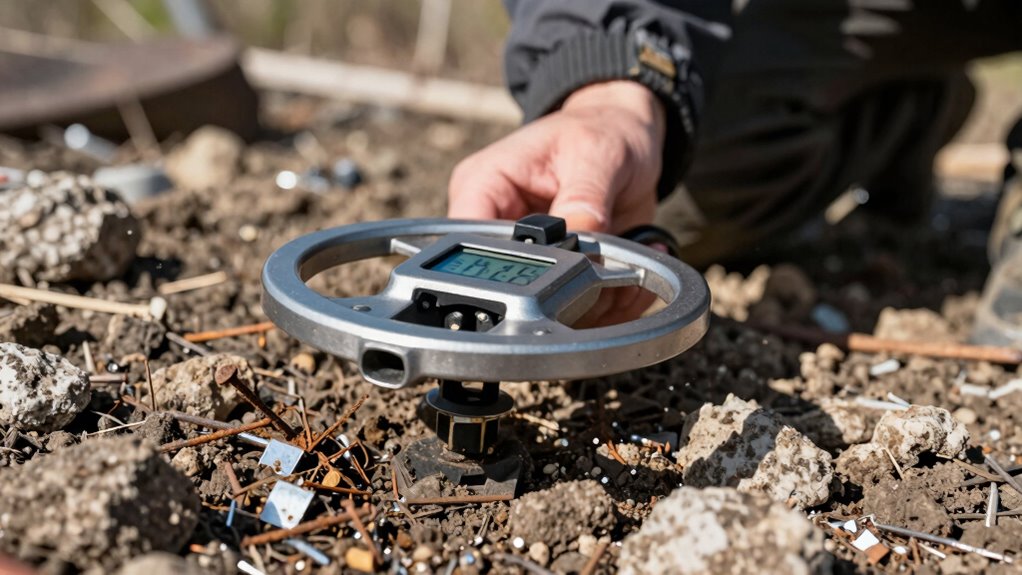
When your metal detector starts giving inconsistent readings or exhibits diminished sensitivity, it’s important to evaluate whether repair or an upgrade is the more practical choice. You want to maintain your freedom to explore without technical frustration, so understanding your repair options versus detector upgrades is essential.
Consider these factors:
- Cost-effectiveness: If repair options are notably cheaper and restore full function, fixing your current detector is sensible.
- Technological advances: Detector upgrades may offer improved discrimination, better ground balance, or wireless connectivity that enhance your detecting experience.
- Frequency of issues: Persistent faults or outdated components suggest investing in a new model might save time and improve reliability.
Preventing False Signals: Best Practices for Metal Detecting
Although false signals can be frustrating, understanding how to minimize them is key to efficient metal detecting. To enhance signal clarity, start by calibrating your detector properly according to the terrain and environmental conditions.
Adjust sensitivity settings to avoid picking up mineralized soil or small trash metals that often cause false positives. Employ discrimination modes selectively; filtering out unwanted metals improves focus on valuable targets.
Regularly ground balance your device to counter the effects of mineral content variations, a common source of misleading signals. Additionally, sweeping the coil slowly and at a consistent height guarantees you don’t miss or misinterpret signals.
Using the right coil size for your search area also contributes to better accuracy. Finally, maintaining your equipment in good condition—cleaning coils and checking connections—prevents technical issues that can mimic false readings.
Following these best practices will help you reduce false signals, allowing your metal detecting to be more productive and rewarding.
Frequently Asked Questions
Can Metal Detectors Detect Non-Metal Objects Like Plastic or Glass?
No, metal detectors can’t detect non-metal objects like plastic or glass because they rely on metal types’ conductivity. However, detector sensitivity might cause false signals if nearby metals create interference, but plastics and glass remain undetectable.
Do Weather Conditions Affect Metal Detector Performance?
Oh, sure, your metal detector’s not just being dramatic—weather conditions cause environmental interference and signal fluctuations. You’ll want to take into account moisture, temperature, and electromagnetic noise since these factors directly affect your device’s performance and your freedom to explore reliably.
Are Some Metal Detectors Better for Beach Detecting?
Yes, some metal detectors excel in beach settings. You’ll want detector types designed for saltwater and wet sand, like pulse induction models, which handle mineralization better, giving you more freedom to explore and find treasures accurately.
Can Metal Detectors Detect Metal Through Water?
Imagine scanning beneath rippling waves—yes, your metal detector can perform underwater detection, but metal conductivity varies with water’s salt content. You’ll need specialized gear to accurately detect metals submerged in water, revealing new treasure-hunting freedom.
How Deep Can a Typical Metal Detector Find Objects?
You can expect a typical metal detector’s detection depth to range from 6 to 12 inches, depending on target size and soil conditions; accurate target identification improves with shallower depths, enhancing your search freedom and efficiency.