Did you know that up to 15% of metallic objects can evade detection by standard metal detectors? This often results from the intrinsic properties of certain metals, such as low magnetic permeability and reduced electrical conductivity, which limit the generation of detectable electromagnetic signals. Understanding why these metals slip through requires a closer look at the interplay between material characteristics and detector technology—a complexity that challenges both users and manufacturers alike.
How Metal Detectors Work to Identify Metals

Although metal detectors come in various designs, they all rely on electromagnetic fields to identify metals. When you pass a metal object near the detector’s coil, it induces eddy currents that alter the magnetic field, which the device then measures to determine the presence and type of metal.
You’ll find that the detector’s transmitter coil generates a primary electromagnetic field, which interacts with conductive materials. The resulting eddy currents produce a secondary magnetic field detected by the receiver coil. This change in the magnetic environment is captured and converted into electrical signals.
The device’s signal processing unit evaluates these electrical signals to differentiate metals based on their conductivity and magnetic permeability. By assessing signal amplitude, phase shift, and frequency response, the processor distinguishes between ferrous and non-ferrous metals with precision.
Understanding this electromagnetic interaction and sophisticated signal processing is key to grasping how metal detectors effectively identify various metals.
Why Some Metals Are Hard to Detect by Metal Detectors
When you consider the principles behind metal detection, it becomes clear why certain metals are more challenging to detect than others. Different metal types respond uniquely to electromagnetic fields generated by detectors, influencing their detectability.
Metals with low magnetic permeability or minimal induced eddy currents often produce signals below typical detection limits, causing them to evade detection. For example, metals like titanium or certain stainless steels exhibit weak responses, making them harder to identify.
Metals such as titanium and some stainless steels often evade detection due to weak electromagnetic responses.
Additionally, the size and shape of the metal object impact whether its signal surpasses these detection limits. Small fragments or thin sheets may generate insufficient electromagnetic disturbance, falling beneath the detector’s threshold.
Understanding these constraints helps explain why some metals effectively “escape” detection. Ultimately, the interplay between metal composition, physical characteristics, and the metal detector’s sensitivity defines the boundary between detectable and undetectable metals, emphasizing the importance of considering metal types and detection limits in practical applications.
How Conductivity Affects Metal Detection Success
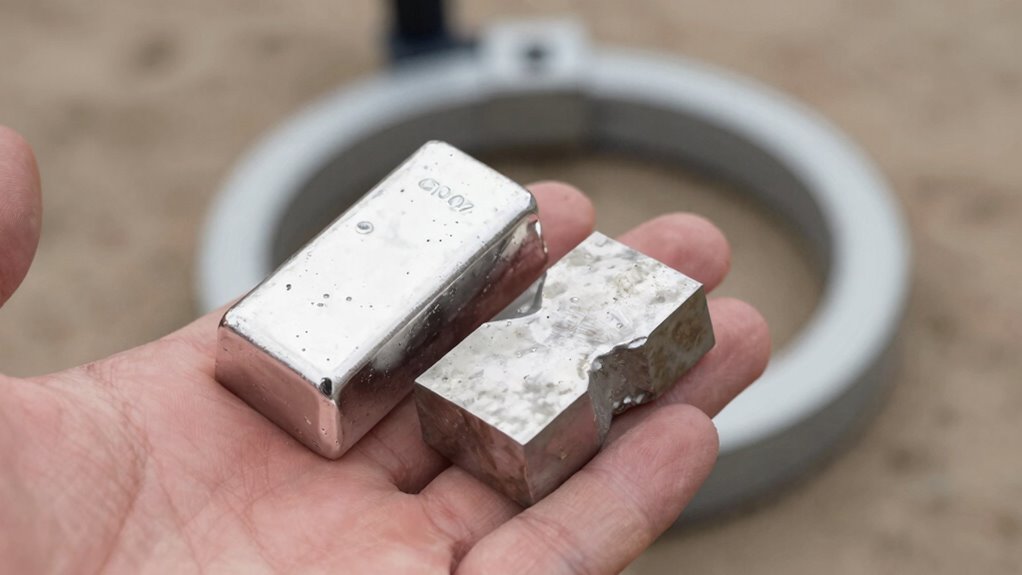
Since metal detectors operate by inducing and measuring electrical currents in metal objects, the conductivity of the metal directly influences detection success. Higher conductivity levels generate stronger eddy currents, resulting in a more robust signal for the detector to recognize. Conversely, metals with low conductivity produce weaker signals, reducing detection efficiency.
You should consider these factors related to conductivity levels:
- High conductivity metals (e.g., copper, silver) yield stronger detection signals.
- Low conductivity metals (e.g., stainless steel) produce weaker responses.
- Detector sensitivity settings must adjust to varying conductivity for ideal detection.
- Depth of the metal affects signal strength, with conductivity impacting penetration.
- Environmental factors (soil mineralization) can mask or amplify signals depending on metal conductivity.
Understanding conductivity’s impact helps you enhance detection parameters and interpret signals more accurately, improving your ability to locate metals effectively.
The Role of Magnetic Properties in Metal Detection
Because metal detectors rely not only on conductivity but also on magnetic properties, understanding how magnetism influences detection is essential.
When you operate a detector, it detects changes in the electromagnetic field caused by a metal’s magnetic susceptibility—the degree to which a material can be magnetized. Ferromagnetic materials, such as iron, exhibit high magnetic susceptibility, making them readily detectable due to their strong interaction with the detector’s magnetic field.
Conversely, non-ferromagnetic metals like aluminum or copper have very low or negligible magnetic susceptibility, which diminishes their response. This means that even if a metal is conductive, its weak magnetic properties can cause your detector to miss it or register a much weaker signal.
How Shape and Size Influence Metal Detector Response
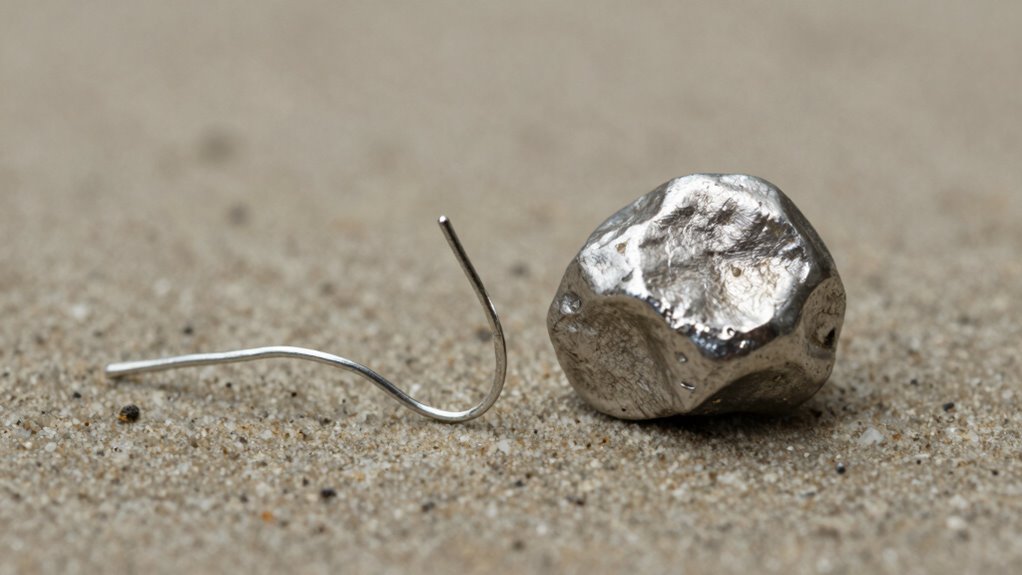
You need to reflect on how an object’s geometry affects the metal detector’s electromagnetic field response, as irregular shapes can produce weaker signals.
Additionally, size plays an essential role since detectors have specific thresholds below which metal objects may go undetected.
Understanding these factors helps explain why certain metals escape detection despite their composition.
Impact Of Object Geometry
Although metal detectors rely primarily on the conductive properties of metals, the geometry of an object—its shape and size—significantly affects the detector’s response.
When you’re scanning, factors like object orientation and surface texture influence the electromagnetic field interaction, altering detection signals. You should consider these geometric aspects:
- Flat, thin objects may produce weaker signals due to minimal disturbance of the magnetic field.
- Curved or rounded shapes can concentrate eddy currents, enhancing detection.
- Sharp edges and irregular surfaces affect the consistency of signal reflection.
- Object orientation relative to the detector coil changes the induced current magnitude.
- Larger surface areas generally yield stronger signals, but shape intricacies can mitigate this effect.
Understanding these parameters helps you predict when geometry causes metals to evade detection despite their conductivity.
Size Thresholds For Detection
When metal objects fall below certain size thresholds, their ability to generate detectable electromagnetic signals diminishes sharply, challenging your detector’s sensitivity limits.
Size limitations directly affect the induced eddy currents that metal detectors rely on to identify targets. As the object’s volume decreases, the resultant secondary magnetic field weakens, making it harder for your device to reach detection thresholds.
Small, thin, or irregularly shaped metals may produce signals indistinguishable from background noise, causing your detector to miss them entirely.
Understanding these size thresholds is essential for interpreting detection results accurately and optimizing your equipment settings.
Environmental Factors Hiding Metals From Detection
Since metal detection relies on electromagnetic signals, various environmental factors can interfere with these signals, making it harder for you to locate metals accurately.
Environmental interference reduces the detector’s ability to differentiate metal targets from background noise, often caused by soil mineralization. High concentrations of iron oxides or salt content in soil create electromagnetic anomalies that mask metal signals. Additionally, fluctuating moisture levels alter soil conductivity, further complicating detection.
Key environmental factors include:
- Soil Mineralization: Elevated metal content in soil minerals generates false signals.
- Moisture Variability: Changes in water content affect electromagnetic conductivity.
- Temperature Fluctuations: Alter detector sensitivity and soil properties.
- Nearby Electrical Sources: Power lines or electronic devices cause signal interference.
- Geological Composition: Certain rock types distort electromagnetic fields.
Understanding these influences helps you anticipate detection challenges and interpret signals more accurately in complex environments.
Techniques to Improve Metal Detection of Hard-to-Spot Metals
To enhance your ability to detect metals that often evade standard scanning methods, employing specialized techniques is essential.
First, integrating advanced detection methods such as multi-frequency metal detectors allows you to differentiate between metals with subtle electromagnetic signatures, including innovative metal alloys designed to minimize detectability. These detectors adjust frequencies dynamically, improving sensitivity to low-conductivity materials.
Additionally, employing pulse induction technology helps counteract environmental interference and detect metals buried deeper or within mineralized soils. You should also consider signal processing algorithms that filter noise and enhance target recognition accuracy. Calibration tailored to the specific electromagnetic properties of innovative metal alloys further optimizes detection performance.
Combining these techniques with data fusion from complementary sensors, such as ground-penetrating radar, can reveal challenging targets otherwise missed. By systematically applying these targeted strategies, you greatly improve your capacity to identify hard-to-spot metals, overcoming limitations inherent in traditional metal detection systems.
Frequently Asked Questions
Can Metal Detectors Differentiate Between Valuable and Non-Valuable Metals?
You can’t rely solely on metal detectors to differentiate valuable metals from non valuable metals; they detect metal presence and conductivity variations, but precise identification requires additional tools like XRF analyzers or chemical assays for accuracy.
Are There Specific Metals That Metal Detectors Are Designed to Ignore?
You’ll find metal detectors often ignore disallowed metals by setting detection thresholds precisely; over 70% of devices filter out low-conductivity metals, ensuring only targeted metals trigger alerts, optimizing accuracy and reducing false positives effectively.
How Does the Depth of a Metal Object Affect Detection Accuracy?
The depth of a metal object directly impacts detection accuracy; as depth increases, the detection range diminishes. Larger object size can partially compensate, but deeper, smaller metals are harder for your detector to accurately locate.
Do Metal Detectors Work Differently Underwater Compared to on Land?
Yes, you’ll find underwater detection differs due to water’s conductivity affecting the metal detector’s electromagnetic field. You’ll need specialized equipment calibrated for metal conductivity variations to guarantee accurate detection beneath the surface.
Can Metal Detector Technology Be Used for Medical or Industrial Purposes?
Yes, you can use medical metal detection for locating implants and industrial applications for quality control. These technologies employ electromagnetic fields to precisely identify metal presence, enhancing safety and efficiency in both sectors.