A smoke detector on the ceiling does not protect the bedroom down the hall. That is the uncomfortable truth behind most home fire-safety plans: people buy the right alarms and then install them in the wrong places, leaving the rooms where they sleep effectively unmonitored. Placement is not decoration — it determines whether the sensor samples the air you breathe or a pocket of stale air nobody occupies.
This guide explains where smoke and carbon monoxide detectors actually belong in a home, and why. You will learn how smoke and CO move through a house differently, the room-by-room rules that fire professionals use, the dead zones to avoid, and how to handle tricky layouts like vaulted ceilings, split-level floors, and long hallways.
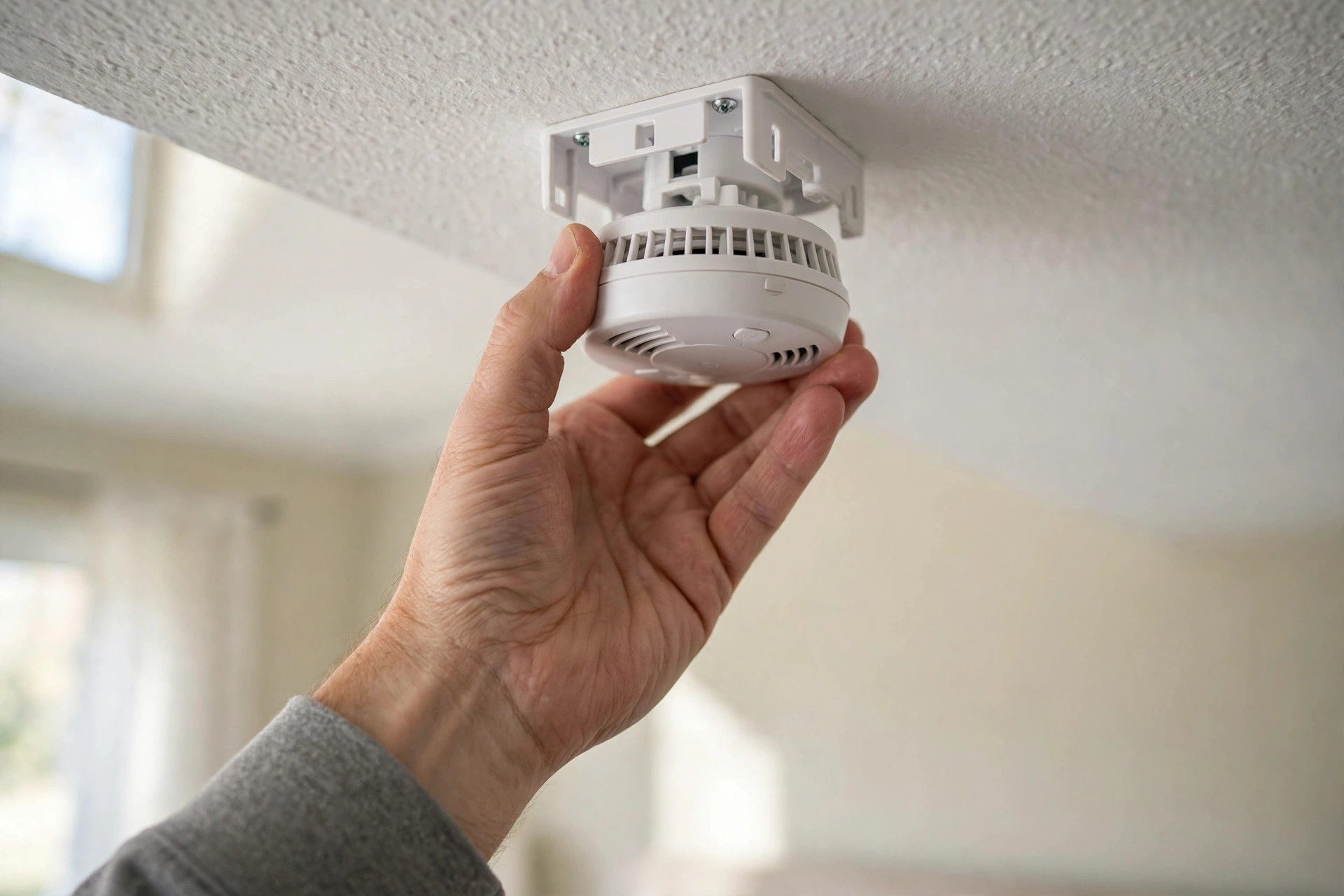
Smoke and CO Move Differently — So They Mount Differently
Smoke rises. Hot combustion gases are buoyant, so smoke climbs to the ceiling, spreads outward, and banks down as the layer deepens. A smoke detector belongs on the ceiling or high on the wall because that is where smoke arrives first — mounting one at chest height can delay detection by minutes, and minutes are the entire margin in a house fire.
Carbon monoxide behaves differently. It diffuses and mixes readily with room air rather than stratifying strongly, so a CO detector works fine on a wall at about eye level or on the ceiling. The old advice to mount CO detectors low “because CO is heavy” is a myth — carbon monoxide is only slightly denser than air, and in practice normal air currents mix it uniformly. What matters for CO is not height but coverage: every level, near every sleeping area.
This difference in behavior is also why combination smoke-and-CO units are mounted like smoke detectors — high on the wall or on the ceiling. The smoke sensor dictates the position, and the CO sensor tolerates it.
The Room-by-Room Rules
Fire professionals follow a simple hierarchy: protect the escape path first, then the places people sleep, then the rest of the house.
Inside every bedroom
Put a smoke alarm inside each bedroom, not just in the hallway outside. Most fatal home fires happen at night, and a closed bedroom door can delay detection by ten minutes or more. A detector inside the room sounds while the air is still breathable, giving you time to react before opening the door.
Outside each sleeping area
Add alarms in the hallway or area immediately outside the bedrooms. If bedrooms sit at opposite ends of the house, each cluster of bedrooms needs its own hallway alarm. One alarm cannot cover two sleeping zones — sound attenuates through walls and closed doors, and the 85-decibel horn that is startling in the same room becomes a muffle two rooms away.
On every level, including the basement
Fire and CO do not respect floor plans. A furnace malfunction in the basement fills the basement first, and a detector on the ground floor may not sample that air for a long time. Every story of the home — basement included — needs at least one smoke alarm and one CO detector.
Kitchens, garages, and bathrooms: handle with care
Do not put a standard smoke alarm in the kitchen — cooking smoke will train you to ignore it, or worse, to disable it. Use a photoelectric alarm at least 10 feet from the cooking appliance, since cooking is one of the most common causes of false smoke alarms. Never install smoke or CO alarms in the garage: exhaust fumes and temperature extremes cause constant nuisance alarms and degrade sensors. Bathrooms are out too — steam triggers smoke alarms and humidity damages CO cells.
Dead Zones: Where Detectors Go Blind
Air does not circulate evenly, and several architectural features create pockets where smoke arrives late or never.
The classic dead zone is the corner where wall meets ceiling. In a standard room, keep ceiling-mounted detectors at least 4 inches from the wall, and wall-mounted units 4 to 12 inches below the ceiling — never tucked tight into the corner where a cushion of still air forms. The same logic applies to blind zones in other sensor types: every detector has geometry it cannot see.
Peaked and vaulted ceilings need special attention. Smoke rises to the highest point and can stratify in the peak, so mount the detector within 3 feet of the peak, measured horizontally — not halfway down the slope where smoke may never reach. For tray or coffered ceilings, place the alarm on the highest surface.
Keep detectors away from supply vents, ceiling fans, and windows. A vent blowing fresh air across a detector dilutes the smoke before the sensor can sample it; a drafty window does the same. The National Fire Protection Association recommends keeping alarms at least 3 feet from any air vent or ceiling fan blade.
Carbon Monoxide Placement: Coverage Beats Precision
Because CO mixes through the air, placement is about coverage rather than exact height. The rules: one CO detector on every level including the basement, and one outside each sleeping area — ideally within 15 feet of bedroom doors so the alarm is audible through a closed door.
Keep CO detectors at least 15 feet from fuel-burning appliances — furnaces, water heaters, fireplaces, stoves — because normal startup can release brief puffs that cause nuisance alarms and teach you to ignore the device. But do not skip the level where the appliance lives; that is where a real leak starts. A detector in the utility room hallway, a reasonable distance from the furnace itself, is the right compromise.
Plug-in CO detectors with battery backup are popular because they solve the power problem — they keep sensing during outages, when generators and alternative heating create the highest CO risk. Just make sure the outlet is not behind heavy furniture that blocks airflow to the sensor vents.

Special Layouts: Split Levels, Long Hallways, and Open Plans
Split-level and multi-story homes confuse the “every level” rule. Treat each half-level difference as its own level: if the living room sits four steps above the entry, that half-flight still separates air masses enough to warrant its own alarm. When in doubt, add the extra unit — detectors are cheap, and redundant coverage only helps.
Long hallways need more than one alarm. Sound and smoke both attenuate with distance, so a hallway longer than about 30 feet deserves an alarm at each end. The same applies to CO: a detector at one end of a long ranch-house hallway may not wake a sleeper at the other end.
Open-plan living areas are actually easier — smoke spreads unobstructed, so one well-placed ceiling alarm covers a large combined kitchen-living space (kept 10+ feet from the cooking zone). The challenge in open plans is audibility in closed bedrooms, which is exactly why interconnected alarms exist: when one sounds, they all sound.
What about stairs?
Stairwells act as chimneys, funneling smoke upward fast. That makes them excellent early-warning locations — an alarm at the top of the stairs often detects a lower-floor fire before any other unit. But do not rely on the stairwell alarm alone for the upper floor’s bedrooms; it protects the escape route, not the sleepers.
Worth buying
The simplest way to cover both threats with fewer devices is a combination smoke-and-CO alarm. The First Alert PC910 10-Year 2-in-1 Photoelectric Smoke Detector with Carbon Monoxide Alarm pairs a photoelectric smoke sensor — the type least prone to cooking nuisance alarms — with an electrochemical CO cell and a sealed 10-year battery, so one ceiling mount covers both hazards per location. If you want every alarm in the house to sound together, the First Alert Battery Powered Z-Wave Smoke Detector & Carbon Monoxide Alarm, 2nd Generation adds wireless interconnect so a basement detection wakes the upstairs bedrooms too.
Disclosure: as an Amazon Associate, awasc.com earns from qualifying purchases.
Frequently Asked Questions
Should smoke detectors go on the wall or the ceiling?
The ceiling is best, at least 4 inches from any wall. If wall mounting, place the alarm 4 to 12 inches below the ceiling — never in the corner where wall meets ceiling, where still air creates a dead zone.
Do carbon monoxide detectors need to be near the floor?
No. CO mixes evenly with room air, so wall mounting at eye level or ceiling mounting both work. Coverage matters far more than height: every level, outside each sleeping area.
How far should a smoke detector be from the kitchen?
At least 10 feet from cooking appliances to reduce nuisance alarms from normal cooking. In or very near the kitchen, a photoelectric alarm or a heat alarm is a better choice than an ionization unit.
Do I need a CO detector if I have no gas appliances?
Yes, if you have an attached garage, a fireplace, or use portable generators or heaters. CO can also enter from a neighbor’s equipment in attached housing. One per level is inexpensive insurance.
Can one combination alarm replace separate smoke and CO detectors?
A listed combination smoke-and-CO alarm protects against both threats from a single location and is fine for most rooms. Just remember it must be mounted like a smoke detector (high on wall or ceiling), and you still need the same room-by-room coverage.