You’ll want to know why your smoke alarm keeps going off when there’s no fire so you can fix it efficiently. Common causes include steam, dust, insects, aerosols, poor placement, low batteries, and wiring faults. I’ll outline quick fixes, maintenance steps, and when to replace or recalibrate sensors so you stop chasing false alerts and restore reliable protection.
Quick Fixes for False Smoke Alarms
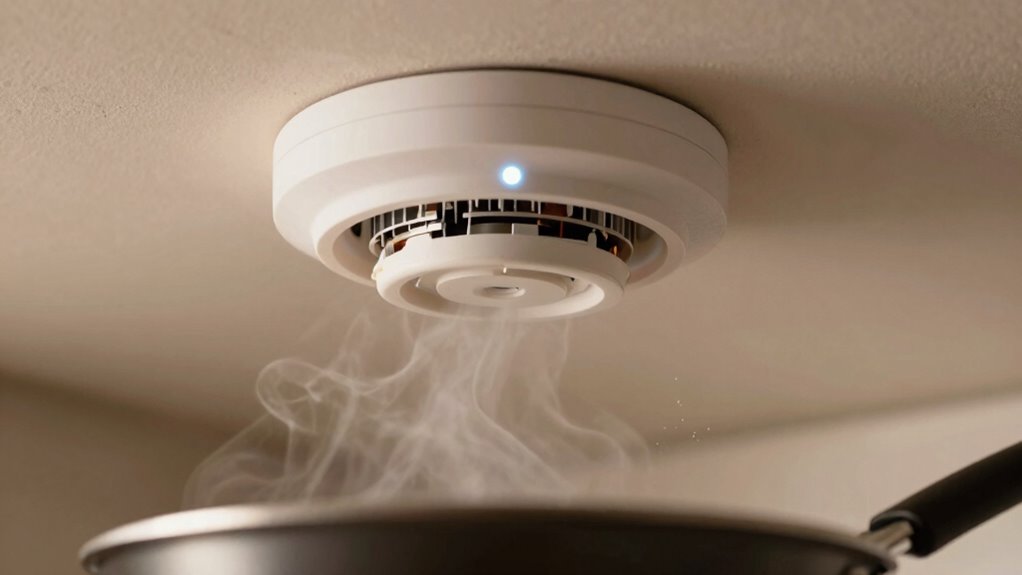
If your smoke alarm keeps sounding when there’s no fire, start with targeted, practical steps you can perform immediately: inspect and clean the unit, replace batteries, and reset the alarm according to manufacturer instructions.
You’ll want to remove dust with compressed air and a soft brush—particles often trigger ionization and optical sensors.
Check placement: avoid mounting too close to bathrooms, HVAC vents, or kitchens where transient aerosols or drafts cause nuisance activations.
If the alarm includes alarm sensitivity adjustments, consult the technical manual to reduce sensitivity within allowed parameters or switch to a different sensor type (photoelectric vs. ionization) better suited to the location.
If possible, lower the alarm’s sensitivity per the manual or choose a photoelectric/ionization model better suited to your space
Verify firmware or smart-alarm settings if applicable, and perform a controlled test after each change.
Maintain a log for smoke detector maintenance—record date, action taken, and test result.
If nuisance alarms persist after these precise interventions, replace the unit to restore reliable operation rather than tolerating recurring false positives.
Cooking Steam, Humidity, and False Alarms
When you cook, steam can enter a detector and scatter light or momentarily change ionization, causing a false alarm.
High ambient humidity can similarly alter sensor response or corrode components, increasing malfunction risk over time.
You’ll need to assess placement, ventilation, and sensor type to mitigate steam-triggered alarms and humidity-induced failures.
Steam Triggered Alarms
How does ordinary cooking steam or high indoor humidity fool your smoke alarm? You’re exposing optical or ionization sensors to airborne droplets that mimic particulates; common steam sources—boiling pots, kettles, hot showers—raise local particle scattering and trigger alarms when alarm sensitivity is high. You should position detectors away from kitchens and bathrooms, use extraction fans, and select models with humidity-compensation.
| Source | Effect |
|---|---|
| Boiling water | Dense steam plume |
| Steaming food | Sustained aerosol |
| Shower | Elevated local RH |
| Dishwasher | Intermittent bursts |
| Slow cooker | Long-duration moisture |
Maintain sensor cleanings, check manufacturer placement guidance, and reduce ambient steam. If false alarms persist, test alternate detector types or adjust sensitivity within spec.
Humidity-Induced Malfunctions
Because humidity changes the optical and electrical environment inside a detector, ordinary cooking steam and high indoor relative humidity can make smoke alarms behave as if there’s combustion present.
You should recognize that condensed droplets scatter light in photoelectric chambers and alter ionic currents in ionization sensors, producing transient signals interpreted as smoke.
Measure local humidity levels and compare them to manufacturer operational ranges; sustained relative humidity above specified thresholds increases false alarm probability.
Implement practical controls: improve ventilation, use range hoods, and position detectors away from kitchens and bathrooms.
For persistent issues, verify sensor calibration and firmware settings—some units allow humidity-compensation adjustments or sensitivity reduction.
If calibration isn’t user-accessible, replace the unit with one rated for high-humidity environments to restore reliable operation.
Dust, Insects, and Dirty Sensors That Trigger Alarms
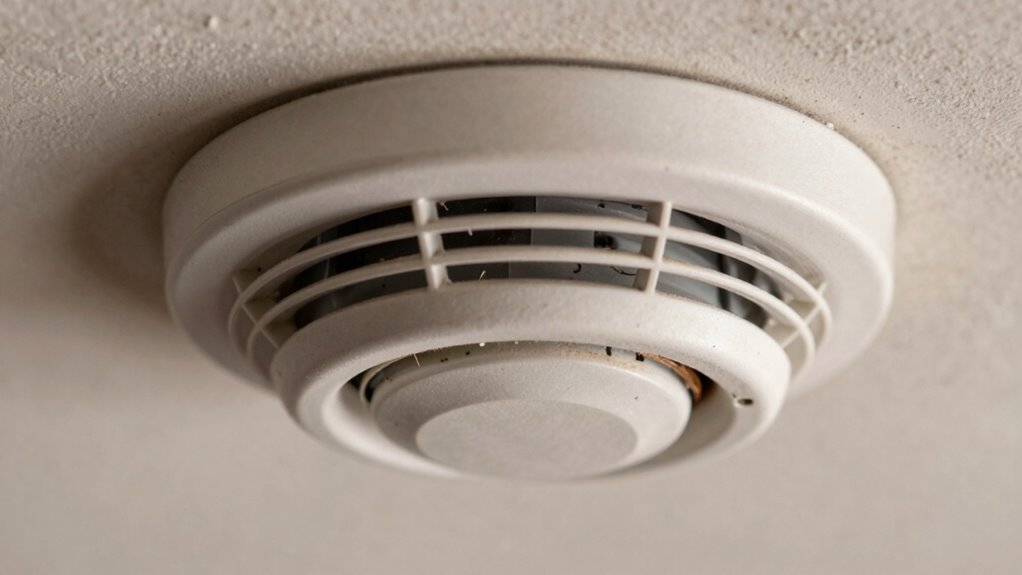
One common cause of false smoke alarms is accumulation of dust, insect debris, or other contaminants on the sensor components, which alters light scattering or ionization paths and triggers the detector.
Dust and insect buildup on sensors can change light scattering or ionization paths, causing false alarms.
You should inspect and clean sensors regularly because dust accumulation degrades optical chamber sensitivity by creating stray particulates that mimic smoke. Insect infestations introduce fragments and excreta into sensing cavities; small bodies can obstruct photodiode fields or deposit conductive material in ionization cells, producing spurious signals.
Use compressed air, soft brushes, and manufacturer-approved cleaning procedures to remove deposits without damaging components. When you open housings, power down the unit to avoid short circuits and note gasket condition—leaks let contaminants reenter.
Maintain surrounding cleanliness: vacuum vents, seal attic penetrations, and fit insect screens. Log cleaning intervals and any recurring false alarms; persistent events after cleaning indicate mechanical wear or contamination in inaccessible locations and warrant sensor replacement per manufacturer specifications.
Batteries, End-of-Life Sensors, and Electrical Faults
Check the battery status first, because low or dead batteries are a common cause of chirps and false alarms.
You’ll also need to replace sensors that have reached their end of life—photoelectric and ionization detectors lose sensitivity and can trigger incorrectly as they age.
Finally, inspect wiring and power connections for loose terminals, voltage irregularities, or shared circuits that can produce intermittent faults.
Low Or Dead Batteries
Batteries are the simplest and most common cause of false alarms: when a smoke detector’s cells weaken or its end-of-life timer reaches expiry, the unit’s circuitry can produce intermittent chirps or full alarms even without smoke.
You should treat low or dead batteries as a primary diagnostic vector: verify battery types (alkaline, lithium, or rechargeable NiMH) and follow battery maintenance schedules to prevent voltage drop and erratic behavior.
- Test voltage with a multimeter before replacing.
- Replace per manufacturer interval, not only when it chirps.
- Use specified battery types to avoid regulator stress.
- Inspect contacts for corrosion or loose springs.
- Record replacement dates to track end-of-life patterns.
Addressing power source issues eliminates many nuisance activations quickly and reliably.
Aging Smoke Sensors
While smoke detectors are designed for reliable long-term operation, their sensing and power systems degrade over time, and you’ll see this as increased false activations or intermittent failures.
You need to understand component aging: particulate chambers, optical emitters/receivers, and internal electronics accumulate dust, corrode, or drift, shortening sensor lifespan.
Replace units per manufacturer end-of-life indications (typically 8–10 years) rather than waiting for failures. For battery-powered models, use fresh cells and check contacts for corrosion.
Maintenance tips: perform quarterly visual inspections, blow out dust with low-pressure air, and test alarms monthly.
Log replacement dates and test results so you can predict end-of-life replacement. If false alarms persist after cleaning and fresh batteries, replace the detector—don’t attempt complex internal repairs.
Wiring And Power Issues
After you’ve ruled out aging sensors and contamination as causes, next look at how the detector is powered and connected: unreliable batteries, expired end-of-life circuits, or faulty house wiring are common sources of intermittent or false alarms.
You should verify battery condition, end-of-life status, and the integrity of wiring connections, since power fluctuations often trigger nuisance activation or reset cycles. Follow a diagnostic sequence: isolate battery versus mains behavior, check the device’s manufacture date, and inspect junctions for loose neutrals or shared circuits that induce voltage transients.
- Replace batteries with fresh, recommended cells and retest behavior.
- Confirm end-of-life indicators; replace detectors past service life.
- Examine wiring connections for corrosion or looseness.
- Measure voltage to detect power fluctuations.
- Avoid multi-device miswiring on shared feeds.
Aerosols, Sprays, and Construction Dust Triggers
Because aerosols and spray mists disperse fine particulates and volatile droplets into the air, they can temporarily raise sensor readings and trigger photoelectric or ionization smoke alarms even when no combustion has occurred.
You should understand aerosol reactions: propellants and solvent droplets scatter light and, in ionization chambers, can alter ion flow, producing transient alarm conditions.
Spray interference occurs when high-concentration bursts—hair spray, deodorant, cleaning sprays—enter the detector cavity or its sensing path.
Construction dust presents a different mechanism: fine cement, drywall, or wood particulates accumulate on sensing elements, degrading thresholds and causing persistent false alarms.
You’ll want to limit activities that generate dense aerosols near detectors and to isolate detectors during renovations.
Routine inspection and targeted cleaning (vacuuming with a soft nozzle, manufacturer-recommended wipes) restore baseline sensitivity.
If false alarms continue despite cleaning and activity control, replace the device or consult the manufacturer to verify sensor integrity and calibration.
Bad Placement, Drafts, and Airflow Problems
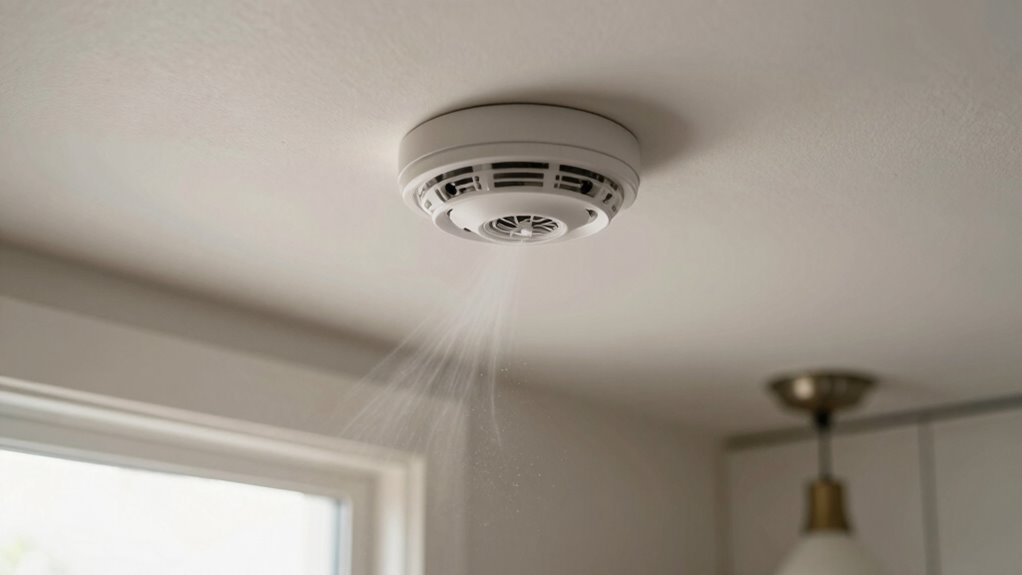
Aerosols and construction dust aren’t the only causes of nuisance alarms; where and how you place detectors and the local airflow around them matter just as much.
You’ll encounter false triggers when sensor positioning puts detectors in turbulent flow, near vents, doors, or stairs where airflow disruption carries particulates or cooking aerosols into the sensing chamber. Ceiling-mounted units near ceiling fans or HVAC returns are especially vulnerable.
- Mounting too close to supply or return vents causes erratic exposure to air parcels.
- Installing near kitchens or bathrooms without consideration of convection leads to transient alarms.
- Placing detectors in dead-air zones delays response, encouraging contamination build-up.
- Positioning adjacent to drafty windows or external doors subjects sensors to outdoor particulates.
- Locating detectors beside ceiling fans or duct elbows increases turbulent mixing and sampling errors.
Assess sensor positioning relative to predictable air patterns; minimizing airflow disruption reduces nuisance events while preserving detection integrity.
Prevent and Troubleshoot False Smoke Alarms
When you’re trying to prevent and troubleshoot false smoke alarms, start with a methodical checklist: verify correct sensor type and placement, eliminate local sources of particulates or steam, confirm proper airflow around the detector, and check power and firmware status.
First, isolate the detector: remove cover, inspect optical chamber or ionization components for dust, insects, or residue; clean with manufacturer-recommended tools.
Second, evaluate environmental factors — cooking aerosols, humidity, construction dust, and HVAC cycles — and mitigate with relocation or barriers.
Third, perform alarm sensitivity adjustments per device specs or via centralized panel; document thresholds and test response with calibrated aerosol testers.
Fourth, confirm power integrity: battery voltage, wiring continuity, and backup.
Fifth, update firmware and log events to identify recurrence patterns.
If alarm persists after these steps, replace the unit and consult manufacturer diagnostics or a certified technician to prevent nuisance activations while maintaining safety compliance.
Smoke alarms worth buying
Understanding how smoke detectors work is only half the job — the other half is having reliable units installed. These are proven models that cover the failure modes this article talks about.
- 2-in-1 photoelectric smoke + electrochemical CO sensing
- 10-year sealed battery — no replacements
- Voice alert tells you the danger type and location
- Plug-in design with AA battery backup for outages
- Electrochemical CO sensor with test/hush button
- Loud 85 dB alarm with low-battery warning
Disclosure: as an Amazon Associate, awasc.com earns from qualifying purchases.
Frequently Asked Questions
How Do Pet Odors Affect Smoke Alarms?
They can trigger alarms—wait—because pet dander drifts into sensors, and odor sensitivity in ionization or photoelectric units alters detection thresholds; you’ll need regular cleaning, filtration, and placement adjustments to prevent false alerts.
Can Scented Candles Trigger False Alarms?
Yes — scented candles can trigger false alarms if they produce visible smoke or dense aerosols; you’ll want to keep candles away from smoke detectors, use low-smoke options, and guarantee adequate ventilation to prevent nuisance triggers.
Do Carbon Monoxide Detectors Get Confused With Smoke Alarms?
No, they’re different sensors, but they can seem confused if detector sensitivity settings or alarm placement cause overlapping triggers; you’ll want to verify CO sensor calibration, separate mounting locations, and test both types per manufacturer specs.
Will Smart-Home Integrations Cause False Alarm Notifications?
Yes — smart-home integrations can trigger false notifications. Like static on a radio, misconfigured smart sensors or flaky home automation rules, network drops, or firmware bugs can mistakenly report alarms, so you should verify settings and update devices.
Can Paint Fumes Set off Smoke Detectors?
Yes — solvent-heavy paint fumes can trigger alarms. Oil-based and high-VOC paint types release particulates and aerosols; poor ventilation issues concentrate vapors near photoelectric or ionization sensors, increasing false-trigger probability.