Natural gas has no smell of its own. The rotten-egg odor you associate with a gas leak is mercaptan, a chemical added purely so human noses can catch what they otherwise never would. But noses get used to smells, sleep through them, and miss slow leaks entirely — which is why dedicated gas leak detectors exist, and why professionals trust instruments over nostrils.
This article explains how natural gas leak detectors work: the sensing technologies inside handheld sniffers and fixed home alarms, how they tell methane apart from everything else in the air, and where each type belongs.
What You Are Actually Detecting: Methane
Pipeline natural gas is mostly methane (typically 85–95 percent), plus small amounts of ethane, propane, and the added mercaptan odorant. A “natural gas detector” is therefore fundamentally a methane detector, tuned to the difference between combustible and toxic gases — methane will not poison you the way carbon monoxide does, but at 5–15 percent concentration in air it becomes explosive, and it can displace oxygen in enclosed spaces.
Methane versus propane: why the gas matters
Not all fuel gases behave the same. Methane (natural gas) is lighter than air and rises, so detectors mount high. Propane (LPG), common in rural homes, RVs, and grills, is heavier than air and pools low — a propane detector belongs near the floor, and a ceiling-mounted methane alarm will miss a propane leak entirely. Butane behaves like propane. Technicians choosing instruments and homeowners placing alarms must match the sensor to the specific gas on site; “gas detector” is not one product but a family, and the wrong family member is blind to your leak.
That distinction shapes the whole design. CO detectors measure low parts-per-million because the danger is poisoning; gas leak detectors measure percent-of-LEL (lower explosive limit) because the danger is ignition. A handheld sniffer that reads “20% LEL” is telling you the air holds one-fifth of the methane concentration needed to explode — actionable information for deciding whether to ventilate, evacuate, or call the utility.
Handheld Sniffers: How the Pros Find Leaks
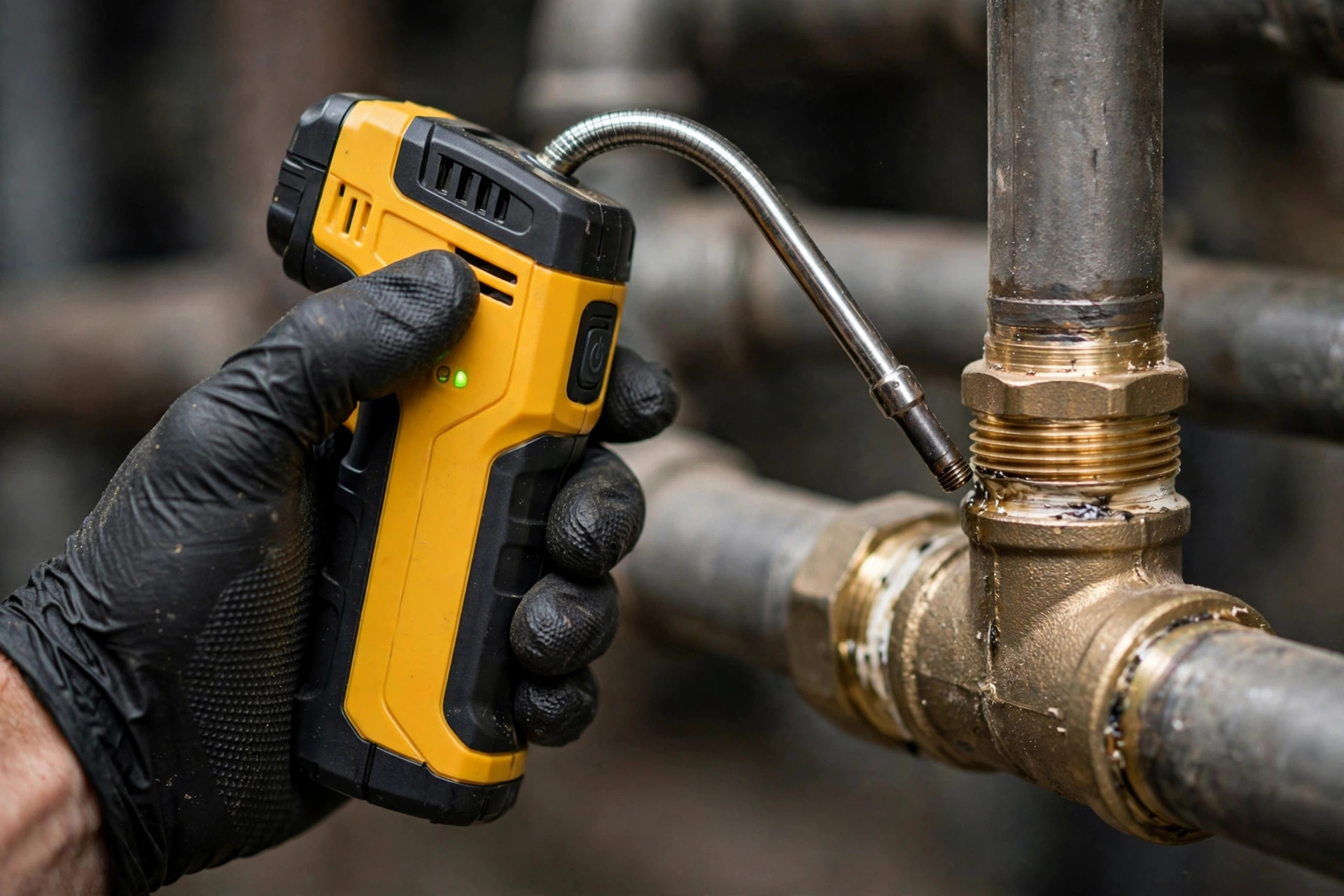
The classic tool is the handheld combustible-gas sniffer: a pistol-grip unit with a flexible gooseneck probe you sweep along pipe joints, fittings, and appliance connections — the practical instrument behind how gas sensors detect leaks in the field. When the probe tip nears leaking gas, the unit beeps faster and the bar-graph display climbs.
Catalytic bead sensors: burning a tiny sample
Many sniffers use a catalytic bead (pellistor): a tiny platinum-wire coil coated in catalyst, heated to several hundred degrees. When combustible gas reaches the bead, it oxidizes on the catalyst, releasing heat that raises the coil’s temperature — and therefore its electrical resistance. A second, sealed reference bead compensates for ambient temperature, and the bridge circuit reads the difference as gas concentration.
Catalytic beads are the workhorse of industrial gas detection because they respond to the whole family of combustible gases and read directly in %LEL. Their weaknesses: the hot bead needs oxygen to work (useless in oxygen-depleted spaces), the catalyst can be poisoned by silicones and lead compounds, and they draw enough power that battery life is measured in hours, not years.
Semiconductor sensors: the affordable alternative
Cheaper handhelds use heated metal-oxide semiconductor sensors — a tin-dioxide film whose resistance drops in the presence of reducing gases like methane. They are sensitive, fast, and cheap, which is why nearly every sub-$50 gas sniffer uses one. The trade-off is selectivity: the film also responds to alcohol vapors, solvents, and other VOCs, so a freshly painted room can look like a gas leak. Professionals learn to confirm semiconductor hits with a second method; homeowners should treat a positive reading as “investigate,” not “certain.”
Infrared point sensors: the premium option
High-end fixed detectors increasingly use nondispersive infrared (NDIR): methane absorbs infrared light at a characteristic wavelength (around 3.3 microns), so shining an IR beam through the air sample and measuring absorption gives a direct, drift-free methane reading. NDIR sensors do not need oxygen, cannot be poisoned, and hold calibration for years. They cost more, which is why they dominate commercial installations rather than hardware-store shelves — though prices are falling.
Fixed Home Detectors: Alarms That Watch While You Sleep
Plug-in and battery-powered home natural-gas alarms work on the same principles, usually with a semiconductor or catalytic sensor behind a louder horn and a longer service life. Placement follows the physics: methane is lighter than air and rises, so mount gas alarms high — on the wall near the ceiling or on the ceiling itself, within about 10 feet of gas appliances but not directly above the stove where cooking fumes cause nuisance alarms.
Do not confuse these with CO alarms. A CO detector will not warn you about a methane leak, and a methane detector will not warn you about carbon monoxide — the sensors are chemically blind to each other’s target. Homes with gas appliances genuinely need both, which is why combination units exist but single-purpose units still dominate: each sensor type has placement and lifespan rules the other does not share.
Fixed detectors also face the causes of false gas detection that plague the category: aerosol sprays, cleaning solvents, and even flatulent pets near a floor-level unit have triggered semiconductor-based alarms. Knowing your sensor type tells you which false triggers to expect.
How Detectors Tell Methane from Everything Else
Selectivity — responding to the target gas and ignoring the rest — is the central engineering challenge, and each technology solves it differently.
Catalytic beads are inherently selective to combustible gases as a class: they only respond to things that burn on the catalyst. That is perfect for explosion safety (you care about anything flammable) but useless for identifying which gas it is. Infrared sensors are selective by wavelength: the 3.3-micron absorption band is characteristic of C-H bonds, so NDIR methane detectors largely ignore non-hydrocarbon gases. Semiconductor sensors are the least selective, responding to almost any reducing vapor — the price of their sensitivity.
Professional instruments layer these: a 4-gas confined-space monitor, for example, typically pairs a catalytic bead for combustibles with electrochemical cells for oxygen, CO, and hydrogen sulfide. The OSHA confined-space standard effectively requires this kind of multi-gas instrumentation before workers enter tanks, sewers, and pits — one gas, one sensor, no shortcuts.
Calibration: why “it beeps” is not enough
There is also a human-factors side to calibration. A detector that cries wolf — alarming on paint fumes or a neighbor’s barbecue — teaches its owner to ignore it, and the next alarm gets dismissed as another false positive. Professionals treat every alarm as real until proven otherwise, ventilate first, and investigate second. For homeowners, the practical rule is simple: if your fixed alarm sounds and you cannot identify a benign cause within a minute or two, leave the house and call the gas utility’s emergency line. Instruments are cheap; second chances are not.
Gas detectors drift. Catalytic beads age, semiconductor films contaminate, and even NDIR optics fog. Professionals bump-test before each use — exposing the sensor to a known calibration gas and confirming it reads correctly — and full-calibrate on schedule. A homeowner’s fixed alarm cannot be bump-tested, which is why its replacement date matters: the sensor inside is slowly going blind, and only the calendar knows.
Worth buying
For tracking down a suspected leak around fittings and appliances, the TopTes PT199 Natural Gas Leak Detector with Audible & Visual Alarm is a semiconductor-based sniffer with a gooseneck probe and escalating alarms — well suited to a homeowner sweeping accessible pipe joints. If you want sensitivity to both methane and propane (for homes with LPG tanks or RVs), the Techamor Y201 Portable Methane/Propane Combustible Gas Leak Sniffer Detector covers both gases with an adjustable sensitivity dial for zeroing in on the source.
Disclosure: as an Amazon Associate, awasc.com earns from qualifying purchases.
Frequently Asked Questions
How do natural gas leak detectors work?
They sense methane using one of three main technologies: catalytic beads that burn a tiny gas sample and measure the heat, semiconductor films whose resistance changes in gas, or infrared beams measuring methane’s characteristic light absorption. Readings are shown in %LEL — percent of the lower explosive limit.
Will a carbon monoxide detector detect a gas leak?
No. CO detectors sense carbon monoxide with electrochemical cells that are blind to methane, and methane detectors are blind to CO. Homes with fuel-burning appliances need both types of protection.
Where should I mount a natural gas detector?
High on the wall or on the ceiling, since methane rises. Place it within about 10 feet of gas appliances but not directly above cooking equipment, where fumes cause nuisance alarms.
Why does my gas detector alarm near cleaning products?
Semiconductor-type sensors respond to many vapors — alcohols, solvents, aerosols — not just methane. This cross-sensitivity is the most common cause of false alarms; ventilate and re-check, and confirm persistent readings professionally.
How often do gas detectors need calibration?
Professional portable instruments should be bump-tested before each use and calibrated on the manufacturer’s schedule. Fixed home alarms cannot be field-calibrated — follow the printed replacement date, typically 5–7 years.