Radon is the second-leading cause of lung cancer, and it enters homes silently — an invisible, odorless radioactive gas seeping up from the soil beneath your foundation. You cannot detect it with your senses, and unlike smoke or carbon monoxide, there is no alarm that screams when levels spike. Detecting radon is a deliberate act: you have to decide to test, choose the right method, and interpret the results.
This article explains how radon gets into homes, the two families of detection — passive test kits and continuous electronic monitors — how each one actually measures the gas, and what your results mean for your health and your house.
What Radon Is and Why It Collects Indoors
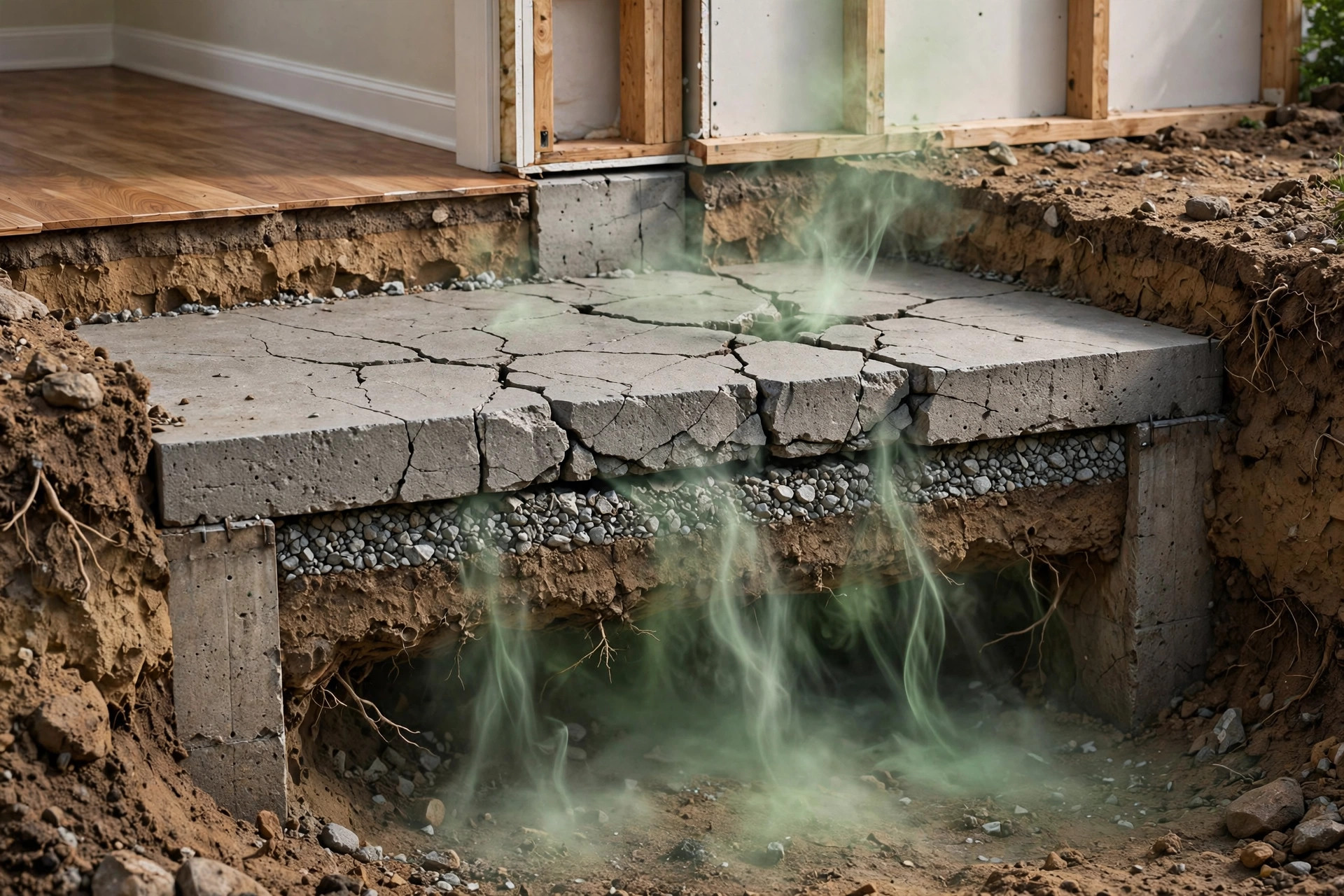
Radon-222 is a radioactive gas formed by the natural decay of uranium in soil and rock. It exists almost everywhere outdoors at harmless trace levels, where it dilutes into the atmosphere. The problem starts at your foundation: the air pressure inside a home is typically slightly lower than in the surrounding soil — the “stack effect” of warm air rising pulls soil gas inward through cracks in the slab, sump pits, crawl spaces, and gaps around pipes.
Once inside, radon has nowhere to go. Outdoors it disperses; indoors it accumulates, sometimes to concentrations hundreds of times the outdoor background. The gas itself is only part of the hazard — radon decays into solid radioactive particles (“radon daughters” like polonium-218) that cling to dust, lodge in the lungs when inhaled, and bombard lung tissue with alpha radiation. That chronic low-dose bombardment is what drives the cancer risk, and it is why the EPA urges every homeowner to test, regardless of where they live.
Radon levels vary enormously — between neighboring houses, between floors of one house, and across seasons. The only way to know your level is to measure it. There is no proxy, no smell, no symptom that warns you first.
Passive Test Kits: The Charcoal and Alpha-Track Methods
Short-term test kits are the most common first step: inexpensive (often under $20), mail-in, and simple enough for anyone to deploy.
Charcoal canisters: adsorption over days
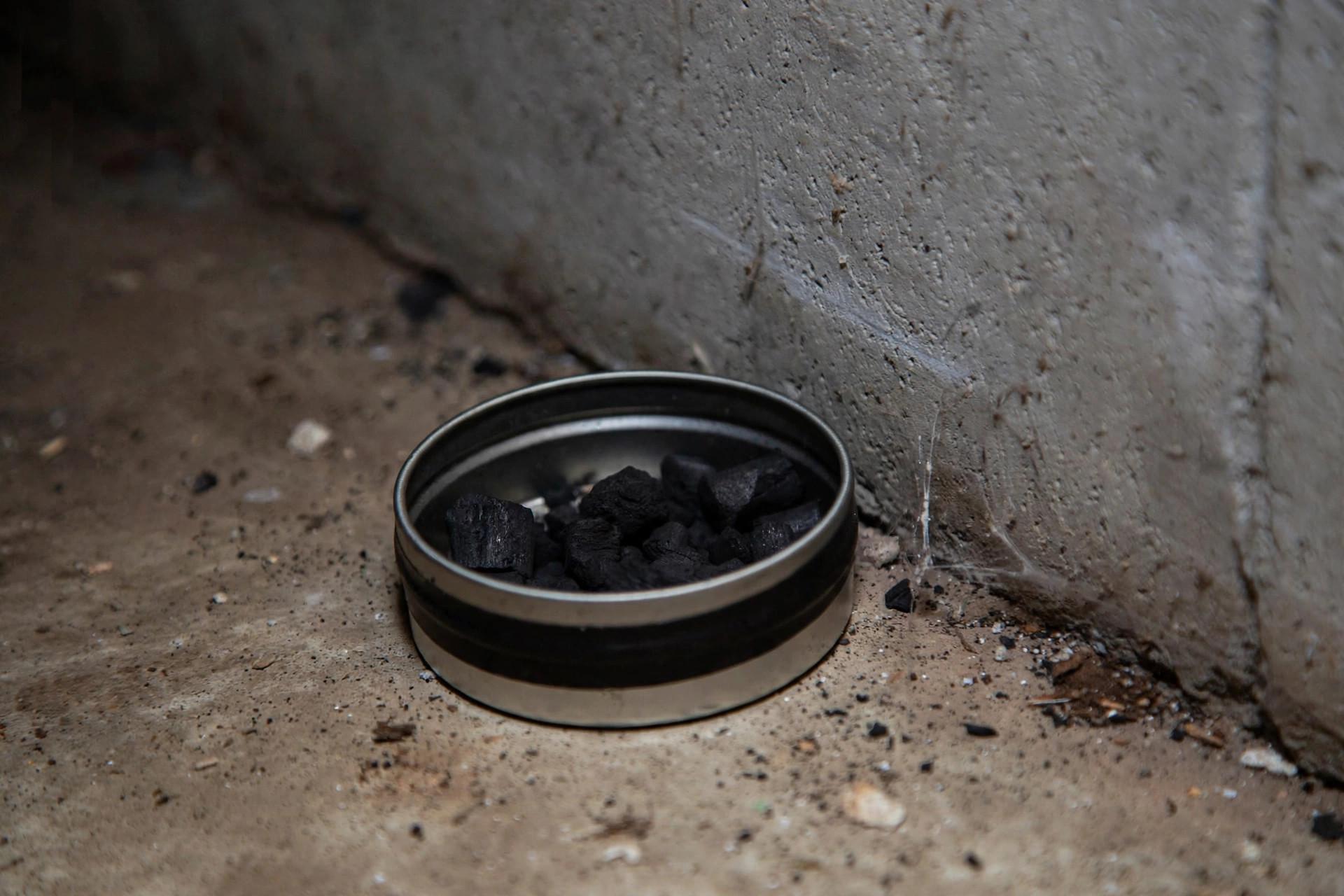
A charcoal test kit is a small canister of activated charcoal you open and leave in the lowest lived-in level of the home for 2 to 7 days. Radon in the air adsorbs onto the charcoal’s enormous internal surface. You then seal the canister and mail it to a lab, which measures the gamma radiation from radon’s decay products trapped in the charcoal and back-calculates the average radon concentration during the exposure.
The weakness is right in the physics: charcoal also adsorbs and releases radon with humidity and temperature swings, so results are approximate — good for screening, not for precision. They are also easily disturbed: moving the canister, running a whole-house fan, or testing during a storm can skew the reading.
Alpha-track detectors: months of silent recording
Alpha-track kits work like photographic film for radiation. Inside the small plastic housing sits a piece of special plastic; when radon decays nearby, the emitted alpha particles etch microscopic tracks into it. After 90 days to a year, the lab chemically enlarges those tracks and counts them under a microscope. More tracks, more radon, averaged over the whole exposure period.
Because they integrate over months, alpha-track detectors smooth out the daily and seasonal swings that make short-term kits jumpy. They are the preferred method for a definitive answer about your home’s typical level — and for confirming that a mitigation system actually worked.
Continuous Electronic Monitors: Watching Radon in Real Time
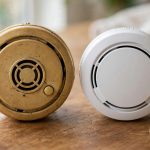
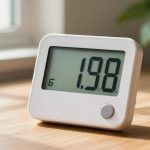
Electronic radon monitors — the Airthings and Ecosense devices sold for home use — detect radon continuously and display the concentration on a screen or app. Most use one of two sensing methods.
Diffusion-chamber monitors let room air drift into a small chamber containing a silicon photodiode. When radon decays inside the chamber, the alpha particle strikes the diode and generates a tiny electrical pulse. The device counts pulses over time and converts the count rate into picocuries per liter (pCi/L). It is the same pulse-counting principle as a Geiger counter, miniaturized and left running for months.
Ionization-chamber monitors work differently: radon decay inside the chamber creates ion pairs in the air, and an applied electric field sweeps those ions to electrodes, producing a measurable current proportional to the radon concentration. Both approaches need long averaging — hours to days — because radioactive decay is random and a short count is statistically noisy. Do not trust a “radon level” displayed after twenty minutes; meaningful readings need at least 48 hours, and a week is better.
Continuous monitors shine at showing patterns: the nighttime rise when the house is closed up, the drop when you air the basement, the seasonal climb in winter. That time-series view is something no mail-in kit can give you, and it is genuinely useful for deciding whether mitigation is warranted.
What the Numbers Mean
In the United States, radon is measured in picocuries per liter. The EPA’s action level is 4 pCi/L: at or above it, fix the home. Between 2 and 4, the EPA suggests considering mitigation, especially if anyone smokes — tobacco smoke and radon multiply each other’s lung-cancer risk far beyond either alone. There is no “safe” threshold; risk rises roughly linearly with concentration, so lower is always better.
Context helps: average indoor levels in the US run around 1.3 pCi/L, outdoor air around 0.4. A reading of 8 is not “twice as bad as 4” in a linear-risk sense — it is twice the risk, full stop. And because levels fluctuate and no detection system is perfectly accurate, a single short-term test is a snapshot, not a verdict: the EPA recommends a follow-up test (preferably long-term) before spending money on mitigation, unless the first reading is very high.
Testing protocol that gives trustworthy results
Test the lowest level you actually live in — not an unfinished storage cellar nobody enters. Close windows and exterior doors for 12 hours before and during a short-term test (normal entry and exit is fine), and avoid testing during severe storms or high winds, which distort soil-gas entry. Place the kit at breathing height, away from drafts, exterior walls, and heat sources. For gas detectors that identify invisible hazards generally, placement discipline is what separates a real measurement from a random number.
If Levels Are High: Detection Leads to Mitigation
Detection is only step one. The standard fix is active soil depressurization: a contractor seals the major entry routes and installs a fan-driven vent pipe that draws radon from beneath the slab and exhausts it above the roofline, reversing the pressure gradient that pulled it in. It is effective — typically cutting levels by up to 99 percent — and costs roughly in line with other major home systems.
After mitigation, retest: first with a short-term kit to confirm the system works, then with a long-term alpha-track detector to verify the annual average. Radon systems have fans and seals that age, so retest every two years and any time you renovate the foundation, change the HVAC, or finish the basement. Detection is not a one-time event; it is a maintenance habit, like checking the gas concentration detected in your air after any change to the building envelope.
Worth buying
For continuous monitoring, the Airthings Corentium Home Radon Detector 223, USA Version (pCi/L) uses a diffusion-chamber alpha sensor to log radon around the clock, so you can see weekly averages and seasonal trends instead of guessing from a single snapshot. For an inexpensive first screen, the First Alert RD1 Radon Gas Test Kit is a classic charcoal-canister mail-in test: deploy it for a few days, send it to the lab, and get a baseline reading before deciding on a monitor or mitigation.
Disclosure: as an Amazon Associate, awasc.com earns from qualifying purchases.
Frequently Asked Questions
How is radon detected in homes?
With dedicated tests, not alarms: short-term charcoal kits (2–7 days, mailed to a lab), long-term alpha-track detectors (months of exposure), or continuous electronic monitors that count alpha-decay pulses in real time. There is no instant-read radon alarm for homes.
What radon level is considered dangerous?
The EPA action level is 4 pCi/L — mitigate at or above it. Between 2 and 4 pCi/L, consider mitigation, especially with smokers in the home. Risk rises with concentration with no fully safe threshold, so lower is always better.
Can I smell or sense radon in my house?
No. Radon is colorless, odorless, and tasteless, and it causes no immediate symptoms. The only way to know your level is to test — which is why the EPA recommends every home be tested regardless of location.
How long does a radon test take?
Short-term kits run 2–7 days; long-term alpha-track kits run 90 days to a year for the most reliable average. Electronic monitors need at least 48 hours for a meaningful reading, with a week or more preferred.
Do radon levels change over time?
Yes — daily, seasonally, and with weather. Levels typically rise at night and in winter when homes are closed up, and storms can spike readings. This variability is why long-term testing gives the most trustworthy picture of your true exposure.