A standard ceiling smoke detector waits for smoke to reach it. An aspirating smoke detector goes looking for it — continuously drawing air through a network of pipes from across a room, a warehouse, or a data hall, and analyzing every sample in a central detection chamber. It is the bloodhound of fire detection: far more sensitive, far earlier, and far more expensive than the alarm over your bedroom door.
This article explains how aspirating smoke detection works, from the pipe network and the sampling fan to the laser-based particle counting inside the detector. You will learn why these systems can warn of a fire at the smoldering stage, where they are worth the cost, and what their limitations are.
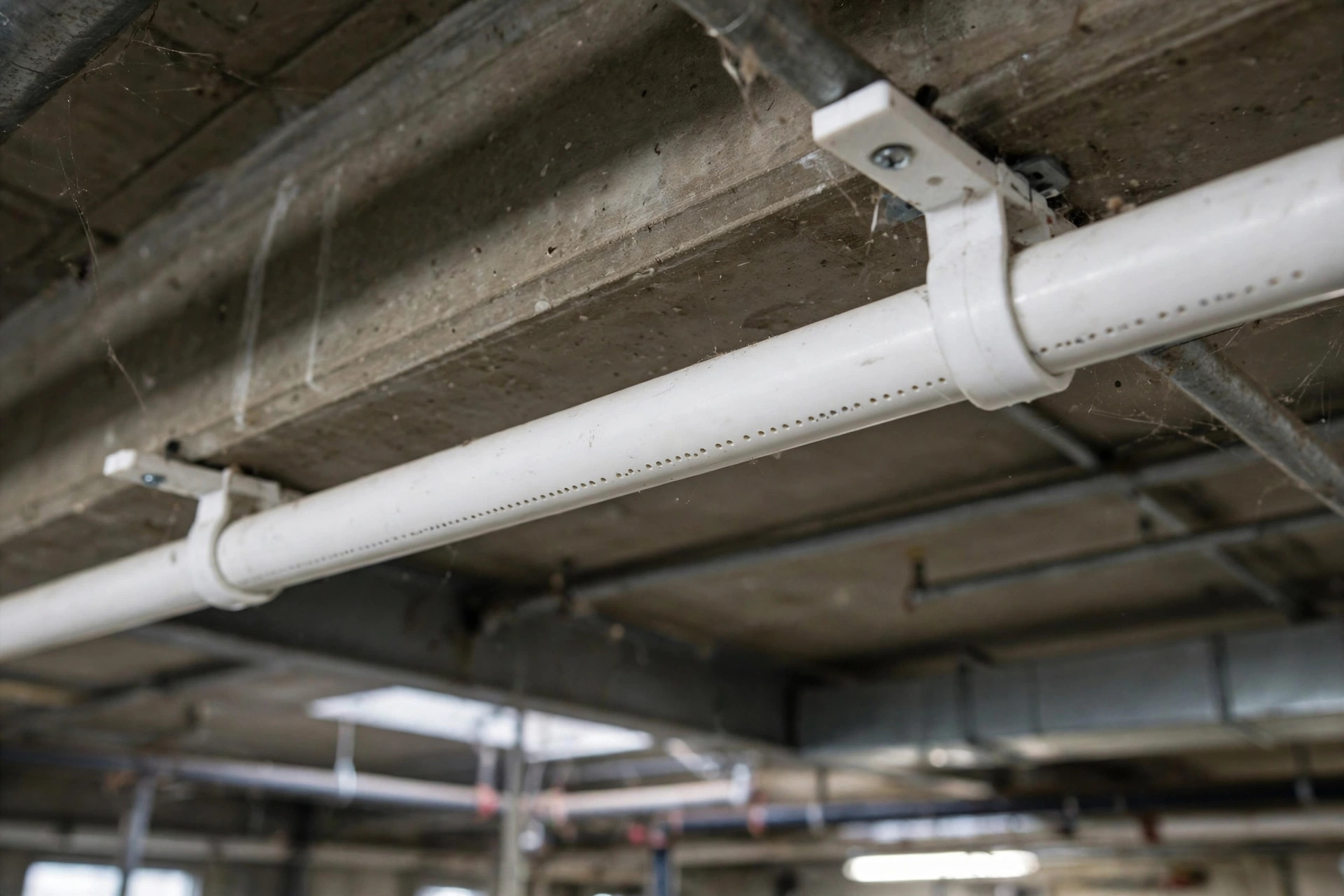
Actively Sampling Air Instead of Waiting for It
Every conventional smoke detector is passive: smoke must travel — by buoyancy and air currents — to the sensing chamber before anything happens. In a large space with high ceilings, that journey can take many minutes, and in the early smoldering stage there may not be enough buoyant smoke to make the trip at all.
Aspirating systems invert the problem. A network of small-bore pipes, typically 25mm plastic tubing, runs through the protected space with sampling holes drilled at intervals. An aspirator — essentially a high-reliability fan inside the detector unit — continuously pulls air through these holes, down the pipes, and into the detection chamber. Transport time from the farthest sampling hole to the detector is a designed parameter, typically kept under a minute, so the system knows not just what it is smelling but roughly where the sample came from. The system samples the entire volume actively, hundreds of times per hour, instead of waiting for smoke to arrive on its own.
This active sampling is what buys the famous early warning. Because the detector sniffs air from everywhere at once, it encounters the first faint traces of combustion particles while a fire is still in its incipient stage — overheating cable insulation, a smoldering component on a circuit board — long before visible smoke exists.
Inside the Detector: Counting Particles with Light
The air samples arrive at a detection chamber that works like a laboratory particle counter shrunk into a wall-mounted box.
Laser nephelometry: seeing the invisible
Most aspirating detectors use a laser-based scattering chamber. Sampled air passes through a focused laser beam, and any particles in the airstream scatter the light. Ultrasensitive photoreceivers measure that scattered light, and the electronics convert it into a particle concentration — effectively counting smoke particles far smaller and far fewer than a conventional photoelectric chamber can resolve.
Sensitivity is adjustable across an enormous range. The most sensitive settings can detect obscuration levels thousands of times lower than a standard smoke alarm’s threshold — the oft-quoted figure is up to 1,000 times more sensitive. In practice, installers tune the sensitivity to the environment: maximum in a clean data center, backed off in a dusty warehouse.
Filtering out the background
Extreme sensitivity creates an obvious problem: ordinary dust would trigger constant alarms. Aspirating detectors solve this with multi-stage air filtering and intelligent signal processing. Incoming air passes through a replaceable filter that strips large dust particles while letting microscopic smoke particles through. Then the firmware compares readings across time and across pipe zones, looking for the signature of combustion — a rising trend with the right particle-size profile — rather than reacting to absolute levels.
Tuning sensitivity to the environment
Commissioning an aspirating system is largely an exercise in setting the right sensitivity for the space. In a clean data hall, the installer may arm the most sensitive alarm threshold the hardware allows, chasing the earliest possible warning. In a warehouse with forklift exhaust and cardboard dust, that same setting would alarm weekly, so thresholds are raised and alarm delays lengthened — trading minutes of earliness for freedom from nuisance trips. Most detectors support multiple alarm levels (alert, action, fire) precisely so a facility can escalate its response gradually instead of evacuating on the first faint signal.
Many units also run a dual-channel comparison: one channel measures the sampled air, the other measures a filtered reference, and the detector alarms on the difference. This cancels out slow environmental drift, the same way noise-cancelling headphones subtract background hum.
Why Early Warning Matters: The Incipient Stage
Fires progress through stages: incipient (overheating, invisible particles), smoldering (visible smoke, no flame), flaming, and heat. Conventional detection typically catches the smoldering-to-flaming transition. Aspirating detection aims a full stage earlier, at the incipient phase — and that gap, often 30 minutes to hours, is where the value lies.
Consider a data center. By the time a ceiling detector alarms, smoke has already spread through cable trays and the fire may be beyond easy suppression — while the business cost of downtime dwarfs the detector’s price. An aspirating system alarming at the overheating-cable stage lets staff isolate the rack before anything burns. The same logic applies to early smoke detection in telecommunications exchanges, museums, clean rooms, and power generation halls.
This is also why aspirating systems dominate in spaces where conventional detectors simply cannot work: atria with 15-meter ceilings, cold storage where electronics would fail, prisons where inmates might tamper with ceiling units, and dusty industrial halls where spot detectors would clog in weeks. The sensitive electronics sit in an accessible corridor; only cheap pipe runs through the hostile space, keeping the expensive electronics safe, clean, and serviceable for their full design life, which is exactly why these systems survive decades in harsh industrial settings.
Limitations: Cost, Complexity, and Maintenance
Aspirating detection is not a better smoke alarm — it is a different class of system, with different burdens.
Cost is the obvious one: a single aspirating detector unit plus pipework can cost ten to fifty times a conventional alarm installation. Design requires hydraulic calculation of the pipe network — hole sizes and spacing must be engineered so every sampling point draws equally, otherwise the far end of the pipe starves. Commissioning involves smoke tests at each hole to verify transport times meet the detection delay budget.
Maintenance is non-trivial. Filters need scheduled replacement, pipes need periodic blow-out to clear dust accumulation, and the laser chamber needs calibration checks. A neglected aspirating system degrades into an expensive conventional one — or worse, a silent one. For ordinary homes and small offices, this complexity is why spot-type alarms remain the right answer: aspirating detection earns its keep only where the protected value or the environment demands it.
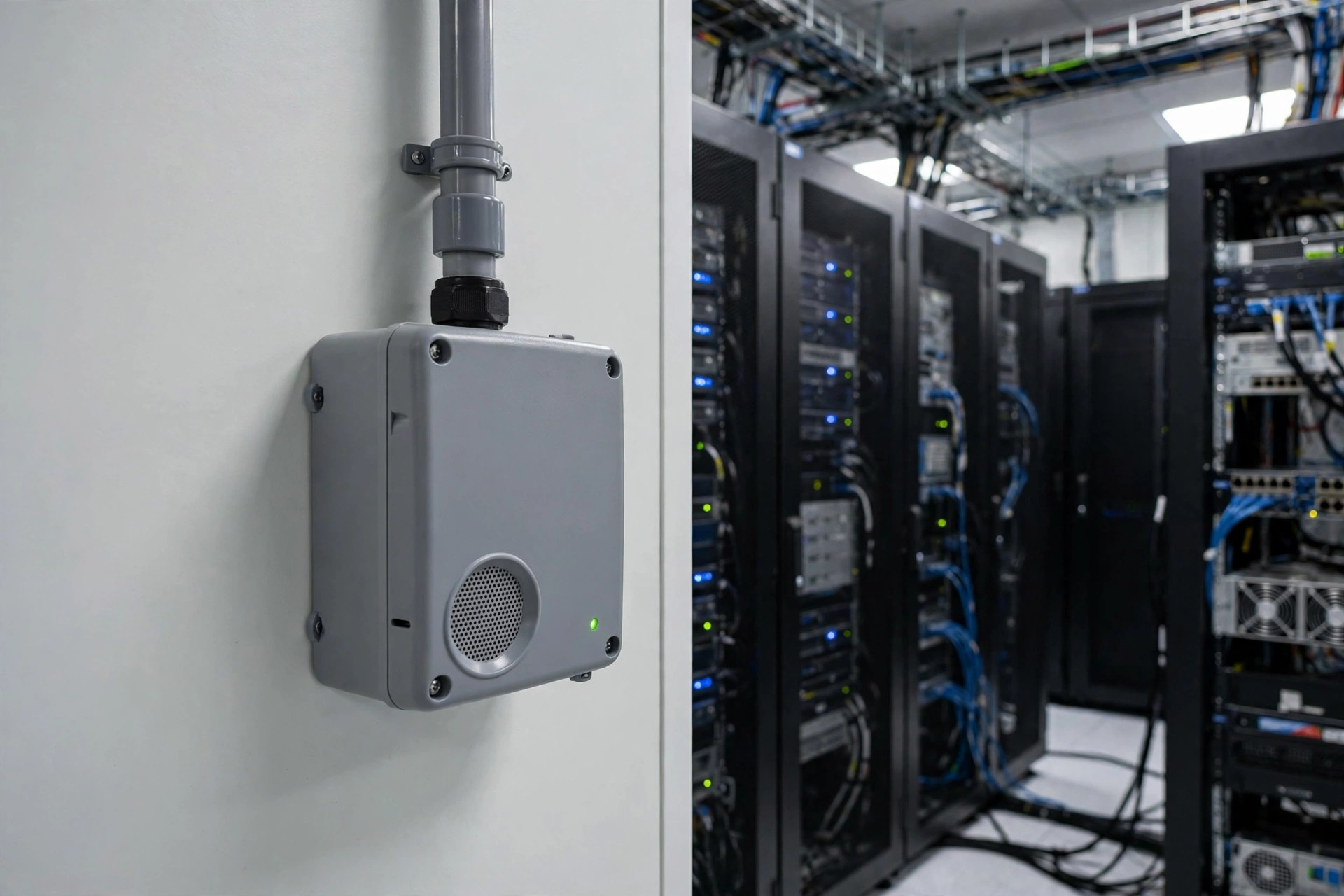
How Aspirating Fits with Other Detection
In practice, aspirating systems rarely stand alone. A large facility layers them: aspirating detection for very early warning in critical zones, conventional smoke detection for general areas, and heat or flame detection where smoke is expected as background. The aspirating system is the tripwire; the other layers are the confirmation.
There is also a diagnostic dividend. Because the detector continuously measures background particle levels, it produces a baseline log of the protected space’s air quality. A slow upward creep in background readings can reveal a developing problem — a failing filter, a new dust source, a change in process — before any alarm threshold is crossed. Conventional spot detectors give you silence until they give you an alarm; aspirating systems give you a trend.
Modern units integrate with building management and fire panels over standard protocols, reporting not just “alarm” but pre-alarm levels, fault conditions, and even which pipe zone the particles came from — giving responders a location before they enter the building. Some installations pair aspirating smoke detection with gas sensing on the same pipe network, sampling for both combustion particles and hazardous gases through one infrastructure.
Frequently Asked Questions
What is an aspirating smoke detector?
A fire detection system that continuously draws air through a pipe network into a central laser-based sensing chamber. By actively sampling air from across a space, it detects combustion particles at the incipient stage — far earlier than passive ceiling detectors.
How much more sensitive is aspirating detection than a normal smoke alarm?
Up to roughly 1,000 times more sensitive at maximum settings, detecting obscuration levels far below a conventional alarm’s threshold. Installers tune sensitivity to the environment to balance early warning against dust-induced nuisance alarms.
Where are aspirating smoke detectors used?
Data centers, telecom exchanges, museums, clean rooms, power stations, high-ceiling atria, cold storage, and dusty industrial halls — anywhere the value at risk is high, early warning is critical, or conventional detectors cannot survive or function.
Do aspirating systems need a lot of maintenance?
More than conventional alarms: filters need scheduled replacement, pipes need periodic clearing, and the sensing chamber needs calibration checks. A neglected system loses its early-warning advantage, so maintenance contracts are standard.
Can I install an aspirating detector in my home?
Technically yes, but it is almost never worthwhile. The cost, design complexity, and maintenance burden are engineered for commercial risks. Quality interconnected spot-type alarms provide the right level of protection for homes at a fraction of the cost.