A smoke alarm screaming in the basement at 2 a.m. is useless to a family asleep upstairs behind closed doors. That gap — between where a fire starts and where people sleep — is the deadliest distance in home fire safety, and interconnected smoke alarms exist to close it. When one alarm detects smoke, every alarm in the house sounds at once.
This article explains how interconnection works, the three ways alarms link together, whether the evidence shows they actually save lives, and what to consider before upgrading your own home.
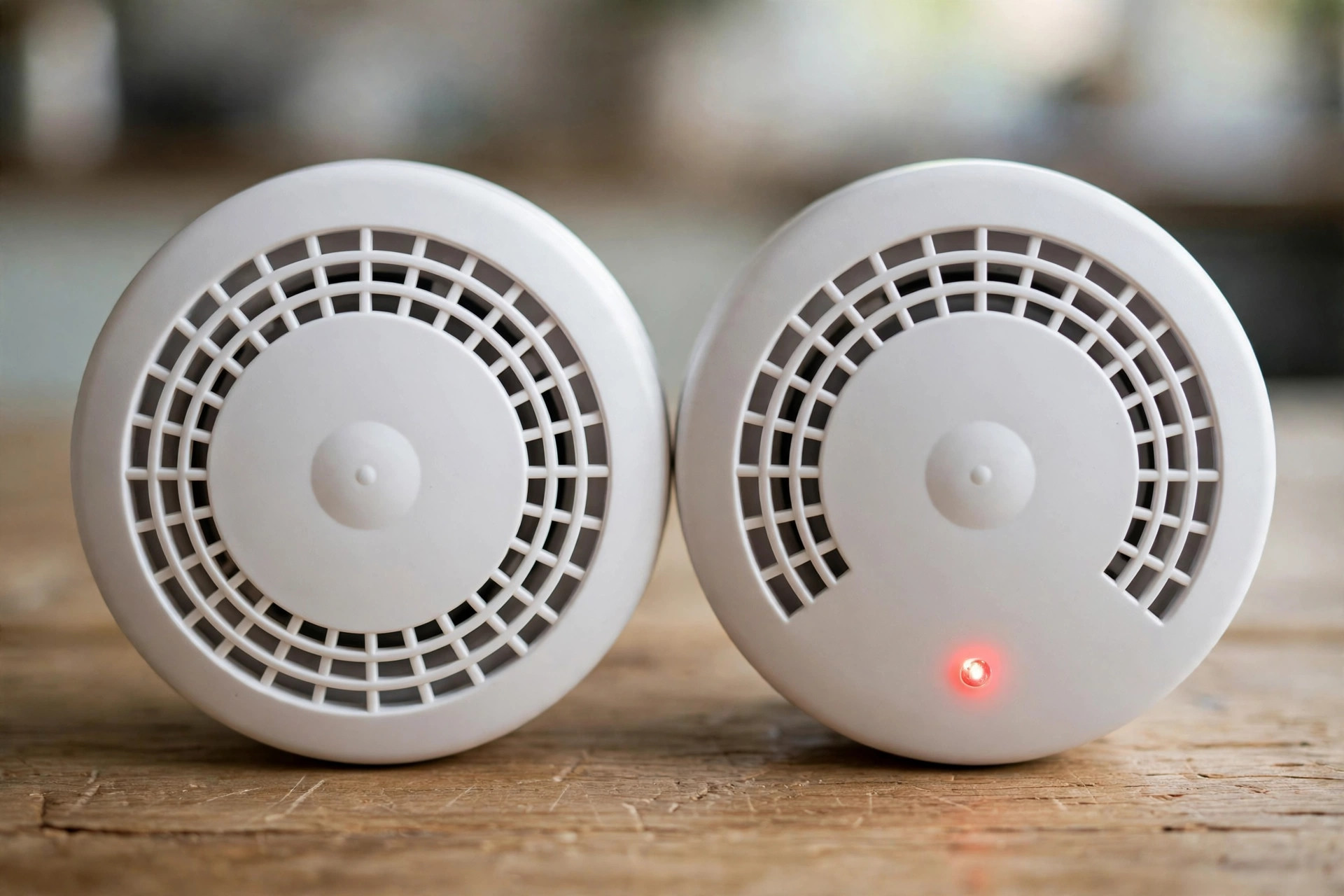
The Problem Interconnection Solves
Sound does not travel through a house the way people imagine. A smoke alarm’s horn is rated around 85 decibels at 10 feet — painfully loud in the same room. But every wall, closed door, and floor in between absorbs sound, and distance weakens it further. By the time that horn reaches a second-floor bedroom from a basement utility room, it can drop below the threshold that reliably wakes a sleeping adult — let alone a child, an elderly person, or someone with hearing loss.
Research on waking effectiveness is sobering: a significant fraction of children sleep through a standard 85-decibel alarm even in the same room, and adults under the influence of alcohol or sleep deprivation do worse. The NFPA’s alarm guidance has long emphasized that audibility where people sleep is the entire point — an alarm nobody hears is a decoration.
Interconnection attacks this directly. Instead of relying on one horn to penetrate the whole house, it turns every alarm into a repeater: detection anywhere means alarm everywhere, including the hallway outside your bedroom.
Three Ways Alarms Link Together
Hardwired interconnection: the third wire
In hardwired systems, alarms connect through a dedicated interconnect wire — usually the red or orange conductor in the alarm’s wiring harness — daisy-chained from unit to unit. When one alarm’s smoke sensor trips, it puts a signal voltage on that wire, and every other alarm on the chain sounds its horn. The signaling is simple and robust: it is a shared “alarm now” line, not a data network, which is why hardwired interconnection from different manufacturers sometimes works but is never guaranteed — signaling voltages and protocols vary.
Hardwired interconnection requires the wire to exist, which usually means it is installed during construction or major renovation. Retrofitting means opening walls, which is why wireless options have taken over the retrofit market.
Wireless radio interconnection
Battery-powered interconnected alarms link via low-power radio — typically in the 900 MHz band or using mesh networking. When one alarms, it broadcasts; the others receive and sound within seconds. Modern units pair at installation with a button press, forming a closed group so your alarms do not trigger the neighbor’s.
Radio interconnection has genuine advantages beyond easy retrofit: it works across detached structures like a garage workshop, and mesh designs relay the signal hop by hop, extending range through large homes. The trade-offs are battery life — the radio must listen continuously — and the small but real possibility of interference in congested radio environments.
Smart and panel-based interconnection
Smart alarms connect through home Wi-Fi to each other and to your phone, adding remote alerts: a fire while you are at work pages you instead of burning unheard. Panel-based systems in larger buildings go further, with a fire alarm control panel that knows exactly which device triggered and can direct voice evacuation messages. For homes, the practical choice is between hardwired and wireless; smart features are a layer on top, not a replacement for the local alarm-everywhere behavior.
Does the Evidence Show They Make You Safer?
The honest answer: the mechanism is sound, the logic is airtight, but isolating interconnection’s effect in fire statistics is genuinely hard. Fire outcome data compares homes with working alarms against homes without — and interconnection is one variable among many (alarm count, placement, maintenance, escape planning).
What the evidence does show clearly is the audibility problem interconnection solves. Studies of alarm audibility through closed doors consistently find that a single remote alarm may not wake sleepers, while an alarm sounding in the hallway outside the bedroom does. Every major fire-safety body — NFPA, USFA, and the UK’s fire services — recommends interconnection for exactly this reason: it converts a detection event anywhere into an audible warning where people actually are.
There is also a second-order benefit that rarely gets mentioned: interconnection defeats the “it’s probably the kitchen again” problem. When every alarm in the house sounds simultaneously, the signal is unmistakable — nobody assumes it is a local nuisance and goes back to sleep. A whole-house alarm carries an authority that a single distant beep does not.

Limitations Worth Knowing
Interconnection multiplies audibility, not detection. If the originating alarm is expired, disabled, or missing its battery, there is nothing to interconnect — the chain is only as strong as its weakest sensor. Homes that interconnect five alarms but never replace them have built an impressive network for distributing silence.
Compatibility is the other trap. Hardwired alarms from different brands may not interoperate on the interconnect wire, and mixing wireless brands essentially never works — each uses proprietary pairing. When upgrading, replace the whole set with one compatible family, or verify cross-brand compatibility explicitly rather than assuming.
Wireless systems need their own maintenance discipline. The radio receiver draws standby current continuously, so battery-only interconnected alarms can exhaust batteries faster than standalone units — check them on schedule, and take low-battery chirps seriously. And in homes with dense Wi-Fi, baby monitors, and smart-home gear, test the interconnection after installing new radio equipment; interference-related dropouts are rare but real.
There is also the question of what happens after the alarm. Interconnection buys you earlier warning; an escape plan converts that warning into survival. Walk the route from each bedroom to the outside with the family, agree on a meeting point, and practice it once — ideally at night, when the interconnection you installed is doing its real job. The best detection in the world only matters if everyone knows where to go when it speaks.
Finally, interconnection does not help anyone who cannot hear a standard horn: the deaf and hard-of-hearing need bed-shaker and strobe accessories, which quality interconnected systems support as add-on devices. Audibility is the goal — the horn is just one means.
Upgrading: What to Actually Do
If your home was built before interconnection was required (most codes began requiring it in new construction in the 1990s, with wireless accepted later), a wireless interconnected set is the highest-value fire-safety upgrade you can buy — typically a few hundred dollars for a whole house, installed in an afternoon with no wiring.
Renters face a special version of this decision. You generally cannot rewire a rental, but nothing stops you from installing battery-powered wireless interconnected alarms alongside the landlord’s units — they are your property, they move with you, and they protect you where the existing coverage is thin. Just be sure your additions do not interfere with or get mistaken for the building’s own system, and never remove or disable the landlord-provided alarms.
Buy one brand and one product family for the whole house, including the basement and garage-adjacent areas. Replace every alarm at once so the expiration dates align — a mixed-age fleet guarantees you will forget which unit expires when. Test the interconnection monthly using one alarm’s test button and confirming the others sound; this single habit verifies both the sensors and the links. And pair the upgrade with the two habits that multiply its value: understanding how your detectors work and keeping bedroom doors closed at night, which buys the extra minutes the alarms are earning you.
Frequently Asked Questions
What does it mean for smoke alarms to be interconnected?
When one interconnected alarm detects smoke or fire, every alarm in the system sounds simultaneously. Detection anywhere produces an audible warning everywhere — especially in hallways outside bedrooms.
Do interconnected alarms really improve safety?
The mechanism directly solves the proven audibility problem: a single distant alarm may not wake sleepers through closed doors, while an alarm sounding outside the bedroom does. Every major fire-safety authority recommends interconnection for this reason.
Can I interconnect alarms from different brands?
Usually not reliably. Hardwired interconnection sometimes works across brands but is never guaranteed; wireless interconnection is proprietary to each manufacturer. Use one compatible product family throughout the house.
Is wireless interconnection as reliable as hardwired?
For homes, yes in practice. Wireless alarms link by radio and sound within seconds of each other. They need battery discipline since the radio listens continuously, and you should re-test after adding new radio equipment nearby — but they are the standard retrofit solution.
Do I still need interconnection if I have a smart alarm that alerts my phone?
Yes. Phone alerts help when you are away, but they depend on Wi-Fi, power, and you noticing your phone at 2 a.m. Local interconnection — every horn sounding — is what wakes sleeping occupants. The two complement each other; neither replaces the other.