Your air conditioner is cooling less every summer, the technician tops up the refrigerant, and nobody can find where it is going. Refrigerant leaks are invisible, often odorless, and expensive — and finding them is a detection problem with its own specialized instruments. HVAC technicians carry electronic leak detectors the way doctors carry stethoscopes, and the physics inside them is purpose-built for the chemistry of modern refrigerants.
This article explains how refrigerant leak detectors work: the sensing technologies tuned to halogenated gases, how technicians actually hunt a leak, and why the refrigerant transition to low-GWP blends is changing the instruments.
Why Refrigerants Need Their Own Detectors
Refrigerants are a chemical family — CFCs, HCFCs, HFCs, HFOs, and natural options like ammonia and CO2 — unified by containing halogens (fluorine, chlorine) or by being hydrocarbons. A general combustible-gas sniffer will miss an HFC leak entirely, because HFCs are neither flammable at room conditions nor detectable by a hot catalytic bead. Refrigerant detection needs sensors tuned to halogen chemistry or to the specific molecule — the same principle by which chemical sensors identify substances through molecular fingerprints.
The stakes are threefold. First, performance: a system low on charge cools poorly and wears its compressor. Second, environment: many refrigerants are potent greenhouse gases — a kilogram of R-404A leaking equals over 3,900 kg of CO2 — and ozone-depleting CFCs/HCFCs are regulated internationally. Third, safety: some newer low-GWP refrigerants (A2L class, like R-32) are mildly flammable, adding a combustion hazard to the mix. The EPA’s refrigerant management rules require leak inspection and repair for systems above certain charge sizes, which is why detection is a compliance activity, not just a maintenance one.
The Heated-Diode Sensor: The Classic Electronic Sniffer
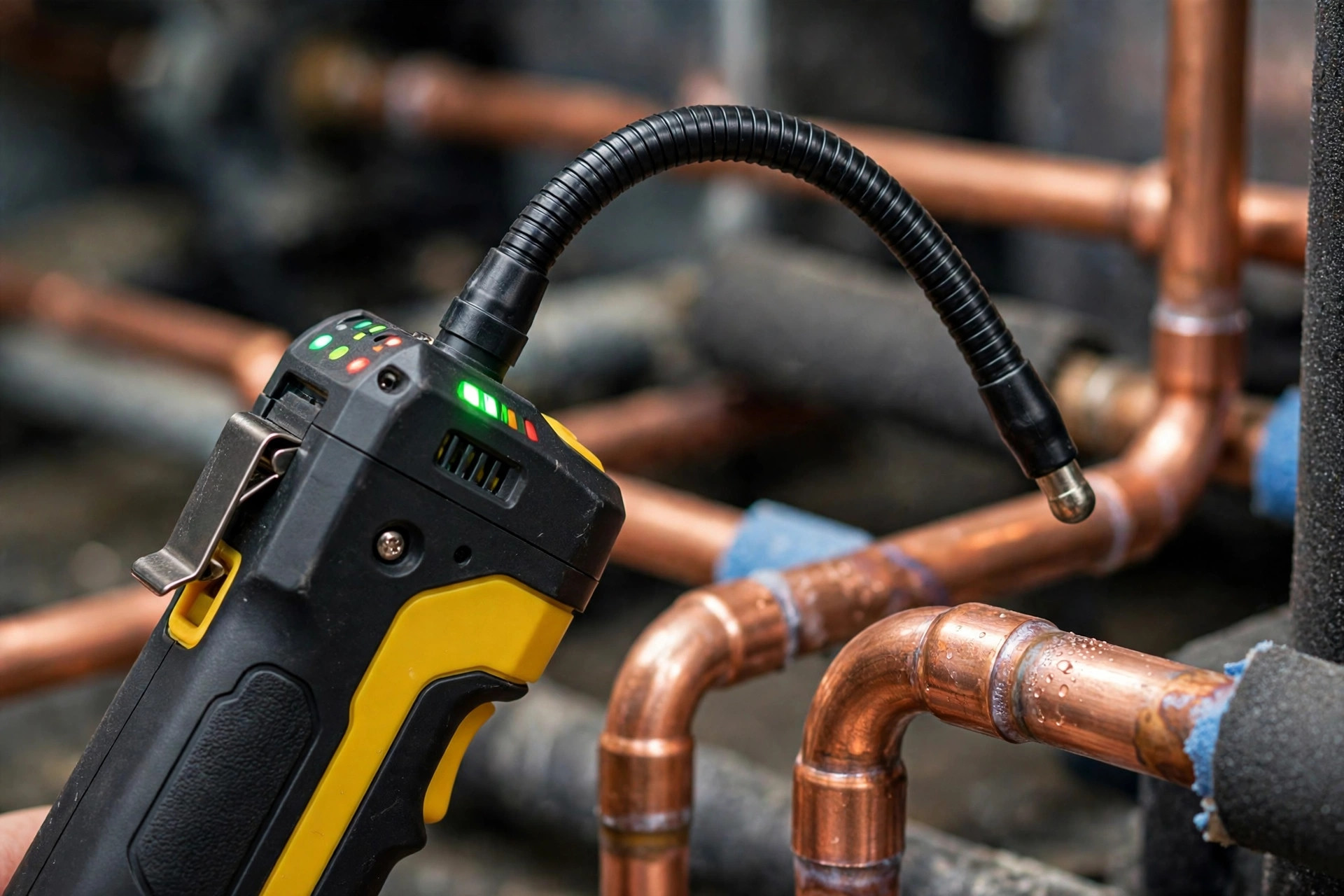
The traditional electronic refrigerant detector uses a heated diode — a small sensing element with a heated surface coated in an alkali metal salt. Here is the elegant part: when halogen atoms from leaking refrigerant reach the hot surface, they ionize, emitting positive ions. Those ions create a tiny current between electrodes, and the current spikes the moment halogen is present.
Heated-diode detectors are exquisitely sensitive to anything containing chlorine or fluorine — which covers essentially all traditional refrigerants. Sensitivity reaches fractions of an ounce per year of leak rate. The trade-offs: the sensor element is consumable (it depletes with exposure and needs periodic replacement), and it responds to any halogen source — including some cleaning solvents and even cigarette smoke — so technicians learn to distinguish a real hit from background.
How a technician hunts with a sniffer
Leak hunting is methodical. The technician calibrates the detector in clean air, sets sensitivity high, and sweeps the probe slowly — about an inch per second — around every joint, flare fitting, Schrader valve, and brazed connection, holding the tip close without touching. When the alarm sounds, they back off, reduce sensitivity, and re-approach to pinpoint: the smallest area that still triggers at the lowest sensitivity is the leak. Wind, fans, and recently serviced areas all complicate the hunt, which is why experienced techs shut down air handlers and let the space settle first.
Infrared and Ultrasonic: The Newer Approaches
Infrared refrigerant detectors
Infrared (NDIR) detectors measure absorption at wavelengths characteristic of the refrigerant molecule — the same principle as infrared methane sensing, retuned. Because the measurement is optical rather than chemical, the sensor does not deplete, does not get poisoned, and holds calibration far longer than a heated diode. It is also inherently more selective: it responds to the target molecule’s absorption bands rather than to any halogen in the air.
The catch is cost and specificity. An NDIR sensor tuned for HFC-134a may be less sensitive to HFO-1234yf, and multi-gas IR detectors need multiple optical channels. As refrigerant blends proliferate, manufacturers have responded with “universal” IR detectors covering the common families — at a premium over heated-diode units.
Ultrasonic leak detectors
Ultrasonic detectors ignore chemistry entirely. Pressurized gas escaping through a pinhole creates turbulence that emits ultrasound — typically around 40 kHz, far above human hearing. The detector’s microphone listens for that signature hiss and reports it. Because it hears the leak rather than smelling the gas, it works on any pressurized refrigerant, needs no calibration gas, and is immune to chemical cross-sensitivity.
The limitation is physics: ultrasound needs a pressure differential and a turbulent orifice. A slow weep in a calm, depressurized system makes no sound, and background ultrasound from bearings, steam traps, and electrical corona can mask or mimic leaks. Ultrasonic is a superb complement — great for scanning large pipe runs quickly — but rarely the sole instrument.
The Old Standbys: Bubbles, Dye, and Nitrogen
Electronic detectors get the glory, but three low-tech methods still do heavy lifting. Bubble solution (soapy water or commercial micro-bubble fluid) painted on a suspect joint reveals leaks as growing bubbles — cheap, unambiguous, and still the confirmation method after an electronic hit. Fluorescent dye injected into the system circulates with the oil and glows under UV light at the leak point, excellent for elusive weeps. And the nitrogen pressure test — pressurizing with dry nitrogen and watching for pressure decay — finds leaks too small for any sniffer when given enough time.
Professionals sequence these: electronic detection to find the neighborhood, bubbles or dye to confirm the exact address, nitrogen to verify the repair. No single method covers every leak geometry — a practical lesson in gas detection limits under real-world conditions, and the reason the gas sensors that detect leaks in other industries follow the same layered philosophy.
How Low-GWP Refrigerants Are Changing Detection
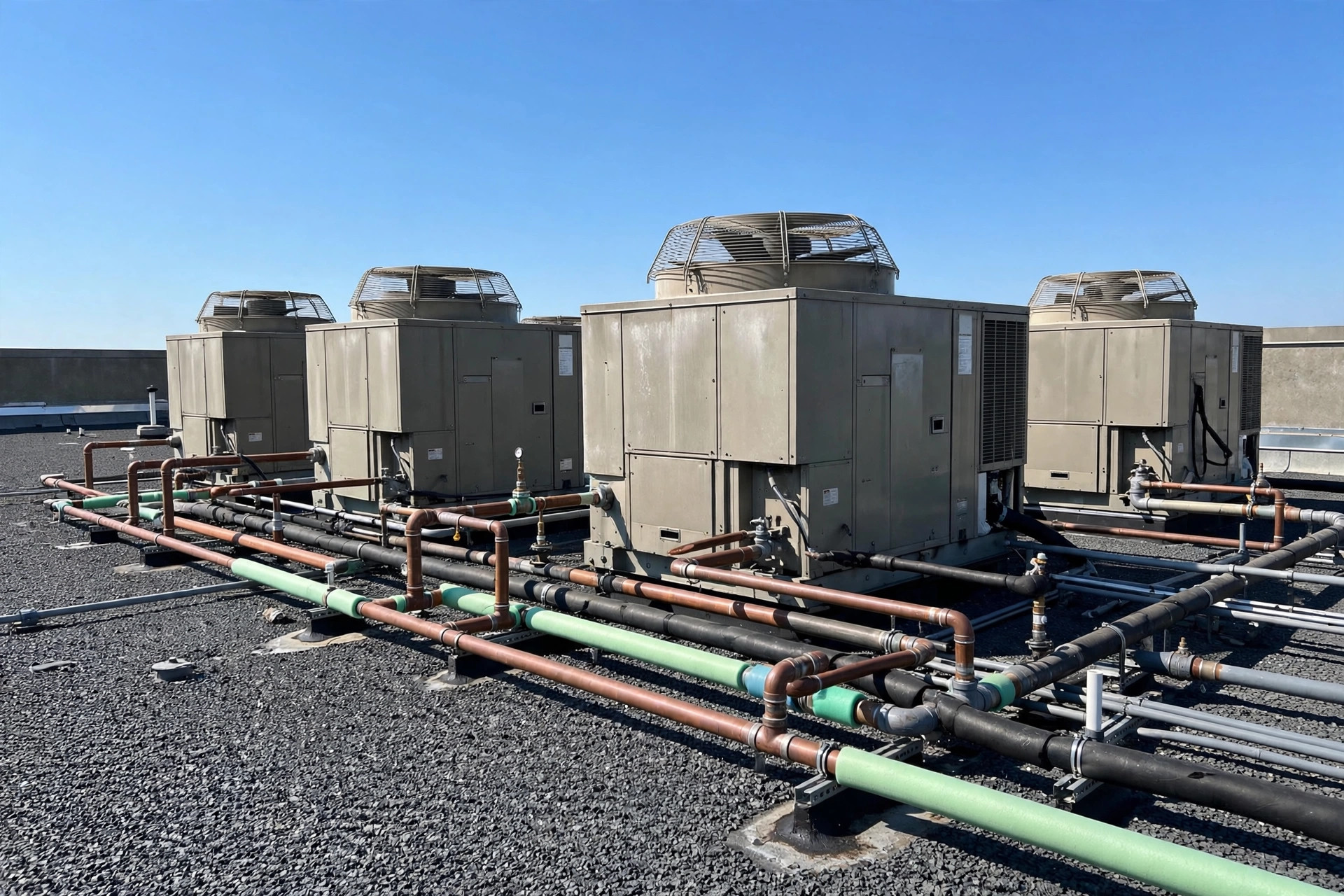
The industry’s shift to low-global-warming-potential refrigerants is rewriting detector requirements. HFOs like R-1234yf behave differently in sensors tuned for HFCs — technicians upgrading from heated-diode to IR often do so specifically for HFO sensitivity. A2L mildly flammable refrigerants (R-32, R-454B) add a second mandate: leak detection for flammability, not just charge loss, which pulls in combustible-gas sensing alongside refrigerant sensing.
Ammonia (R-717) in industrial systems is its own world — toxic at low ppm, pungent enough that noses usually win, but electrochemical ammonia sensors guard unoccupied machinery rooms. CO2 (R-744) systems need CO2 monitoring for asphyxiation risk in enclosed spaces. The trend is clear: as refrigerants diversify, “the refrigerant detector” is becoming a family of instruments, and the technician’s toolkit keeps growing.
The regulatory direction also favors earlier detection. Leak-repair mandates increasingly trigger at lower leak-rate thresholds, and some jurisdictions now require periodic inspection of smaller systems that were previously exempt. For facility managers, this turns leak detection from a breakdown activity into a scheduled program — quarterly sweeps with an electronic detector, logged and trended, catching the slow weeps before they become charge losses.
What this means for homeowners
If your residential system uses R-410A or the newer R-454B, annual leak inspection matters more than it used to — mildly flammable blends reward early detection. You cannot meaningfully hunt refrigerant leaks with a hardware-store combustible-gas sniffer; the chemistry is wrong. What you can do is watch for symptoms (declining cooling, ice on the evaporator coil, hissing, or an unexplained spike in your electricity bill) and call a technician with the right instrument — and ask whether they use heated-diode or infrared, because for modern blends the answer affects what they can find — and therefore what you end up paying to recharge.
Worth buying
For DIY-savvy homeowners and technicians, the Elitech CPU-1G HVAC Refrigerant Leak Detector, Halogen Gas Sniffer is a heated-diode unit sensitive enough to catch small halogen-refrigerant leaks around accessible fittings. As a step up with broader refrigerant coverage, the Elitech WJL-6000S Freon Leak Detector, Halogen Refrigerant Gas Sniffer adds adjustable sensitivity for pinpointing the source once you have a general location.
Disclosure: as an Amazon Associate, awasc.com earns from qualifying purchases.
Frequently Asked Questions
How do refrigerant leak detectors work?
Most use a heated-diode sensor: halogen atoms from leaking refrigerant ionize on a hot surface, creating a measurable current. Newer infrared detectors measure the refrigerant’s light absorption instead, and ultrasonic detectors listen for the high-frequency hiss of escaping gas.
Can a regular gas leak detector find refrigerant leaks?
No. Standard combustible-gas sniffers cannot detect HFC refrigerants, which are neither flammable at room conditions nor visible to catalytic-bead sensors. Refrigerant detection needs halogen-tuned or molecule-specific instruments.
What is the most sensitive way to find a refrigerant leak?
Heated-diode electronic sniffers detect fractions of an ounce per year. For confirmation, bubble solution or UV dye pinpoints the exact joint, and a nitrogen pressure-decay test verifies repairs. Professionals layer all three.
Why are new refrigerants harder to detect?
Low-GWP HFOs and blends respond differently in sensors tuned for older HFCs, and mildly flammable A2L refrigerants add a flammability-detection requirement on top of charge-loss detection. Detector technology is evolving with the chemistry.
Should homeowners buy a refrigerant leak detector?
For most homeowners, no — watching for symptoms (poor cooling, ice on coils, hissing) and calling a qualified technician is more effective. Electronic detectors need technique to use well, and the wrong sensor chemistry finds nothing.