Stuffy meeting rooms make people drowsy, slow, and headachy — and the culprit is often invisible: carbon dioxide building up from everyone’s breath. CO2 monitors promise to make that invisible buildup visible, translating the air you exhale into a number on a screen that tells you when to open a window. They have moved from laboratories and submarines into classrooms, offices, and homes.
This article explains how CO2 monitors work: the infrared sensing at their core, why they need fresh-air calibration, what the numbers mean for health and cognition, and how to use one effectively.
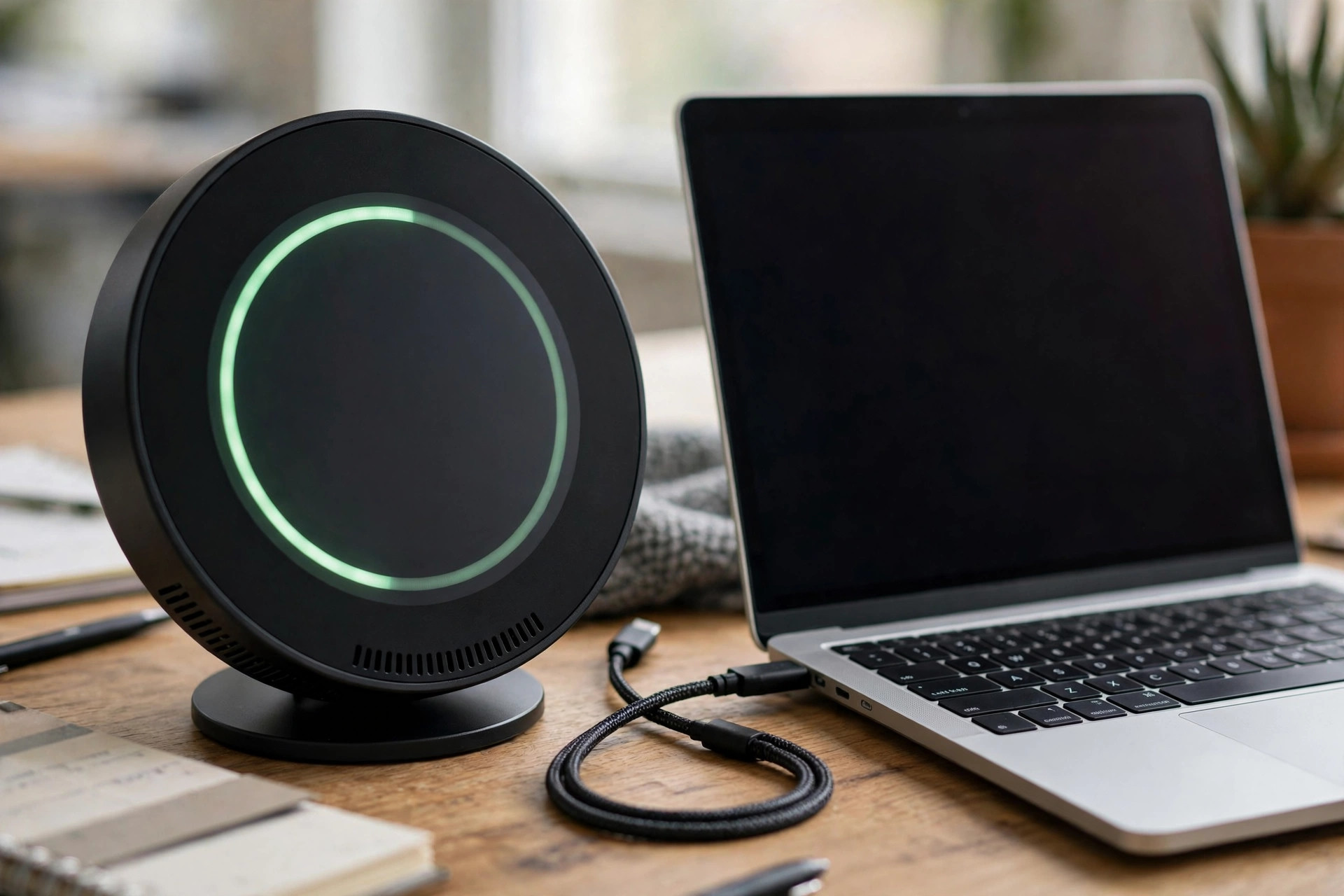
Why Carbon Dioxide Builds Up Indoors
Every person exhales roughly 35,000 to 50,000 parts per million of CO2 with each breath — about a hundred times the outdoor background of around 420 ppm. In a sealed room, that exhaled breath accumulates fast: a classroom of thirty students can push past 2,000 ppm within a single lesson if ventilation is poor.
CO2 itself becomes a problem well before it becomes dangerous. Outdoor air sits near 420 ppm. At 800–1,000 ppm, most people notice nothing, but sensitive individuals feel stuffy. By 1,500–2,000 ppm, drowsiness, headaches, and measurable drops in cognitive performance appear in studies. Above 5,000 ppm — the occupational 8-hour exposure limit — the air is genuinely unhealthy, and at 40,000 ppm it becomes immediately dangerous. The monitor’s job is to catch the climb long before the danger zone, in the range where opening a window fixes everything.
Crucially, CO2 is also a proxy. Where CO2 accumulates, so do the other things exhaled and emitted indoors — body odors, bioeffluents, and airborne pathogens. Ventilation guidance during the pandemic made this explicit: a CO2 reading is a real-time ventilation score. High CO2 does not prove the air is infectious, but it proves the air is shared and stale, which is exactly when air quality detection earns its keep.
NDIR: Measuring CO2 with Infrared Light
Nearly every CO2 monitor uses nondispersive infrared (NDIR) sensing — the same optical principle as infrared methane detection, tuned to carbon dioxide’s absorption fingerprint.
CO2’s signature wavelength
Carbon dioxide strongly absorbs infrared light at 4.26 microns. Inside the sensor, an infrared lamp shines through a small sample chamber onto a detector filtered to that wavelength. Clean air lets the beam through; CO2 in the chamber absorbs part of it. The deeper the absorption dip, the higher the concentration. Because the measurement is a direct physical absorption — not a chemical reaction — the sensor does not get consumed, poisoned, or worn out by the gas it measures.
Why dual-beam designs drift less
The classic failure of cheap NDIR sensors is drift: the IR lamp dims with age, dust films the optics, and the “zero” wanders. Better sensors use a dual-beam design — one channel measures at the CO2 absorption wavelength, a reference channel measures at a nearby wavelength CO2 ignores. The reading comes from the ratio, so lamp aging and optical fouling cancel out. Single-beam sensors compensate instead with ABC — automatic background calibration — which quietly re-zeroes the sensor to 400 ppm whenever it sees stable low readings, on the assumption that the room eventually gets fresh air.
Calibrating properly
The correct calibration ritual is simple: take the monitor outdoors (or to a well-ventilated room you know is at background), let it stabilize for 15-20 minutes, and trigger the manual calibration — usually a long press of a button. Do this every 6-12 months, and any time readings start looking suspicious. For dual-beam sensors this is mostly a formality; for single-beam units with ABC it is the difference between data and fiction. If your monitor offers no manual calibration at all, treat its absolute numbers as approximate and focus on trends instead: the shape of the curve through the day still tells you when ventilation is failing, even if the baseline is off by a hundred ppm.
The ABC trap
That assumption is the trap. If a monitor lives permanently in a stuffy bedroom that never drops to outdoor levels, ABC will slowly drag its calibration downward, and readings will understate reality. This is why quality monitors let you disable ABC and calibrate manually in known fresh air — and why a monitor that always reads a suspicious 450 ppm in a closed office deserves skepticism, not trust.
What the Numbers Mean — and What to Do About Them
Most monitors display a simple traffic-light logic: green under ~800–1,000 ppm, yellow to ~1,400, red above. The thresholds are guidance, not law, but they map well to the research: under 1,000 ppm is genuinely fresh-feeling air; sustained 1,500+ deserves action.
Offices are discovering a second use: demand-controlled ventilation. Instead of running fans on a fixed schedule, the building management system reads CO2 sensors in each zone and ventilates only where people actually are — cutting energy waste while keeping air fresh. In these systems the monitor is not a display for humans but a control input for machines, and its accuracy directly drives both comfort and the energy bill. A drifting sensor here does not just mislead; it mis-ventilates.
Action usually means ventilation, and here the monitor pays for itself as a diagnostic tool. Crack a window and watch the number fall — you have just measured your ventilation working. If numbers stay high with windows open, the problem is the building: blocked vents, a failed HVAC damper, or occupancy beyond the system’s design. That is gas concentration detected in air doing what detection is for — turning a vague complaint (“this room feels stuffy”) into a quantified, fixable problem.
Do not chase outdoor levels indoors. A lived-in room will always run a few hundred ppm above background; the goal is keeping the elevation modest, not achieving 420 ppm with the windows sealed. As a rule of thumb, if your monitor rarely drops below 1,000 ppm even overnight with the room empty, suspect calibration drift rather than a ventilation emergency — and recalibrate before blaming the building.

Limitations: What CO2 Monitors Cannot Tell You
A CO2 monitor measures CO2 — nothing else. It will not warn you about carbon monoxide (a different molecule, a different sensor), radon, formaldehyde off-gassing from new furniture, or PM2.5 from cooking. Treating a green CO2 reading as a clean bill of health for all indoor air is the most common misuse.
Placement matters more than buyers expect. CO2 is slightly denser than air and mixes well, but a monitor sitting directly above a desk of exhaling workers reads high, while one in a drafty hallway reads low. Mount it at breathing height, away from windows, doors, and direct breath, in the space people actually occupy — a monitor is only as honest as its location, so choose that location deliberately. And remember the gas detection limits in closed spaces: a monitor in the living room says nothing about the sealed bedroom down the hall.
Finally, cheap monitors lie in specific ways: slow response times that miss rapid changes, temperature sensitivity that shifts readings, and the ABC drift described above. A $30 unit is fine for learning your home’s patterns; for decisions about workplace ventilation or health, spend the extra for a dual-beam sensor with manual calibration.
Worth buying
For a bedroom or home office, the KETOTEK CO2 Monitor Indoor Air Quality Meter with Temperature & Humidity Display gives you an NDIR CO2 reading alongside temperature and humidity — the three numbers that together describe whether a room feels fresh. If you prefer a compact desktop unit, the Newentor CO2 Detector with Indoor Temperature & Humidity, Carbon Dioxide Meter offers the same core NDIR measurement in a smaller footprint for desks and nightstands.
Disclosure: as an Amazon Associate, awasc.com earns from qualifying purchases.
Frequently Asked Questions
How do CO2 monitors work?
Almost all use NDIR sensing: an infrared beam passes through an air sample, and CO2 absorbs light at its characteristic 4.26-micron wavelength. The amount of absorption translates directly into a parts-per-million reading — no chemical reaction, no consumable sensor.
What CO2 level should I worry about indoors?
Under ~1,000 ppm is good; sustained readings above 1,500 ppm call for ventilation; above 5,000 ppm (the occupational 8-hour limit) the air is unhealthy. Most indoor action happens in the 800–2,000 range, where opening a window solves the problem.
Why does my CO2 monitor always read around 400–450 ppm?
Probably automatic background calibration (ABC): the sensor assumes the room periodically reaches outdoor fresh-air levels and re-zeroes itself to 400 ppm. In a permanently stuffy room this drags readings down — disable ABC and calibrate manually in genuine fresh air.
Can a CO2 monitor detect carbon monoxide?
No. CO2 and CO are different molecules requiring different sensors. A CO2 monitor gives zero warning of carbon monoxide — you need a dedicated electrochemical CO detector for that.
Where should I place a CO2 monitor?
At breathing height in the occupied zone, away from windows, doors, vents, and direct exhaled breath. One monitor covers one room — readings do not transfer through closed doors.