You’ll measure gas concentration by converting a gas–sensor interaction into an electrical or optical signal, then relate that signal to concentration through calibration and compensation. Common approaches include electrochemical cells, semiconductor sensors, NDIR and tunable laser absorption, and photoionization for VOCs. Each method has strengths, limits, and environmental sensitivities, so you’ll need to match sensor type, sampling technique, and maintenance to the application to get reliable results—and there are trade-offs worth exploring.
How Gas Detection Works : The Basics

Because gases you need to detect are often invisible and diffuse, reliable sensing relies on measuring a physical interaction between the gas and a sensor element. You’ll focus on core gas properties—molecular weight, polarity, reactivity, and diffusion coefficient—to select appropriate detection methods.
Concentration measurement converts that interaction (e.g., heat change, conductivity shift, optical absorption) into a calibrated electrical signal. You’ll control sampling: intake location, flow rate, and temperature to reduce variability from stratification or adsorption.
Concentration measurement turns sensor interactions—heat, conductivity, or optical changes—into calibrated electrical signals; control sampling location, flow, and temperature.
Signal conditioning includes amplification, filtering, and temperature compensation to separate true concentration changes from noise and drift. Calibration against known standards establishes response curves and limits of detection; you’ll perform zero and span checks regularly.
Response time and recovery time are evaluated under defined step changes. You’ll also consider interferences: cross-sensitivity, humidity, and particulate deposition, and mitigate them via selective sensors, filters, or algorithmic compensation.
Documentation of procedures guarantees repeatable, auditable results.
Electronic Gas Detectors: Types and Uses
You’ll encounter three primary electronic detector technologies: electrochemical sensors for low‑range toxic gases with high specificity, infrared optical detectors for stable, noncontact measurement of hydrocarbons and CO2, and semiconductor metal‑oxide sensors that offer cost‑effective, broad‑spectrum sensing with temperature-dependent response.
You’ll learn how each sensor’s operating principle, response time, cross‑sensitivity, and maintenance needs determine appropriate applications and calibration protocols.
You’ll also compare lifespan, power consumption, and suitability for fixed versus portable deployments.
Electrochemical Sensors Overview
Electrochemical sensors are compact instruments that measure specific gas concentrations by converting chemical reactions at an electrode into an electrical signal; you’ll find them widely used for toxic gases (like CO, H2S) and oxygen monitoring because of their selectivity, low power draw, and linear output.
You’ll interface with a cell comprising working, counter, and reference electrodes immersed in electrolyte; target gas diffuses through a membrane, reacts at the working electrode, and generates a current proportional to concentration.
Calibration, temperature compensation, and cross-sensitivity coefficients are crucial for accurate readings. You’ll select sensor technologies based on target gas, expected range, response time, and lifetime.
Maintenance focuses on periodic calibration, membrane inspection, and replacing exhausted cells to guarantee reliable gas sensing in field or fixed installations.
Infrared Optical Detectors
When you need continuous monitoring for hydrocarbons, CO2, or other infrared-active gases, infrared (IR) optical detectors offer robust, low-drift measurements by detecting gas-specific absorption of IR light across a defined path; they convert that absorption into concentration using Beer–Lambert law–based algorithms. You’ll deploy IR sources and detectors aligned across a sample path; measured attenuation at target wavelengths gives quantitative gas concentration with minimal cross-sensitivity. Optical designs include single-beam, dual-beam, and non-dispersive infrared (NDIR) implementations; signal processing corrects for source drift and particulate interference. Typical applications are leak detection, process control, and ambient monitoring where infrared absorption is selective. The table below summarizes common features, advantages, and limitations.
| Feature | Advantage | Limitation |
|---|---|---|
| Selectivity | High for IR-active gases | Inactive gases undetectable |
| Stability | Low drift | Requires calibration |
Semiconductor Metal Oxide
Semiconductor metal oxide (SMO) sensors use a heated metal-oxide semiconductor surface—commonly tin dioxide (SnO2), zinc oxide (ZnO), or tungsten oxide (WO3)—whose electrical resistance changes when target gas molecules adsorb and react, allowing you to detect and quantify oxidizing or reducing gases by measuring resistance shifts.
You’ll rely on tailored semiconductor materials and microheater control to set operating temperature, optimize sensitivity, and reduce cross-sensitivity. Signal conditioning converts resistance change to concentration via calibration curves; drift compensation and periodic recalibration maintain accuracy.
- Understand operating principle and temperature dependence to choose sensor applications.
- Evaluate selectivity strategies: dopants, filters, and sensor arrays with pattern recognition.
- Implement calibration, baseline stabilization, and interference mitigation for reliable field performance.
Optical and Spectroscopic Methods for Trace Gases
You’ll examine tunable diode laser absorption spectroscopy (TDLAS) for rapid, line-specific quantification of trace gases using narrowband near-infrared or mid-infrared lasers and wavelength modulation to improve sensitivity.
You’ll also consider Fourier transform infrared spectroscopy (FTIR) for broadband, multi-species detection and spectral fitting against high-resolution databases to extract concentrations.
Comparison will focus on detection limits, spectral interference, response time, and field-deployable versus laboratory configurations.
Tunable Diode Laser Absorption
Tunable diode laser absorption spectroscopy (TDLAS) uses narrow-linewidth semiconductor lasers swept across a specific molecular absorption line to measure trace gas concentration via Beer–Lambert attenuation; you’ll tune the laser wavelength, detect transmitted intensity, and convert absorption depth—corrected for path length and pressure/temperature—into concentration using known line-strength and line-shape parameters.
You’ll employ tunable lasers to interrogate isolated lines, compare measured absorption spectra to modeled profiles, and minimize cross-interference. Detection is direct, fast, and highly selective.
- Configure a single-pass or multipass cell to increase effective path length and improve sensitivity.
- Implement wavelength modulation or direct absorption with calibrated laser tuning to reject noise.
- Apply real-time fitting of absorption spectra with temperature/pressure compensation and baseline correction.
You’ll get parts-per-billion sensitivity for well-chosen alterations.
Fourier Transform Spectroscopy
Fourier transform spectroscopy (FTS) is a broadband, high-resolution technique that measures trace-gas absorption by recording an interferogram and converting it to a spectrum via Fourier transform, letting you capture many molecular lines simultaneously with high throughput and precise wavenumber calibration. You use FTS to resolve narrow absorption features across wide bands, adjusting spectral resolution by changing maximum optical path difference. In practice, you align a Michelson interferometer, collect interferograms, apply phase correction and apodization, then Fourier-transform to retrieve calibrated spectra for concentration retrieval via line-by-line fitting.
| Parameter | Typical value |
|---|---|
| Spectral resolution | 0.001–0.5 cm⁻¹ |
| Bandwidth | 0.1–5 µm |
| Throughput | High (Jacquinot advantage) |
| Noise-equivalent conc. | ppb–ppm depending on pathlength |
Chemical and Colorimetric Gas Tests for Quick Field Checks

When you need a fast, low-cost indication of specific gases on site, chemical and colorimetric tests offer portable, user-friendly responses by producing a color change proportional to analyte presence.
You’ll use chemical indicators in the field to convert a targeted gas into a visually quantifiable signal; reagents are chosen for selectivity, reaction kinetics, and stability. Colorimetric analysis lets you read concentration semi-quantitatively against a calibrated chart or with a handheld photometer for improved precision.
Procedures emphasize sampling time, temperature control, and avoidance of interferents.
- Test strips and badges — single-use devices impregnated with chemical indicators for quick pass/fail screening.
- Tube-based colorimetric methods — draw known volume through reagent-packed glass tubes; measure stain length or intensity.
- Wet-chemistry kits — mix sample with reagent solutions, then compare color to standards or measure absorbance.
You’ll rely on these methods for rapid decisions, confirmatory checks, and when instrumental access is limited.
What Affects Sensor Accuracy and Detection Limits
Although many factors interplay, sensor accuracy and detection limits are ultimately governed by the transduction mechanism, noise sources, and sampling conditions you control in the field or lab.
You need to evaluate inherent sensor sensitivity factors: detection principle (electrochemical, PID, NDIR, MOS), active surface area, catalyst or membrane selectivity, and signal conditioning bandwidth.
Noise sources—thermal, shot, 1/f, and interference from co‑pollutants—set the practical limit of detection; reducing amplifier noise and increasing integration time improves precision but can slow response.
Environmental influences such as temperature, humidity, pressure, and flow rate alter reaction kinetics, diffusion rates, and baseline drift; you must apply temperature compensation, humidity corrections, and controlled sampling to mitigate these effects.
Calibration frequency, reference gas quality, and sensor aging (drift, poisoning) further constrain accuracy over time.
Design your measurement protocol to quantify uncertainty: characterize limit of detection, quantitation, linear range, and repeatability under representative environmental influences and sampling regimes.
Choosing a Gas Detector for Home, Industry, or Research
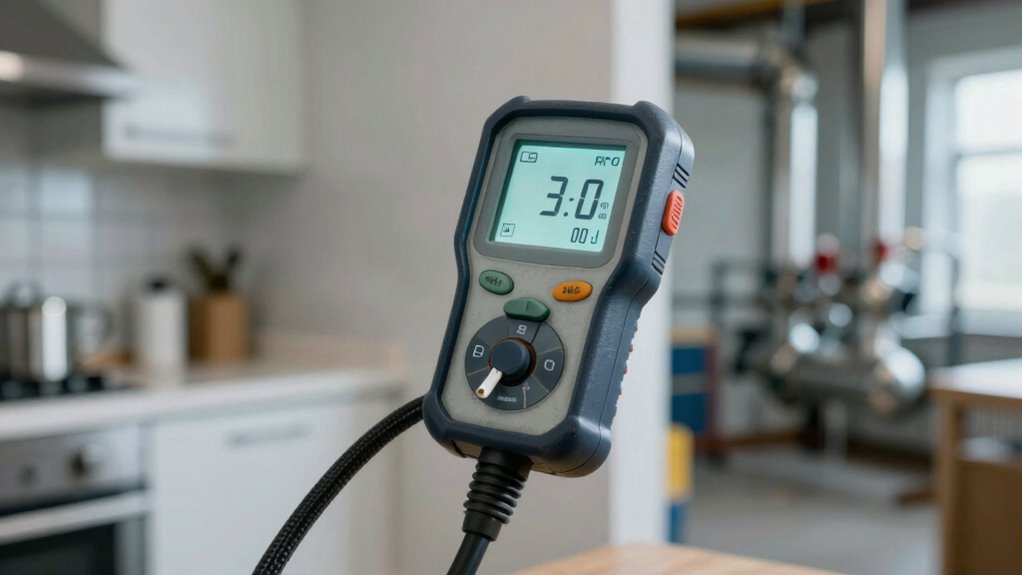
Choosing the right gas detector starts with matching the device’s sensing principle and performance envelope to your application: home safety needs low-cost, low-maintenance detectors tuned to common hazards (CO, natural gas, smoke).
Choosing the right gas detector means matching sensor type and performance to the application — from simple home safety to industrial needs.
Industrial settings demand robust sensors with higher accuracy, wider dynamic range, and intrinsic safety ratings.
Research applications require calibrated instruments with known limits of detection, traceable calibration, and configurable sampling.
You’ll assess detector features against gas types, environmental factors, and applicable industry regulations. Consider response time, cross-sensitivity, measurement range, and ingress protection.
- For home safety: prioritize simple user interface, low false-alarm rate, predictable maintenance schedules, and compatibility with common gas types.
- For industry: select units meeting industry regulations, hazardous-area certifications, and modular sensors for multiple analytes.
- For research applications: choose instruments supporting documented calibration techniques, data logging, and configurable sampling rates.
Make procurement decisions based on validated performance data, serviceability, and how environmental factors affect sensor drift and operational lifetime.
Sampling, Calibration, and Maintenance Best Practices
Maintenance and calibration routines are what keep gas detectors reliable and compliant, so you should establish documented sampling schedules, calibration intervals, and maintenance checks tailored to the sensor type and deployment environment.
You’ll define sampling techniques (direct-read, pumped, or diffusion) based on response time, location access, and expected concentrations; use probe placement and flow rates to avoid dilution or stagnant zones.
Set calibration frequency by sensor drift characteristics and regulatory requirements—electrochemical cells often need monthly checks, PID and catalytic sensors weekly to monthly, and infrared sensors quarterly to semiannually.
Create maintenance schedules that include functional bump tests, filter inspection, connector cleaning, and firmware verification; log all actions for traceability.
Monitor performance trends to determine sensor replacement before end-of-life or failed linearity. For critical systems, implement redundant sensors and automated span checks.
Gas detectors worth buying
If this article has you thinking about the gas risks in your own home, a dedicated detector is the practical next step. These handheld and plug-in units cover the gases discussed above.
- Detects natural gas, methane, propane and LPG
- Audible + visual alarm that scales with concentration
- Handheld sniffer with flexible gooseneck probe
- Portable combustible-gas sniffer for methane/propane
- Adjustable sensitivity with bar-graph readout
- Pocket-size for checking joints, valves and lines
Disclosure: as an Amazon Associate, awasc.com earns from qualifying purchases.
Frequently Asked Questions
How Do Gas Detectors Handle Extremely Cold or Hot Environments?
You’ll use temperature compensation and regular sensor calibration to maintain accuracy; ruggedized housings, heaters or coolers, and vendor-specified operating ranges mitigate extremes, while diagnostics and drift checks guarantee reliable readings in very cold or hot environments.
Can Pets or Plants Affect Indoor Gas Readings?
Like a whisper altering a room’s hum, yes — pet emissions and plant respiration can slightly skew indoor gas readings; you’ll need calibrated sensors, controlled sampling locations, and compensation algorithms to maintain precise, practical monitoring accuracy.
Are There Health Symptoms That Require Immediate Detector Replacement?
Yes — if you experience dizziness, headache, nausea, confusion or loss of consciousness, you should replace the detector immediately; perform detector maintenance and sensor calibration checks after symptoms to verify device integrity and continued safety.
How Are Cross-Sensitivities Tested in Multi-Gas Sensors?
You test cross-sensitivities by exposing the multi-gas sensor to controlled interferents and target gases simultaneously, performing cross sensitivity analysis, then adjusting sensor calibration accordingly; you’ll document response matrices, repeatability, and drift under defined conditions.
Can DIY Sensors Be Legally Used in Commercial Settings?
You generally can’t rely on DIY sensors for commercial use without certification; you’ll need to meet DIY regulations, validate sensor accuracy through calibrated testing, document compliance, and often use certified devices or third-party-approved systems for legal deployment.