Leak detectors identify the presence of water by sensing environmental changes such as moisture accumulation, conductivity variation, and temperature shifts rather than relying solely on flow measurement. Components like moisture sensors, conductivity probes, and temperature detectors work in conjunction to trigger alerts when water is detected in unintended areas, enabling early leak identification even when water flow remains constant or minimal. This approach addresses the challenge of undetected leaks that do not produce measurable flow changes, which can lead to prolonged water damage. The article examines the detection mechanisms, sensor integration strategies, and system design considerations that enable reliable water presence identification without flow data.
Why Leak Detectors Don’t Need to Measure Water Flow
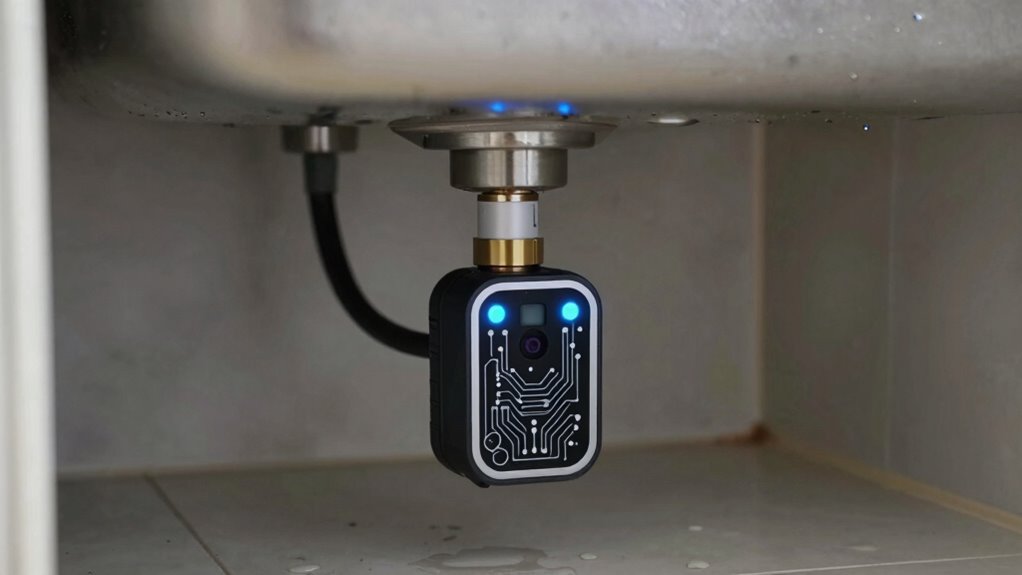
Although measuring water flow might seem essential for detecting leaks, leak detectors don’t actually require this data to identify water presence effectively. Flow measurement involves quantifying the volume or rate of water passing through a pipe, which can be complex and expensive.
Instead, leak detection focuses on identifying anomalies such as moisture accumulation, conductivity changes, or pressure variations that directly indicate water presence. By bypassing flow measurement, you gain a simpler, more reliable detection method that isn’t dependent on maintaining constant flow data or complex calibration.
Leak detection targets moisture and pressure anomalies, offering simpler, more reliable alerts without complex flow data.
This approach enables quicker response times and reduces false alarms caused by fluctuating flow rates unrelated to leaks. Essentially, you don’t need to monitor how much water is flowing; you only need to detect where unwanted water is.
This distinction empowers you to implement leak detection systems that provide freedom from continuous flow monitoring while ensuring effective and timely alerts about water intrusion.
How Leak Detectors Sense Water Without Measuring Flow
You don’t always need to measure water flow to detect leaks because many sensors rely on direct contact or environmental changes.
Common sensor types include conductive, capacitive, and moisture-sensitive materials that trigger alerts when water is present.
Understanding these detection mechanisms helps clarify how leak detectors identify water without flow measurement.
Sensor Types Explained
Effective water leak detection relies on sensors designed to identify the presence of water without measuring flow rates.
You’ll find that various sensor technologies excel in detection accuracy by targeting different physical properties. Understanding these sensor types helps you select solutions that balance sensitivity and reliability, ensuring freedom from unnoticed leaks.
- Conductivity Sensors: Detect water by measuring electrical conductivity changes.
- Capacitive Sensors: Sense variations in dielectric constant when water is present.
- Optical Sensors: Use light refraction or absorption changes to identify moisture.
- Acoustic Sensors: Pick up sound waves generated by leaks without flow measurement.
- Humidity Sensors: Monitor ambient moisture levels indicating potential leaks.
Each type offers distinct advantages, enabling you to tailor leak detectors to your specific environment and needs.
Detection Mechanism Basics
Leak detectors identify the presence of water by responding to specific physical changes rather than tracking flow rates. You rely on the sensor functionality designed to detect alterations such as changes in electrical conductivity, humidity, or capacitance when water is present.
These sensors operate independently of flow measurement, focusing instead on direct water contact or environmental shifts. This approach enhances detection accuracy by minimizing false positives associated with flow fluctuations.
For example, moisture sensors detect water by a measurable change in resistance, while capacitive sensors sense dielectric variations caused by water. Understanding these mechanisms empowers you to select systems that prioritize immediate and reliable detection, granting you freedom from complex flow monitoring while maintaining precise leak identification.
This precision is essential in applications demanding prompt response to water presence.
How Electrical Conductivity Detects Water Leaks

Although water is a poor conductor on its own, impurities and dissolved minerals greatly increase its electrical conductivity, allowing detectors to identify leaks by measuring changes in resistance between sensor probes.
When water contacts the sensor, the electrical resistance drops, signaling a breach. This principle underpins conductivity testing, a reliable method for leak detection without needing to measure flow.
You benefit from this technique because it provides:
- Immediate detection of conductive liquid presence.
- High sensitivity to small volumes of leak water.
- Resistance-based thresholds for precise alerts.
- Minimal false positives in dry conditions.
- Easy integration in various environments and surfaces.
How Moisture Sensors Catch Hidden Leaks Early
You can detect hidden leaks early by using moisture sensors that monitor changes in humidity and soil moisture levels.
These sensors provide real-time data, allowing you to identify leaks before they cause significant damage.
Implementing this method enhances your ability to respond quickly, reducing repair costs and preventing structural issues.
Early Leak Detection Methods
Early detection of water intrusion relies heavily on moisture sensors that can identify subtle changes in humidity or dampness before visible damage occurs.
You’ll find that early leak detection methods blend traditional methods with advanced technologies to maximize accuracy and responsiveness. Traditional methods like visual inspections and manual moisture meters provide baseline assessments but lack continuous monitoring capabilities.
Advanced technologies, including wireless moisture sensors and infrared thermography, offer real-time data and pinpoint hidden leaks quickly. These methods empower you to act swiftly, preventing costly damage.
- Continuous humidity monitoring for early anomaly detection
- Wireless sensor networks enabling flexible placement
- Infrared imaging to reveal concealed moisture
- Data analytics for trend identification
- Automated alerts minimizing response time
Together, these tools grant you freedom from undetected leaks.
Benefits Of Moisture Sensors
Building on the advancements in continuous humidity monitoring and wireless sensor networks, moisture sensors excel at detecting hidden leaks that often evade traditional inspection methods.
By providing real-time moisture detection, these sensors enable you to identify leaks before they cause significant damage. Their high sensor reliability guarantees consistent performance even in challenging environments, minimizing false alarms and maintenance downtime.
With precise data on moisture levels, you gain actionable insights, allowing timely interventions that preserve structural integrity and prevent costly repairs.
Furthermore, moisture sensors can be strategically placed in inaccessible or concealed areas, granting you freedom from manual inspections.
This proactive approach not only safeguards your property but also optimizes resource allocation, making moisture sensors indispensable for efficient, early leak detection without relying on flow measurement.
How Acoustic Sensors Detect Water Through Vibrations

Although acoustic sensors rely on detecting vibrations, their effectiveness in identifying water leaks comes from analyzing the specific frequency patterns generated by escaping fluid. When water leaks under pressure, it creates unique acoustic waves that propagate through pipes and surrounding materials.
You can’t just detect any vibration; you need vibration analysis to differentiate leak signals from ambient noise. Acoustic sensors capture these subtle waveforms, then algorithms isolate characteristic frequencies indicative of water leaks. This method allows you to pinpoint leak locations without direct flow measurement.
Key aspects include:
- Detection of high-frequency acoustic waves caused by turbulent water flow at leak points
- Filtering background noise via advanced signal processing
- Real-time vibration analysis to monitor changes over time
- Sensitivity to pipe material and environmental conditions
- Wireless sensor networks enabling flexible deployment and continuous monitoring
How Humidity Sensors Help Spot Indoor Water Leaks
Humidity sensors play a critical role in detecting indoor water leaks by continuously measuring moisture levels in the air. When a leak occurs, excess water vapor increases local humidity, which these sensors detect promptly through precise humidity detection.
By analyzing changes in relative humidity, the sensors identify abnormal moisture patterns, signaling a potential leak even before any visible damage appears. This proactive moisture measurement helps prevent costly repairs and maintains your indoor environment’s integrity.
You’ll appreciate that humidity sensors can operate independently of water flow, providing an added layer of leak awareness where traditional flow-based detectors fall short. Their sensitivity to subtle humidity fluctuations guarantees early warning, empowering you to act swiftly and maintain control over your space.
Humidity sensors detect leaks even without water flow, offering early alerts through subtle moisture changes.
In environments where water presence isn’t obvious, humidity detection offers a non-invasive, reliable method to spot leaks early, enhancing your freedom to manage water issues proactively and avoid disruptions caused by hidden moisture accumulation.
How Contact Sensors Detect Water by Surface Touch
Contact sensors detect water by directly sensing moisture when it touches a surface, providing immediate confirmation of a leak. These sensors rely on contact detection principles, where electrodes or conductive elements respond to the presence of water by completing an electrical circuit.
Surface sensitivity is critical, as the sensor must accurately discern water contact without false triggers from humidity or condensation. When water bridges the sensor’s conductive parts, it changes the electrical resistance, triggering an alert.
By using contact sensors, you gain precise, real-time detection that doesn’t depend on flow measurement. This method is especially useful for localized leak detection in areas where water pooling poses risks.
- Immediate response upon water surface contact
- High surface sensitivity reduces false alarms
- Compact design suits constrained spaces
- Electrical resistance changes enable accurate detection
- Suitable for detecting small, early-stage leaks
This technology empowers you to address leaks promptly, maintaining control and preventing costly damage.
Overview of Key Non-Flow Leak Detection Technologies
While surface touch sensors excel at detecting water presence at specific points, a range of other non-flow leak detection technologies offer alternative approaches to identifying leaks without measuring fluid flow.
Acoustic sensors, for instance, leverage sound wave analysis to detect anomalies caused by escaping water, enabling early leak identification in pressurized systems. Similarly, humidity sensors monitor ambient moisture levels, signaling leaks through changes in relative humidity.
Infrared thermography detects temperature variations induced by moisture presence, providing visual leak mapping without direct contact. Additionally, chemical sensors identify specific compounds in water, alerting you to contamination linked with leaks.
These technologies reflect significant leak detection advancements, granting you flexibility to select methods tailored to your environment. By integrating these tools, you gain thorough monitoring capabilities that don’t depend on flow measurement, enhancing leak detection responsiveness while preserving operational freedom.
Embracing these innovations guarantees you stay ahead in protecting infrastructure without flow-based constraints.
Why Detecting Leaks Without Measuring Flow Is Beneficial
Because you don’t always have access to flow data or want to avoid intrusive installation, detecting leaks without measuring flow offers distinct advantages.
Detecting leaks without flow measurement offers clear benefits when flow data is unavailable or installations must remain non-intrusive.
This approach provides you with flexibility while maintaining high sensitivity and accuracy. It eliminates the need for complex integration with existing flow systems, reducing both upfront and maintenance costs.
The leak benefits extend to quicker deployment and less disruption in operational environments, granting you freedom from dependence on flow meters.
Key advantages include:
- Reduced installation complexity by avoiding flow sensor retrofitting
- Lower overall cost savings through minimized hardware and labor
- Enhanced adaptability in diverse piping systems and materials
- Improved early leak detection without waiting for anomalous flow patterns
- Increased reliability in environments where flow data is unreliable or inaccessible
How to Place Leak Sensors for Best Leak Detection
To guarantee effective leak detection, you’ll need to position sensors at critical points where water accumulation is most likely, such as near joints, valves, and low-lying areas.
Consider environmental factors like temperature, humidity, and potential interference that could affect sensor accuracy.
Proper placement tailored to your system’s layout maximizes early leak identification and minimizes damage risk.
Optimal Sensor Placement
Although selecting the right leak detector is essential, placing sensors ideally is equally important to guarantee early and accurate water leak detection.
Ideal sensor placement hinges on strategic positioning to maximize coverage and minimize blind spots. When planning your sensor deployment, focus on areas prone to leaks or water accumulation. You want sensors to detect moisture promptly, enabling swift action.
Consider these key principles for ideal placement:
- Install sensors near joints, valves, and fittings where leaks commonly occur
- Position sensors along the lowest points in a system for natural water flow detection
- Maintain sensor spacing to avoid gaps in coverage without excessive overlap
- Use multiple sensors in large or complex piping networks for thorough monitoring
- Confirm sensors are accessible for maintenance without compromising detection capabilities
This approach grants you freedom to monitor efficiently and confidently.
Environmental Considerations
Beyond strategic sensor placement based on system layout, environmental factors play a significant role in optimizing leak detection performance. When positioning leak detectors, you need to evaluate ambient conditions like temperature, humidity, and exposure to contaminants, as these affect sensor accuracy and durability.
Integrating sustainable technology means selecting sensors resistant to environmental degradation, ensuring long-term reliability while supporting water conservation goals. You should place sensors where water is most likely to accumulate, such as low points or near joints, but also where environmental interference is minimal.
Proper environmental assessment reduces false alarms and maximizes detection speed, allowing you freedom from unnecessary maintenance. By aligning sensor placement with environmental realities and sustainability principles, you enhance your system’s precision and contribute proactively to efficient water management.
How Smart Leak Detectors Work With Home Automation
When you integrate smart leak detectors with your home automation system, you gain real-time monitoring and automated responses that can considerably reduce water damage.
These devices leverage smart home integration to provide seamless communication with your existing network, enabling automated alerts directly to your smartphone or control hub. This means you’re instantly informed of potential leaks without waiting for visible signs or manual checks.
Key functionalities include:
- Continuous environment sensing without measuring flow rates
- Immediate automated alerts via app notifications or emails
- Integration with smart valves to shut off water supply automatically
- Data logging for trend analysis and predictive maintenance
- Compatibility with other home systems such as HVAC and security
Comparing Non-Flow Leak Detection to Flow-Based Systems
Because leak detection technologies serve different needs, understanding the distinctions between non-flow and flow-based systems is essential for selecting the right solution.
Non-flow leak detectors rely on sensors that detect the presence of water directly, offering non-flow advantages such as immediate localized detection without requiring integration into the plumbing system. This independence grants you installation flexibility and reduces complexity, especially in retrofit scenarios.
Conversely, flow-based systems monitor water movement through pipes, identifying anomalies in flow patterns. However, flow limitations include potential false alarms due to normal usage fluctuations and challenges detecting small or slow leaks when baseline consumption varies.
While flow-based systems excel in continuous monitoring of entire plumbing networks, they may struggle with pinpoint accuracy in complex setups.
By understanding these technical differences, you can better align your choice with your specific requirements—whether you prioritize rapid localized alerts with non-flow advantages or thorough system monitoring despite flow limitations.
This clarity empowers you to maintain your water infrastructure efficiently and freely.
How Leak Detectors Tell the Difference Between Spills and Leaks
When you examine leak detectors, you’ll find they analyze specific leak patterns to distinguish between transient spills and continuous leaks.
They also differentiate water sources by monitoring flow rates and sensor inputs to identify anomalies.
Understanding these mechanisms helps you interpret alerts with greater accuracy and respond appropriately.
Detecting Leak Patterns
Although both spills and leaks involve unwanted water presence, leak detectors use distinct pattern recognition algorithms and sensor data analysis to differentiate between the two.
By leveraging advanced leak detection technologies and moisture sensor advancements, these systems identify characteristic signatures unique to persistent leaks versus transient spills. You’ll notice that leak patterns exhibit consistent moisture levels over time, whereas spills show abrupt spikes followed by rapid drying.
Key factors analyzed include:
- Temporal stability of moisture readings
- Spatial distribution of detected water
- Rate of moisture accumulation
- Sensor response duration
- Recurrence frequency of wetness signals
This analytical approach empowers you to trust leak detectors in distinguishing ongoing leaks from one-time spills, ensuring freedom from false alarms and enhancing water damage prevention strategies.
Differentiating Water Sources
Understanding leak patterns sets the stage for accurately differentiating water sources in detection systems. When you analyze the characteristics of water presence—such as duration, volume, and location—your leak detector can perform precise leak differentiation.
It distinguishes between transient spills and persistent leaks by evaluating temporal patterns and moisture spread. For example, a spill typically manifests as a sudden, localized moisture event, whereas a leak shows gradual, continuous water accumulation.
Advanced sensors integrate this data, enabling you to identify genuine leaks without measuring flow directly. By focusing on these nuanced differences, you gain freedom from false alarms and unnecessary interventions.
Ultimately, mastering leak differentiation empowers you to maintain system integrity and efficiency, ensuring that only critical water sources trigger alerts.
How Long Do Non-Flow Leak Detectors’ Batteries Last?
How long can you expect the batteries in non-flow leak detectors to last before needing replacement? Typically, the battery lifespan ranges from 1 to 3 years, depending on device specifications and usage conditions.
These detectors use low-power sensors, optimizing energy consumption to extend battery life without compromising detection accuracy.
To maximize battery lifespan, consider these maintenance tips:
- Regularly test detector functionality to identify declining battery performance early.
- Replace batteries promptly when low-battery alerts activate to avoid system downtime.
- Store detectors in environments within recommended temperature ranges to preserve battery efficiency.
- Use high-quality batteries as specified by the manufacturer to guarantee consistent power supply.
- Limit unnecessary alarm tests that consume additional battery power.
How to Troubleshoot False Alarms in Leak Detectors
When false alarms occur in leak detectors, you need to systematically identify their source to maintain system reliability. Start with false alarm troubleshooting by checking for environmental factors like humidity or dust that may trigger sensors. Next, verify sensor calibration; improper calibration often leads to inaccurate readings and false alerts. Regular sensor maintenance and recalibration are essential to guarantee accuracy.
| Issue | Possible Cause | Recommended Action |
|---|---|---|
| False alarm frequency | Sensor drift | Recalibrate sensors |
| Intermittent alarms | Environmental noise | Shield or relocate sensors |
| Continuous false alarms | Hardware malfunction | Inspect and replace sensor |
Leak protection worth buying
A sensor is only useful if it warns you in time. These smart detectors and alarms turn the detection principles above into real protection for your home.
- WiFi alerts via SMS, email and app push
- Loud on-device siren plus phone notifications
- 2-pack covers two leak-prone spots
- 110 dB alarm warns of rising sump water
- 10 ft float switch for early warning
- Indoor/outdoor rated for basements and crawl spaces
Disclosure: as an Amazon Associate, awasc.com earns from qualifying purchases.
Frequently Asked Questions
Can Leak Detectors Be Used in Outdoor Plumbing Systems?
Yes, you can use leak detectors in outdoor plumbing systems; they provide precise leak detection by monitoring pressure changes or acoustic signals, allowing you to maintain freedom from water waste and costly damage without relying on flow measurements.
Are Leak Detectors Safe for Use Near Electrical Appliances?
Of course, your blender won’t start a rebellion against leak detectors—yes, they’re designed with leak detector safety and appliance compatibility in mind, ensuring they coexist peacefully near electrical appliances without sparking any unintended chaos or hazards.
How Often Should Leak Detectors Be Maintained or Replaced?
You should perform maintenance frequency checks every 6-12 months to guarantee peak function, considering the detector lifespan typically spans 3-5 years; timely replacement preserves detection accuracy and maintains your freedom from unexpected water damage.
Do Leak Detectors Work in Freezing Temperatures?
Imagine your cabin’s leak detector alerting you despite freezing conditions. Yes, they function in freezing temperatures, but temperature sensitivity varies. Choose models designed for cold to guarantee reliable detection without false alarms or system failures.
Can Leak Detectors Be Integrated With Smartphone Alerts?
Yes, you can enable smartphone integration with many leak detectors, allowing instant alert notifications. This guarantees you maintain control and freedom by remotely monitoring potential leaks, enhancing your property’s safety through precise, real-time communication.