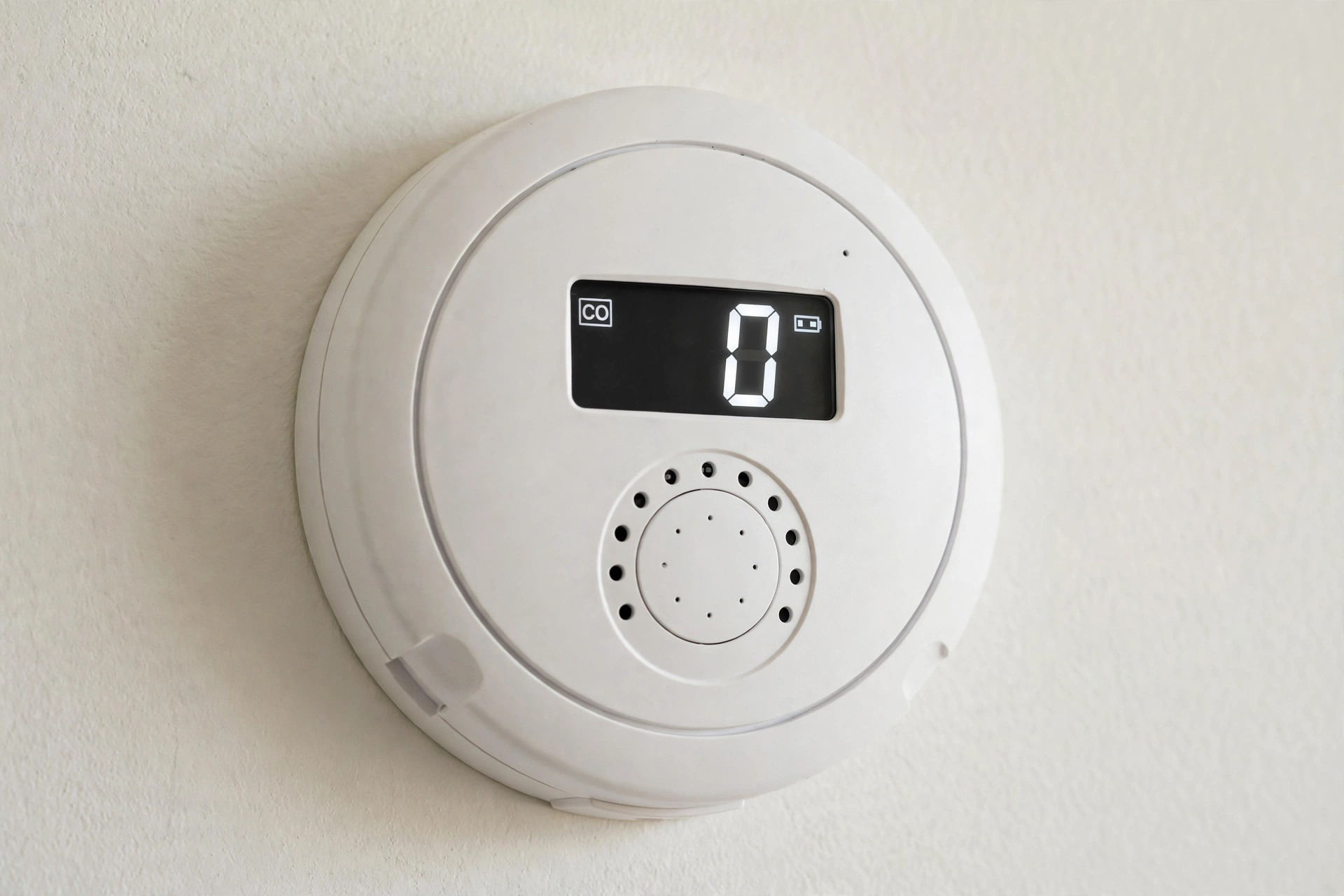
You cannot see carbon monoxide, smell it, or taste it. That single fact is what makes it dangerous — and it is also the reason your own senses are useless against it. Carbon monoxide (CO) sends tens of thousands of people to emergency departments every year, and the only reliable warning most homes have is a small plastic box on the wall that never sleeps.
This article explains how that box works. You will learn what happens inside a carbon monoxide detector at the chemical level, why alarms are deliberately designed not to sound the instant they sense gas, which sensing technologies manufacturers use, and where these devices fall short — so you can place, test, and trust yours with a clear understanding of the mechanism.
Why Your Senses Cannot Catch Carbon Monoxide
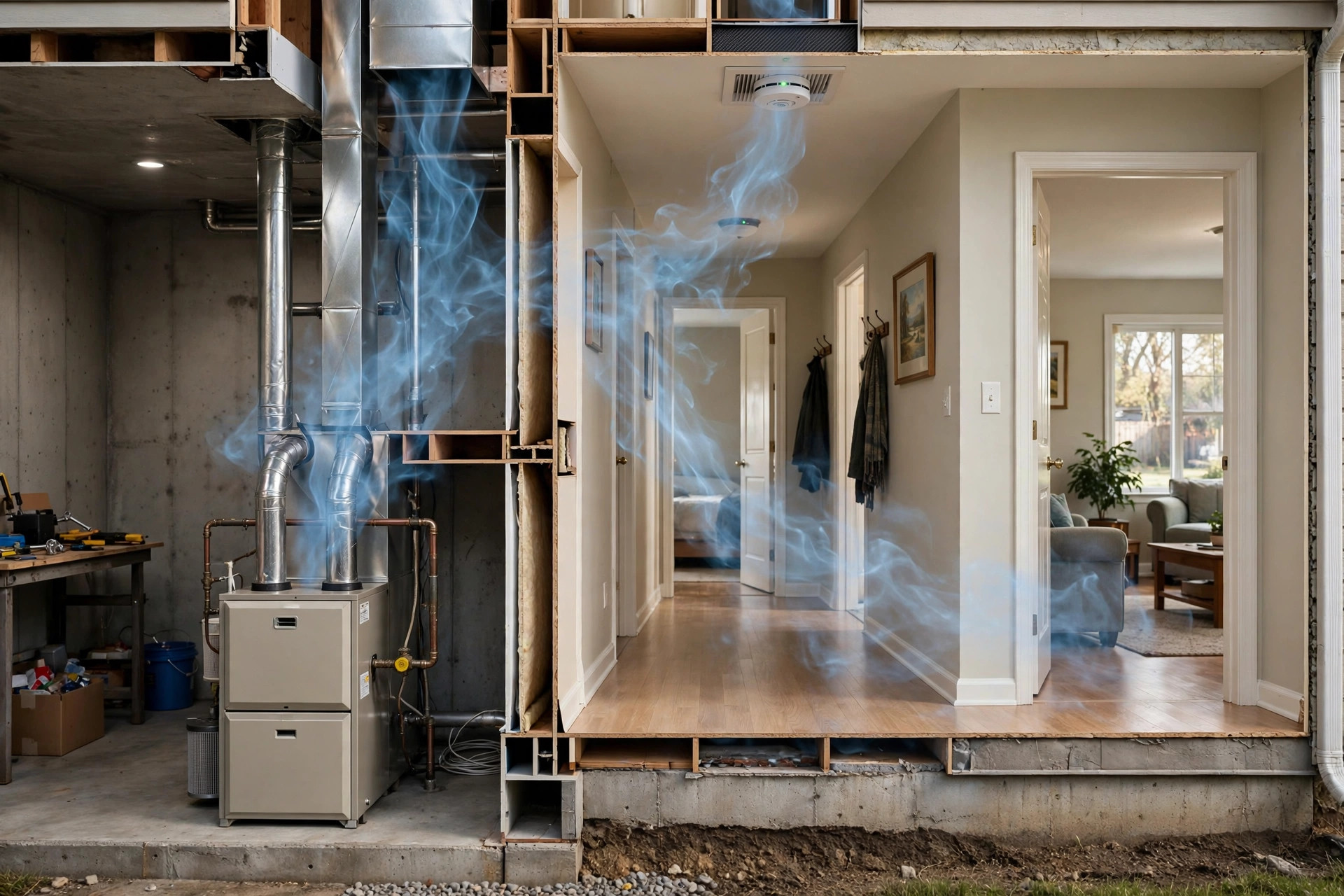
Carbon monoxide is produced whenever fuel burns incompletely: a malfunctioning furnace, a blocked chimney, a car idling in an attached garage, a portable generator running too close to the house. The gas itself is colorless and odorless, but the real problem is what it does inside you.
When you breathe, oxygen binds to hemoglobin in your red blood cells and rides to your tissues. Carbon monoxide binds to the same hemoglobin — roughly 200 times more readily than oxygen does — forming carboxyhemoglobin. Once CO occupies those seats, oxygen cannot. Your blood keeps circulating, but it carries less and less usable oxygen, and your organs slowly starve while you feel nothing unusual at first.
Early symptoms — headache, dizziness, nausea, confusion — mimic the flu or simple tiredness. That is the cruel part: as exposure continues, your judgment degrades, so you become less capable of recognizing the danger or acting on it. People have gone back to sleep in a CO-filled room because they assumed they were just coming down with something. A detector exists precisely because human perception fails at every stage of this chain.
The Electrochemical Cell: How Most CO Detectors Sense Gas
The overwhelming majority of home carbon monoxide detectors use an electrochemical sensor — essentially a tiny, purpose-built fuel cell that is tuned to react with carbon monoxide and nothing else. It has no moving parts, draws very little power, and can run for years on a battery.
A miniature fuel cell tuned to carbon monoxide
Inside the sensor sits a small chamber with two or three electrodes bathed in an acidic electrolyte, usually a sulfuric acid solution. Air from the room diffuses through a membrane into this chamber. When carbon monoxide molecules reach the sensing electrode, they oxidize — they react with water in the electrolyte to form carbon dioxide, releasing electrons in the process.
Those released electrons flow as a tiny electric current between the electrodes. No carbon monoxide, no reaction, no current. The more CO in the air, the stronger the current. The sensor is, in effect, “burning” the carbon monoxide electrochemically and measuring the energy of that reaction.
Current becomes a concentration reading
The detector’s circuitry converts that microamp-level current into a parts-per-million (ppm) concentration. Fresh outdoor air contains almost no CO — typically under 1 ppm. A properly tuned sensor can resolve single-digit ppm changes, which is why quality detectors can track a slow leak long before it becomes an emergency.
Calibration matters here. The relationship between current and concentration drifts as the cell ages and as temperature and humidity swing, so the detector’s firmware applies compensation curves. This is one reason detectors have a finite service life: the chemistry inside the cell is slowly consumed and contaminated over years of continuous exposure to air.
Why the alarm waits instead of sounding instantly
Here is the design decision most people misunderstand. A CO detector does not alarm the moment it senses a few parts per million. It uses time-weighted thresholds, because carbon monoxide poisoning is a function of both concentration and duration.
Under the UL 2034 safety standard, a detector must alarm within 60 to 240 minutes at 70 ppm, within 10 to 50 minutes at 150 ppm, and within 4 to 15 minutes at 400 ppm. A brief puff of exhaust that spikes to 40 ppm and clears in minutes should not wake the whole house at 3 a.m. — but a furnace leaking 100 ppm all night absolutely must. The detector keeps a running tally of exposure, exactly mirroring how the gas accumulates in your blood, and sounds only when the combination of level and time becomes dangerous.
Other Ways to Sense Carbon Monoxide
Electrochemical cells dominate the market, but two other technologies appear in some detectors, and understanding them explains why sensor choice affects reliability.
Biomimetic gel sensors
Biomimetic sensors imitate your own blood. They contain a gel embedded with a material that reacts with carbon monoxide much like hemoglobin does — the gel literally darkens as it absorbs CO. An optical sensor watches the color change, and the detector translates the darkening rate into a concentration reading.
These sensors are inexpensive and draw almost no power, which made them popular in early battery-only detectors. Their weakness is reversibility: once the gel has absorbed CO, it clears slowly, so the sensor can lag behind rapidly changing conditions. They have largely been displaced by electrochemical cells in modern units.
Metal oxide semiconductor sensors
Metal oxide sensors use a heated film of tin dioxide whose electrical resistance drops when reducing gases — including CO — touch its surface. They are cheap, rugged, and respond quickly, which is why they appear in some combination smoke-and-CO units and in industrial monitors.
The trade-off is selectivity. A heated metal oxide film reacts to many gases, not just carbon monoxide: hydrogen, ethanol vapors, and various volatile organics all shift its resistance. In a home full of cleaning products, cooking fumes, and off-gassing materials, that broad appetite is a liability, which is why electrochemical cells remain the gold standard for dedicated CO alarms.
What Causes False Alarms — and Missed Ones
Carbon monoxide detectors are far less nuisance-prone than photoelectric smoke detectors, but they are not immune to error. Knowing the failure modes — including the causes of false alarms that plague all home sensors — helps you interpret what the alarm is telling you.
Cross-sensitivity is the biggest one. Electrochemical CO cells respond to hydrogen gas, and charging lead-acid batteries — in a garage workshop or a boat — release hydrogen. A detector mounted near a battery charger can alarm with no CO present at all. High humidity and rapid temperature swings can also nudge readings, which is why bathrooms and unheated garages are poor locations.
Missed detections usually trace back to placement or age rather than sensor physics. CO mixes readily with air, but a detector sealed inside a closet, buried behind furniture, or mounted in a dead-air pocket near the ceiling corner may sample stale air while the bedroom fills with gas. And an expired sensor cell simply goes quiet: the chemistry depletes, the current fades, and the detector loses sensitivity without any visible sign — which is why end-of-life warnings and replacement dates exist.
Low-battery chirps deserve a special mention. That periodic single chirp is not an alarm; it is the detector telling you its power is failing. People who “solve” it by removing the battery have disabled the only CO sensing in the home. If your unit chirps, replace the battery or the unit the same day.
Placing, Testing, and Replacing Your Detector
Because carbon monoxide diffuses evenly through air, placement rules are simpler than for smoke: put a detector on every level of the home, including the basement, and outside each separate sleeping area. If your bedrooms are on opposite ends of a hallway, you need coverage at both ends — one alarm cannot protect a sleeper behind a closed door thirty feet away.
Keep detectors at least 15 feet from fuel-burning appliances like furnaces and stoves to avoid nuisance readings from normal startup puffs, but never skip the level where those appliances live. Do not place them in garages, kitchens, or bathrooms, where fumes, humidity, and temperature extremes degrade the sensor. Wall mounting at about eye level or on the ceiling both work, since CO neither pools at the floor nor races to the ceiling the way smoke does.
Test the alarm monthly with the test button — this checks the circuitry and horn, though not the sensor cell itself. Vacuum the vents gently once or twice a year; dust films slow air diffusion into the chamber. And respect the replacement date printed on the unit: most CO detectors, and most multi-sensor devices that include CO sensing, expire after 7 to 10 years. An expired detector on the wall is decoration, not protection.
The National Fire Protection Association publishes detailed guidance on alarm placement and maintenance, and it is worth checking your setup against their recommendations once a year.
Worth buying
If your home lacks CO protection, a plug-in unit with battery backup covers the most common failure — a power outage during a storm, exactly when furnaces and generators work hardest. The Kidde Carbon Monoxide Detector, Plug In Wall with AA Battery Backup, Test-Hush Button (KN-COB-DP2) is a straightforward electrochemical unit that keeps sensing even if the mains drop. If you want to see the actual concentration rather than waiting for the horn, the Kidde Carbon Monoxide Detector, AC Plug-In with Lithium Battery Backup, Digital Display (KN-COP-DP-10YH) adds a digital ppm readout so you can watch low-level readings over time.
Disclosure: as an Amazon Associate, awasc.com earns from qualifying purchases.
Frequently Asked Questions
How does a carbon monoxide detector actually sense the gas?
Most use an electrochemical cell: CO diffuses into the sensor and oxidizes at an electrode, releasing electrons as a tiny current. The detector converts that current into a parts-per-million reading and alarms when the time-weighted exposure becomes dangerous.
Why doesn’t my CO detector alarm immediately when it senses gas?
Poisoning depends on both concentration and time, so detectors use time-weighted thresholds per UL 2034 — for example, alarming within 60–240 minutes at 70 ppm but within 4–15 minutes at 400 ppm. Brief low-level puffs should not trigger a full alarm.
Can a CO detector give false alarms?
Yes, though it is less common than with smoke alarms. Hydrogen from charging batteries is the classic trigger, since electrochemical cells are cross-sensitive to it. High humidity, temperature extremes, and an expired sensor cell can also cause false or missed readings.
Where should I install carbon monoxide detectors?
On every level of your home including the basement, and outside each sleeping area. Keep them at least 15 feet from fuel-burning appliances, and avoid garages, kitchens, and bathrooms where fumes and humidity degrade the sensor.
How long do carbon monoxide detectors last?
Typically 7 to 10 years from manufacture, depending on the model. The electrochemical cell’s chemistry depletes over time, so an expired unit loses sensitivity silently — check the replacement date printed on the detector and replace it on schedule.