Think of a litmus strip for your building’s safety — it reacts to distinct signatures and tells you what’s happening. You’ll learn how smoke, heat, flame, and gas sensors each produce measurable cues, how fusion logic weights and correlates those cues into a single likelihood metric, and how calibration and environmental tuning reduce false positives while preserving fast detection. Keep going to see how those pieces fit and what to watch for in real installations.
How Multi-Sensor Fire Detection Works
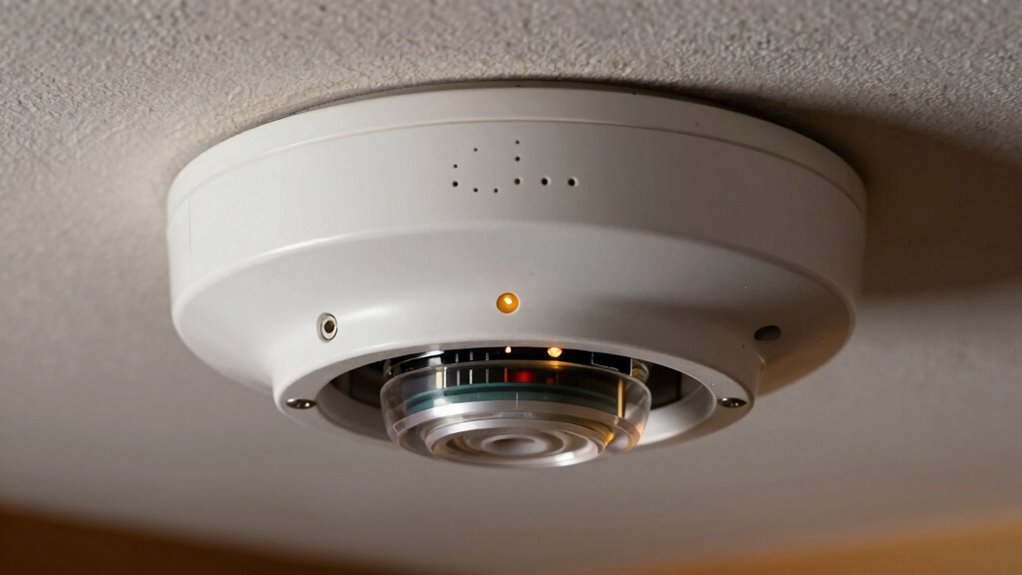
When multiple sensors are combined, the detector evaluates distinct physical signatures—smoke particles, rising temperature, and infrared/ultraviolet radiation—against configured algorithms so you get faster, more reliable alarm decisions.
You’ll see sensor technology integrated into a single housing or networked modules, each providing quantitative inputs with defined sampling rates and thresholds. You compare signal patterns against algorithmic models that weight inputs based on confidence metrics and environmental baselines.
You configure hysteresis, debounce intervals, and fault-tolerance logic to prevent false positives while preserving sensitivity. You monitor diagnostic outputs—signal-to-noise ratios, sensor drift estimates, and communication integrity—to schedule calibration and replacement.
You’ll rely on event classification layers that escalate from advisory to alarm states according to probabilistic scoring. You implement redundancy and cross-validation so a single sensor failure won’t compromise detection.
You document performance parameters and test procedures to verify compliance with fire safety standards and guarantee the system responds predictably under varied operational conditions.
What Each Sensor Contributes: Smoke, Heat, Flame, and Gas
Although each sensor type detects different physical phenomena, you should treat their outputs as complementary inputs to a unified decision model:
smoke sensors (optical or ionization) quantify particulate concentration and particle size distribution, heat sensors measure rate-of-rise and absolute temperature against environmental baselines, flame sensors detect characteristic IR/UV spectral signatures and flicker frequency, and gas sensors register volatile combustion byproducts (CO, CO2, hydrocarbons) with calibrated ppm responses.
You’ll use smoke sensors for early detection of smoldering fires where particulates rise before thermal signature. You’ll rely on heat detectors to confirm sustained thermal excursions or rapid rate-of-rise events insensitive to transient aerosols.
You’ll configure flame sensors to identify open-flame spectral patterns in line-of-sight applications and to reject non-combustion IR/UV sources via narrowband filtering and temporal analysis. You’ll employ gas sensors to detect toxic combustion products and to provide concentration trends useful for evaluating fire stage and ventilation influence.
Each sensor’s metrics are precise inputs for downstream logic without assuming redundancy.
How Fusion Logic Detects Real Fires Versus Nuisances
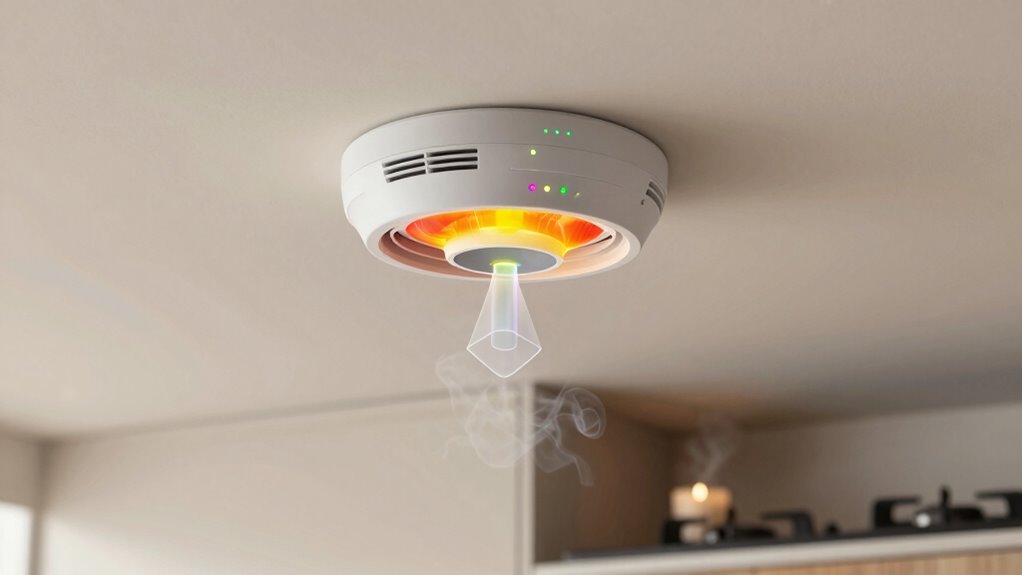
Because false alarms stem from a wide range of non-fire stimuli, your fusion logic must combine sensor-specific evidence into a calibrated likelihood score and decision threshold.
Because false alarms arise from many non-fire sources, fuse sensor evidence into a calibrated likelihood score and decision threshold.
You’ll ingest inputs from smoke obscuration, particulates, thermal trends, flame flicker, and gas concentrations, converting each into normalized feature vectors. Fusion logic weights are derived from probabilistic models (Bayesian networks, logistic regressions, or trained classifiers) that map features to a fire classification likelihood.
You’ll apply sensor reliability priors and temporal smoothing to suppress transient nuisances and emphasize sustained, correlated signatures. Decision rules translate likelihood into actions: alert, pre-alarm, or inhibit, with hysteresis to prevent oscillation.
You’ll validate thresholds with labeled event datasets and measure false positive/negative trade-offs via ROC curves. In deployment, continuous self-diagnostics adjust for sensor drift and context signals (ventilation, occupancy) to maintain calibrated probabilities.
The result is a reproducible, auditable pipeline that distinguishes true fires from benign triggers while documenting confidence for each fire classification.
Tuning Systems for Kitchens, Warehouses, and Industrial Plants
Having established a calibrated fusion pipeline for distinguishing fires from nuisances, you now have to tailor sensor thresholds, weighting, and suppression logic to the operational characteristics of specific environments like kitchens, warehouses, and industrial plants. You’ll set higher thermal thresholds and smoke-particle algorithms for kitchens to avoid cooking false alarms, while preserving rapid response to grease and flaming ignition—this balances kitchen safety with uptime. In warehouses you’ll prioritize air-flow-aware sampling, multi-point CO and optical correlation to address warehouse hazards such as dust and forklift emissions. Industrial plants demand zone-specific policies, combustible inventories mapping, and integration with process control interlocks.
| Environment | Primary tuning focus | Example adjustment |
|---|---|---|
| Kitchen | Odor/steam discrimination | Raise smoke threshold; tighten optical-IR fusion |
| Warehouse | Airflow/dust compensation | Use distributed sampling; add CO correlation |
| Industrial | Process-integrated zoning | Enable interlocks; inventory-weighted sensitivity |
How to Choose the Right Multi-Sensor Fire Detection System
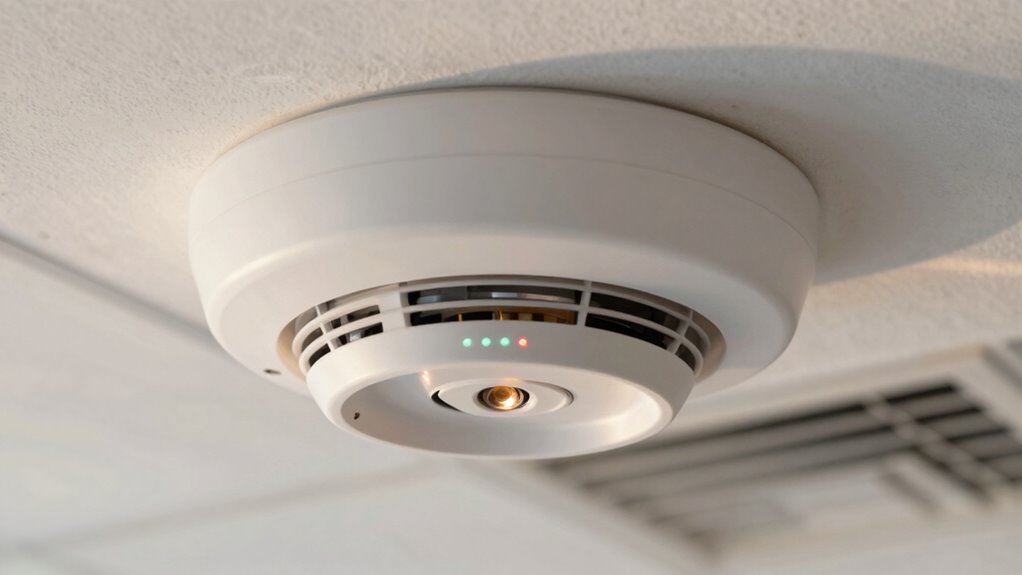
Which performance criteria and site constraints matter most for your facility? You should quantify detection speed, false alarm tolerance, environmental conditions, coverage area, and regulatory requirements.
Map those criteria to system features: alarm thresholds, adaptive algorithms, communication protocols, and zone granularity. Evaluate sensor types—photoelectric, ionization, thermal, and combined detectors—against expected fire signatures, particulates, and aerosols.
Map detection criteria to features—alarm thresholds, adaptive algorithms, communication protocols, and zone granularity; evaluate photoelectric, ionization, thermal, and combined sensors.
Create a decision matrix scoring detection probability, immunity to nuisance sources, maintenance cycle, and life-cycle cost. Prioritize systems with configurable thresholds and multi-parameter fusion if your environment has mixed hazards.
Verify compatibility with existing fire panels, building management, and redundancy needs. Specify environmental ratings (IP, temperature range), power options, and diagnostic reporting.
Require vendor data: test reports, false-alarm statistics, and compliance certificates. Finally, choose the system that maximizes detection confidence while minimizing interventions, based on weighted scores aligned to your operational risk tolerance and maintenance capacity.
Installing, Testing, and Maintaining Multi-Sensor Detectors
When you install multi-sensor detectors, follow a methodical plan that covers siting, mounting, wiring, and baseline calibration to guarantee reliable, repeatable performance.
Begin by applying installation techniques that map detector placement to coverage models and airflow patterns; avoid obstructions and sources of nuisance stimuli.
Mount detectors using specified heights, orientations, and vibration-isolated fixtures; secure wiring in compliance with electrical and communication standards, including shielded cabling where required.
Perform initial baseline calibration in the installed environment so sensors record normal background signatures.
Test functionality with standardized test tools: simulated smoke, heat, and CO stimuli, plus built-in self-test routines and network diagnostics.
Record offsets and thresholds, then adjust alarm setpoints to preserve sensitivity without increasing false alarms.
Implement a maintenance schedule emphasizing cleaning, sensor swap intervals, firmware updates, and post-event recalibration.
Use maintenance tips that specify inspection frequency, documentation procedures, and fail-safe verification to ascertain continued detection fidelity and regulatory compliance.
Real-World Examples: Faster Detection and Fewer False Alarms
Three field cases illustrate how multi-sensor detectors deliver faster, more reliable alarms while cutting false positives: a commercial kitchen where combined heat and smoke thresholds reduced nuisance alerts from cooking plumes by 68% while maintaining earlier response to grease fires; an office tower where differential algorithms using CO and optical scatter detected smoldering insulation 22 minutes sooner than single-mode units; and a transit depot where airflow-aware placement plus acoustic vibration rejection prevented recurrent false alarms from idling buses.
In these real life scenarios you’ll see consistent improvements in alarm reliability driven by sensor fusion, threshold logic, and context-aware placement. You can quantify benefits: reduced response time, fewer dispatches, and lower maintenance.
Deployment notes emphasize calibration curves, hysteresis settings, and algorithm tuning to balance sensitivity versus specificity. Operational protocols adapt: event logs for forensic review, periodic re-calibration after HVAC changes, and targeted sensor cleaning schedules.
The technical conclusion is clear — integrating multiple physical modalities yields measurable gains in detection speed and false-alarm mitigation.
Smoke alarms worth buying
Understanding how smoke detectors work is only half the job — the other half is having reliable units installed. These are proven models that cover the failure modes this article talks about.
- 2-in-1 photoelectric smoke + electrochemical CO sensing
- 10-year sealed battery — no replacements
- Voice alert tells you the danger type and location
- Plug-in design with AA battery backup for outages
- Electrochemical CO sensor with test/hush button
- Loud 85 dB alarm with low-battery warning
Disclosure: as an Amazon Associate, awasc.com earns from qualifying purchases.
Frequently Asked Questions
Do Multi-Sensor Detectors Comply With International Fire Codes and Standards?
Yes — think of compliance verification as the compass guiding you; multi-sensor detectors are designed to meet international standards, and you’ll verify conformity through testing, documentation review, certification, and periodic audits set by regulators.
Can Multi-Sensor Systems Integrate With Building Automation and Security Platforms?
Yes — you can integrate multi-sensor systems with building automation and security platforms; system interoperability is achieved via standardized protocols and APIs, enabling automation benefits like coordinated alerts, HVAC control, access management, and centralized monitoring for faster response.
What Are the Privacy Implications of Detectors That Include Cameras?
Like a microscope revealing detail, you’ll face camera surveillance concerns: image capture raises consent and access issues, so you’ll enforce strict data security, retention limits, encryption, and role-based audit controls to minimize privacy risks.
How Do Detectors Perform in Extreme Temperatures or Corrosive Environments?
Detectors perform variably; you’ll need models with specified temperature resilience and environmental durability ratings. You’ll verify operation via manufacturer data, testing across extremes, corrosion-resistant housings, and sealed sensors to maintain accuracy and longevity.
Are There Subscription or Recurring Costs for Software Updates and Cloud Services?
Yes — you’ll often face subscription models for cloud services and optional software maintenance; fees cover updates, analytics, and support. Review contracts for tiers, update cadence, SLA terms, and whether maintenance includes firmware, security patches, and feature upgrades.