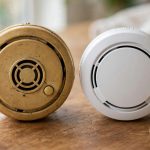
You interact with smoke detectors by breathing the same air they sample, but they don’t “see” smoke the way you do. They sense tiny combustion particles and gases—sizes, charge, and composition determine how they respond—so different fires and sources produce very different signals. Knowing which particle types trigger which sensor lets you pick and place alarms for real-world risks, and it also explains false alarms and gaps in protection.
Core Answer: What Smoke Detectors Actually Detect
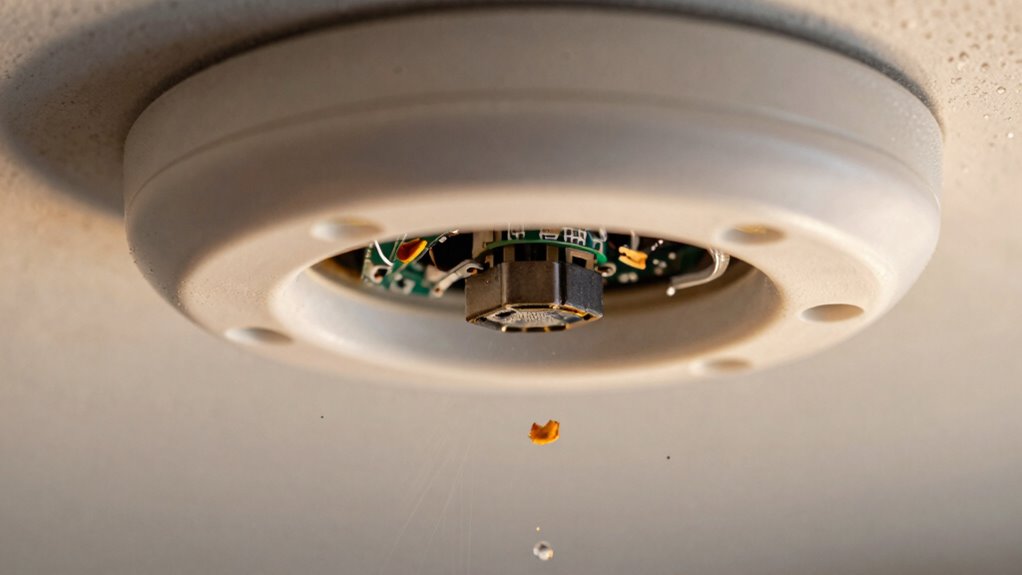
Smoke detectors don’t sense “smoke” as you might imagine; they detect particles and combustion byproducts in the air. You’ll find two dominant sensor technology approaches: ionization and photoelectric.
Ionization units use a small radioactive source to ionize air; disruption by submicron combustion particulates alters current and triggers an alarm. Photoelectric sensors project a light beam; larger particles scatter light into a photodiode, creating a thresholded signal.
Ionization detectors use a tiny radioactive source to sense submicron particles; photoelectric units detect larger particles by light scattering.
Both respond to aspects of smoke composition—volatile gases, soot, and aerosolized droplets—so detector response depends on particle size distribution, optical properties, and chemical load. You should know detectors report presence, not precise concentration or flame type.
Placement and maintenance matter: clogged or painted sensors, wrong location relative to combustion sources, or expired sensors degrade detection. For reliable performance, follow manufacturer specs, test periodically, replace units per lifecycle guidance, and use combined or multi-sensor alarms where varied smoke compositions are likely.
Particle Science: Size, Composition, and How Smoke Behaves
Because particle size and composition govern how combustion byproducts move, interact, and trigger sensors, you’ll need to look at aerosols, soot, and gases as distinct but interrelated components.
You’ll measure particle size across a broad distribution: nanoparticles (<100 nm) form from gas-to-particle conversion, fine particles (0.1–2.5 µm) dominate flaming combustion, and coarse particles (>2.5 µm) arise from smoldering and mechanical disruption.
Smoke composition determines optical properties, chemical reactivity, and transport. Carbonaceous soot absorbs light and coagulates; inorganic salts scatter. Volatile organic compounds condense to form secondary aerosols, altering size and refractive index.
Aerodynamic behavior—settling velocity, diffusion, and convection—depends on diameter and density; smaller particles remain suspended longer and penetrate sensor chambers more readily.
You’ll account for humidity and temperature, which modify hygroscopic growth and volatility, shifting both particle size and smoke composition in real time.
Understanding these parameters lets you predict sensor exposure, alarm thresholds, and the likely pathway from combustion chemistry to detector response.
How Photoelectric Sensors Respond to Smoky Fires

Having established how particle size, composition, and ambient conditions govern airborne behavior, you can now examine how photoelectric detectors convert those aerosol properties into an electrical alarm signal.
In photoelectric detection you’re relying on light scattering: a beam or LED produces a stable photon flux across a sensing chamber; when a smoke particle enters, it scatters photons into a photodiode or phototransistor, producing a measurable current change.
The detector’s signal-processing differentiates transient noise from sustained scattering patterns consistent with smoky fires, using thresholds, integration windows, and adaptive baselines.
Particle optical properties—size distribution, refractive index, and concentration—determine scattering cross-section and angular distribution, so dense, larger combustion aerosols produce stronger signals than sparse or ultrafine particles.
Particle optical traits—size, refractive index, concentration—govern scattering strength and angles, so larger, denser smoke yields stronger detector signals
You’ll need to understand that airflow patterns and deposition within the chamber affect sensitivity and false-alarm susceptibility, so manufacturers optimize baffles and flow paths to present representative smoke particle samples while rejecting dust and insects, maintaining reliable alarm performance in realistic smoky-fire scenarios.
How Ionization Sensors Detect Fast-Burning Flames
Although they operate on a different physical principle than photoelectric units, ionization sensors are particularly responsive to the small, highly ionized combustion particles produced by fast-flaming fires.
You’ll find ionization technology uses a small radioactive source to ionize air in a sensing chamber; when flame characteristics create abundant charged combustion ions and submicron particles, they change the chamber current and trigger the alarm. The response is rapid for flames that produce many ions and fine particulates.
- You’ll note sensitivity: ionization sensors detect minute changes in ion current caused by high-charge, low-mass combustion products common to flaming combustion.
- You’ll appreciate placement: because flame characteristics influence ion production, sensors near likely flame sources will alarm sooner.
- You’ll understand limitations: these units favor detection of ionic and submicron species, so their design and calibration prioritize electrical conductivity shifts over optical scattering.
This practical, technical view helps you predict performance in fast-burning scenarios.
Why Cooking, Dust, and Steam Trigger Alarms : And How to Choose and Place Smoke Detectors

Ionization sensors’ sensitivity to submicron, charged combustion products helps explain why non-fire sources—like cooking aerosols, household dust, and bathroom steam—can set off alarms: those activities produce fine particles or change air ionization enough to alter chamber current.
You’ll notice cooking smoke contains ultrafine particles and volatile combustion ions that mimic flame-generated signatures, so ionization alarms trip more readily near kitchens.
Dust accumulates in sensing chambers, creating conductive paths or scattering light in optical units, while steam condenses into droplets that transiently increase particle count and refractive index, triggering photoelectric detectors.
To minimize nuisance alarms, choose detectors by environment: use photoelectric units near kitchens and bathrooms for better response to smoldering particles and reduced sensitivity to ultrafine cooking aerosols; reserve ionization detectors for areas where fast-flaming fires are plausible.
For detector placement, follow clearance guidelines—mount ceilings centrally, avoid immediate proximity (within 3–6 feet) to stoves, vents, or showers, and maintain regular cleaning and replacement.
Smoke alarms worth buying
Understanding how smoke detectors work is only half the job — the other half is having reliable units installed. These are proven models that cover the failure modes this article talks about.
- 2-in-1 photoelectric smoke + electrochemical CO sensing
- 10-year sealed battery — no replacements
- Voice alert tells you the danger type and location
- Plug-in design with AA battery backup for outages
- Electrochemical CO sensor with test/hush button
- Loud 85 dB alarm with low-battery warning
Disclosure: as an Amazon Associate, awasc.com earns from qualifying purchases.
Frequently Asked Questions
Do Pets Trigger Smoke Detectors by Shedding Particles?
Yes — pets can trigger detectors indirectly: your pet dander may mimic or obscure smoke particles in optical sensors, increasing false alarms or sensitivity, especially with dust buildup; keep detectors clean and positioned away from pet bedding.
Can Scented Candles Interfere With Detector Sensors?
Could scented candles interfere with detector sensors? Yes, they can: dense soot or oily aerosols from candles may trigger ionization or photoelectric detectors, so you should use well-ventilated rooms and clean fixtures to reduce false alarms.
How Do Smoke Detectors Perform in Very Cold Temperatures?
In very cold temperatures, detectors can misoperate: frozen humidity and low temperature may cause delayed response or nuisance alarms, reduce battery output, and affect sensor materials, so you should install units rated for cold environments and test frequently.
Do Smoke Detectors Sense Carbon Monoxide or Other Gases?
No — you won’t get CO alerts from a standard smoke alarm; think of it as a gate that only fits particles, not invisible fumes. For carbon monoxide detection you need dedicated gas sensor technology and CO-specific alarms.
How Long Do Smoke Detectors Remain Accurate Before Recalibration?
You’ll find most smoke detectors remain accurate 8–10 years before recalibration frequency matters; detector lifespan often dictates replacement instead of recalibration, so you should replace units after about a decade rather than expect ongoing recalibration.